


Page 52 - Hall et al (2015) Principles of Critical Care-McGraw-Hill
P. 52
CHAPTER 3: Intensive Care Unit Staffing  21


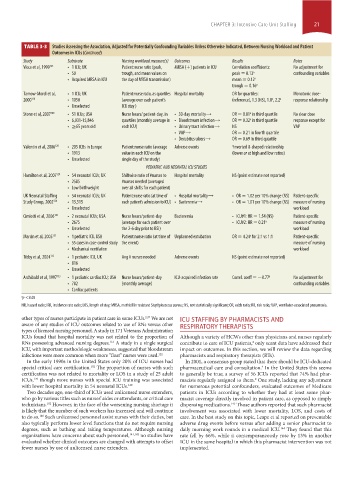
                      TABLE 3-3     Studies Assessing the Association, Adjusted for Potentially Confounding Variables Unless Otherwise Indicated, Between Nursing Workload and Patient
                              Outcomes in ICUs (Continued)
                    Study          Substrate          Nursing workload measure(s)  Outcomes  Results            Notes
                    Vicca et al, 1999 125  •  1 ICU; UK  Patient:nurse ratio (peak,   MRSA (+) patients in ICU  Correlation coefficients:  No adjustment for
                                   •  50              trough, and mean values on           peak = 0.13 a        confounding variables
                                   •  Acquired MRSA in ICU  the day of MRSA transmission)  mean = 0.12 a
                                                                                           trough = 0.16 a
                    Tarnow-Mordi et al,   •  1 ICU; UK  Patient:nurse ratio, as quartiles  Hospital mortality  OR for quartiles:  Monotonic dose-
                    2000 110       •  1050            (average over each patient’s         (reference), 1.3 (NS), 1.8 , 2.2 a  response relationship
                                                                                                         a
                                   •  Unselected      ICU stay )
                    Stone et al, 2007 109  •  51 ICUs; USA  Nurse hours/ patient-day, in   •  30-day mortality→  OR = 0.81  in third quartile  No clear dose
                                                                                                 a
                                   •  6,031-15,846    quartiles (monthly average in  •  Bloodstream infection→  OR = 0.32  in third quartile  response except for
                                                                                                 a
                                   •  ≥65 years old   each ICU)         •  Urinary tract infection→  NS         VAP
                                                                        •  VAP→            OR = 0.21 in fourth quartile
                                                                        •  Decubitus ulcers→  OR = 0.69 in third quartile
                    Valentin et al, 2006 128  •  205 ICUs in Europe  Patient:nurse ratio (average   Adverse events  a Inverted U-shaped relationship
                                   •  1913            value in each ICU on the             (lower or at high and low ratios)
                                   •  Unselected      single day of the study)
                                                              PEDIATRIC AND NEONATAL ICU STUDIES
                    Hamilton et al, 2007 129  •  54 neonatal ICUs; UK  Shiftwise ratio of #nurses to   Hospital mortality  NS (point estimate not reported)
                                   •  2585            #nurses needed (averaged
                                   •  Low birthweight  over all shifts for each patient)
                    UK Neonatal Staffing   •  54 neonatal ICUs; UK  Patient:nurse ratio (at time of   •  Hospital mortality→  •  OR = 1.02 per 10% change (NS) Patient-specific
                    Study Group, 2002 134  •  13,515  each patient’s admission to ICU) •  Bacteremia→  •  OR = 1.01 per 10% change (NS) measure of nursing
                                   •  Unselected                                                                workload
                    Cimiotti et al, 2006 130  •  2 neonatal ICUs; USA  Nurse hours/patient-day   Bacteremia  •  ICU#1: HR = 1.54 (NS)  Patient-specific
                                   •  2675            (average for each patient over       •  ICU#2: HR = 0.21 a  measure of nursing
                                   •  Unselected      the 2-6 day prior to BSI)                                 workload
                                                                                                 a
                    Marcin et al, 2005 131  •  1 pediatric ICU, USA  Patient:nurse ratio (at time of  Unplanned extubation  OR = 4.24  for 2:1 vs 1:1  Patient-specific
                                   •  55 cases in case-control study the event)                                 measure of nursing
                                   •  Mechanical ventilation                                                    workload
                    Tibby et al, 2004 132  •  1 pediatric ICU, UK  Avg # nurses needed  Adverse events  NS (point estimate not reported)
                                   •  816
                                   •  Unselected
                    Archibald et al, 1997 133  •  1 pediatric cardiac ICU; USA  Nurse hours/patient-day   ICU-acquired infection rate  Correl. coeff = −0.77 a  No adjustment for
                                   •  782             (monthly average)                                         confounding variables
                                   •  Cardiac patients
                    a p <0.05
                    HR, hazard ratio; IRR, incidence rate ratio; LOS, length of stay; MRSA, methicillin resistant Staphylococcus aureus; NS, not statistically significant; OR, odds ratio; RR, risk ratio; VAP, ventilator-associated pneumonia.

                    other types of nurses participate in patient care in some ICUs.  We are not   ICU STAFFING BY PHARMACISTS AND
                                                              2,37
                    aware of any studies of ICU outcomes related to use of RNs versus other   RESPIRATORY THERAPISTS
                    types of licensed nursing personnel. A study in 171 Veterans Administration
                    ICUs found that hospital mortality was not related to the proportion of   Although a variety of HCWs other than physicians and nurses regularly
                    RNs possessing advanced nursing degrees.  A study in a single surgical   contribute to care of ICU patients,  only scant data have addressed their
                                                  112
                                                                                                  2
                    ICU, with important methodologic weaknesses, suggested that bloodstream   impact on outcomes. In this section, we will review the data regarding
                    infections were more common when more “float” nurses were used. 122  pharmacists and respiratory therapists (RTs).
                     In the early 1990s in the United States only 20% of ICU nurses had   In 2001, a consensus group stated that there should be ICU-dedicated
                    special critical care certification.  The proportion of nurses with such   pharmaceutical care and consultation.  In the United States this seems
                                                                                                     4
                                           102
                    certification was not related to mortality or LOS in a study of 25 adult   to generally be true; a survey of 56 ICUs reported that 74% had phar-
                    ICUs,  though more nurses with special ICU training was associated   macists regularly assigned to them.  One study, lacking any adjustment
                                                                                                   2
                        139
                    with lower hospital mortality in 54 neonatal ICUs. 129  for numerous potential confounders, evaluated outcomes of Medicare
                     Two decades ago, one-third of ICUs used unlicensed nurse extenders,   patients in  ICUs  according  to  whether  they  had at  least  some  phar-
                    who go by various titles such as nurses’ aides or attendants, or critical care   macist coverage directly involved in patient care, as opposed to simply
                    technicians.  However, in the face of the worsening nursing shortage it   dispensing medications.  Those authors reported that such pharmacist
                                                                                           143
                            102
                    is likely that the number of such workers has increased and will continue   involvement  was associated  with  lower mortality,  LOS,  and  costs of
                    to do so.  Such unlicensed personnel assist nurses with their duties, but   care. In the best study on this topic, Leape et al reported on preventable
                          140
                    also typically perform lower level functions that do not require nursing   adverse drug events before versus after adding a senior pharmacist to
                    degrees, such as bathing and taking temperatures. Although nursing   daily morning work rounds in a medical ICU.  They found that this
                                                                                                            144
                    organizations have concerns about such personnel, 141,142  no studies have   rate fell by 66%, while it contemporaneously rose by 13% in another
                    evaluated whether clinical outcomes are changed with attempts to offset   ICU in the same hospital in which this pharmacist intervention was not
                    fewer nurses by use of unlicensed nurse extenders.    implemented.


            Section01.indd   21                                                                                        1/22/2015   9:36:46 AM

