


Page 495 - Hall et al (2015) Principles of Critical Care-McGraw-Hill
P. 495
CHAPTER 42: Aortic Dissection  365


                    a center of excellence appears to be of importance for maximizing results
                    in this complex condition.
                     Indications for Emergency Stenting (personal communication,
                    Dr Benjamin Starnes, Chief of Vascular Surgery, University of Washington)
                      • Organ malperfusion (kidney, limb, gut)
                      • Rupture/leak (bloody left pleural effusion)
                      • Progressive paraparesis/plegia (if occurs, need to aggressively drain
                      cerebrospinal fluid and increase blood pressure to increase cord
                      perfusion pressure) 71-73

                    Complications of Stenting
                      • CVA—3% (thought due to large delivery device contacting aortic
                      arch during implantation)
                      • Fevers (“postimplantation syndrome”—as can occur with deep venous
                      thrombosis)
                      • Thrombocytopenia (workup for heparin antibodies is usually negative)
                      • Graft-related (all rare)
                      a.  Migration
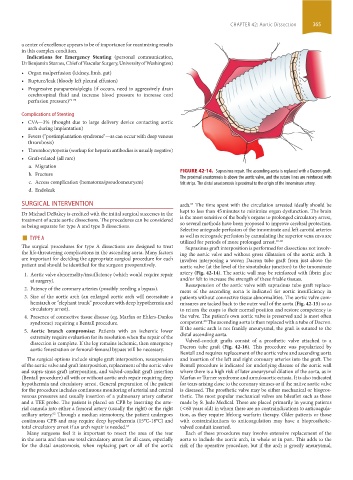
                      b.  Fracture                                        FIGURE 42-14.  Suprasinus repair. The ascending aorta is replaced with a Dacron graft.
                                                                          The proximal anastomosis is above the aortic valve, and the suture lines are reinforced with
                      c.  Access complication (hematoma/pseudoaneurysm)   felt strips. The distal anastomosis is proximal to the origin of the innominate artery.
                      d.  Endoleak

                    SURGICAL INTERVENTION                                 arch.  The time spent with the circulation arrested ideally should be
                                                                             64
                    Dr Michael DeBakey is credited with the initial surgical successes in the   kept to less than 45 minutes to minimize organ dysfunction. The brain
                    treatment of acute aortic dissections. The procedures can be considered   is the most sensitive of the body's organs to prolonged circulatory arrest,
                    as being separate for type A and type B dissections.  so several methods have been proposed to improve cerebral protection.
                                                                          Selective antegrade perfusion of the innominate and left carotid arteries
                        ■  TYPE A                                         as well as retrograde perfusion by cannulating the superior vena cava are
                    The surgical procedures for type A dissections are designed to treat   utilized for periods of more prolonged arrest. 65-68
                                                                           Suprasinus graft interposition is performed for dissections not involv-
                    the life-threatening complications in the ascending aorta. Many factors   ing the aortic valve and without gross dilatation of the aortic arch. It
                    are important for deciding the appropriate surgical procedure for each   involves interposing a woven Dacron tube graft from just above the
                    patient and should be identified for the surgeon preoperatively.  aortic valve (at the level of the sinotubular junction) to the innominate
                      1.  Aortic valve abnormality/insufficiency (which would require repair   artery (Fig. 42-14). The aortic wall may be reinforced with fibrin glue
                       at surgery).                                       and/or felt to increase the strength of these friable tissues.
                                                                           Resuspension of the aortic valve with suprasinus tube graft replace-
                      2.  Patency of the coronary arteries (possibly needing a bypass).  ment of the ascending aorta is indicated for aortic insufficiency in
                      3.  Size of the aortic arch (an enlarged aortic arch will necessitate a   patients without connective tissue abnormalities. The aortic valve com-
                       hemiarch or “elephant trunk” procedure with deep hypothermia and   missures are tacked back to the outer wall of the aorta (Fig. 42-15) so as
                       circulatory arrest).                               to return the cusps to their normal position and restore competency to
                      4.  Presence of connective tissue disease (eg, Marfan or Ehlers-Danlos   the valve. The patient’s own aortic valve is preserved and is most often
                       syndrome) requiring a Bentall procedure.           competent.  The ascending aorta is then replaced with a tube of Dacron.
                                                                                  69
                      5.  Aortic branch compromise: Patients with an ischemic lower   If the aortic arch is not frankly aneurysmal, the graft is sutured to the
                       extremity require evaluation for its resolution when the repair of the   distal ascending aorta.
                       dissection is complete. If the leg remains ischemic, then emergency   Valved-conduit grafts consist of a prosthetic valve attached to a
                       aortic fenestration or femoral-femoral bypass will be necessary.  Dacron tube graft (Fig. 42-16). This procedure was popularized by
                                                                          Bentall and requires replacement of the aortic valve and ascending aorta
                     The surgical options include simple graft interposition, resuspension   and insertion of the left and right coronary arteries into the graft. The
                    of the aortic valve and graft interposition, replacement of the aortic valve   Bentall procedure is indicated for underlying disease of the aortic wall
                    and supra-sinus graft interposition, and valved-conduit graft insertion   where there is a high risk of later aneurysmal dilation of the aorta, as in
                    (Bentall procedure) all with or without aortic arch repair requiring deep   Marfan or Turner syndrome and annuloaortic ectasia. It is also indicated
                    hypothermia and circulatory arrest. General preparation of the patient   for tears arising close to the coronary sinuses or if the native aortic valve
                    for the procedure includes continuous monitoring of arterial and central   is diseased. The prosthetic valve may be either mechanical or biopros-
                    venous pressures and usually insertion of a pulmonary artery catheter   thetic. The most popular mechanical valves are bileaflet such as those
                    and a TEE probe. The patient is placed on CPB by inserting the arte-  made by St Jude Medical. These are placed primarily in young patients
                    rial cannula into either a femoral artery (usually the right) or the right   (<60 years old) in whom there are no contraindications to anticoagula-
                    axillary artery.  Through a median sternotomy, the patient undergoes   tion, as they require lifelong warfarin therapy. Older patients or those
                              62
                    continuous CPB and may require deep hypothermia (15°C-18°C) and   with contraindications to anticoagulation may have a bioprosthetic-
                    total circulatory arrest if an arch repair is needed. 63  valved conduit inserted.
                     Many surgeons feel it is important to resect the area of the tear   Each of these procedures may involve extensive replacement of the
                    in the aorta and thus use total circulatory arrest for all cases, especially   aorta to include the aortic arch, in whole or in part. This adds to the
                    for the  distal anastomosis, when replacing part or all of the aortic   risk of the operative procedure, but if the arch is grossly aneurysmal,


            section03.indd   365                                                                                       1/23/2015   2:08:32 PM

