


Page 491 - Hall et al (2015) Principles of Critical Care-McGraw-Hill
P. 491
CHAPTER 42: Aortic Dissection  361


                                                                          However, it  is now rarely used  due  to development  of advanced non-
                                                                          invasive techniques with the added benefit of improved detection of the
                                                                          aortic IMH and penetrating ulcer variants. 33-37
                                                                           Since type A dissections are life-threatening surgical emergencies, it is
                                                                          critical to assess involvement of the ascending aorta.
                                                                           Contrast-enhanced CT scanning is readily available at most institu-
                                                                          tions and is the most commonly used modality to evaluate aortic dis-
                                                                          sections,  particularly  in  patients  with  type  B.   Specific  identification
                                                                                                           38
                                                                          of true and false lumens with a flap is possible, as well as detection of
                                                                          pericardial effusion and accurate depiction of the extent of the dissec-
                                                                          tion. The newer spiral (helical) CT scans that are now available in most
                                                                          hospitals yield excellent two- and three-dimensional images and should
                                                                          be electrocardiographically gated to reduce motion artifacts from a
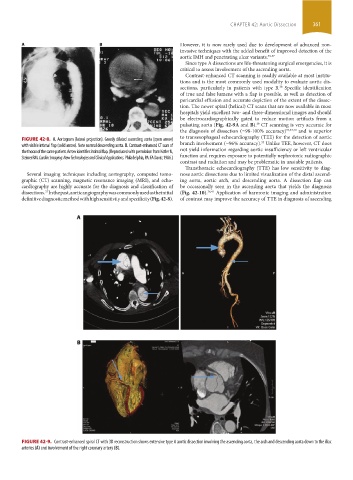
                                                                          pulsating aorta (Fig. 42-9A and B).  CT scanning is very accurate for
                                                                                                    39
                                                                          the diagnosis of dissection (̴98-100% accuracy) 32,33,40  and is superior
                    FIGURE 42-8.  A. Aortogram (lateral projection). Grossly dilated ascending aorta (open arrow)   to transesophageal echocardiography (TEE) for the detection of aortic
                                                                                                     33
                    with visible intimal flap (solid arrow). Note normal descending aorta. B. Contrast-enhanced CT scan of   branch involvement (̴96% accuracy).  Unlike TEE, however, CT does
                    the thorax of the same patient. Arrow identifies intimal flap. (Reproduced with permission from Kotler N,   not yield information regarding aortic insufficiency or left ventricular
                    Steiner RM. Cardiac Imaging: New Technologies and Clinical Applications. Philadelphia, PA: FA Davis; 1986.)  function and requires exposure to potentially nephrotoxic radiographic
                                                                          contrast and radiation and may be problematic in unstable patients.
                                                                           Transthoracic echocardiography (TTE) has low sensitivity to diag-
                     Several imaging techniques including aortography, computed tomo-  nose aortic dissections due to limited visualization of the distal ascend-
                    graphic (CT) scanning, magnetic resonance imaging (MRI), and echo-  ing aorta, aortic arch, and descending aorta. A dissection flap can
                    cardiography are highly accurate for the diagnosis and classification of   be occasionally seen in the ascending aorta that yields the diagnosis
                    dissections.  In the past, aortic angiography was commonly used as the initial   (Fig. 42-10). 36,41  Application of harmonic imaging and administration
                            33
                    definitive diagnostic method with high sensitivity and specificity (Fig. 42-8).     of contrast may improve the accuracy of TTE in diagnosis of ascending


                    FIGURE 42-9.  Contrast-enhanced spiral CT with 3D reconstruction shows extensive type A aortic dissection involving the ascending aorta, the arch and descending aorta down to the iliac
                    arteries (A) and involvement of the right coronary artery (B).


            section03.indd   361                                                                                       1/23/2015   2:08:26 PM

