


Page 493 - Hall et al (2015) Principles of Critical Care-McGraw-Hill
P. 493
CHAPTER 42: Aortic Dissection  363


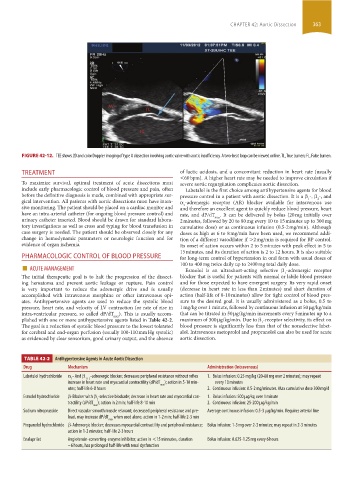
                    FIGURE 42-12.  TEE shows 2D and color Doppler imaging of type A dissection involving aortic valve with aortic insufficiency. A two-beat loop can be viewed online. TL, True Lumen; FL, False Lumen.

                    TREATMENT                                             of lactic acidosis, and a concomitant reduction in heart rate (usually
                                                                          <60 bpm). A higher heart rate may be needed to improve circulation if
                    To maximize survival, optimal treatment of acute dissections must   severe aortic regurgitation complicates aortic dissection.
                    include early pharmacologic control of blood pressure and pain, often   Labetalol is the first choice among antihypertensive agents for blood
                    before the definitive diagnosis is made, combined with appropriate sur-  pressure control in a patient with aortic dissection. It is a β -, β -, and
                                                                                                                        2
                                                                                                                     1
                    gical intervention. All patients with aortic dissections must have inten-  α -adrenergic receptor (AR) blocker available for intravenous use
                                                                           1
                    sive monitoring. The patient should be placed on a cardiac monitor and   and therefore an excellent agent to quickly reduce blood pressure, heart
                    have an intra-arterial catheter (for ongoing blood pressure control) and   rate, and dP/dT . It can be delivered by bolus (20 mg initially over
                                                                                     max
                    urinary catheter inserted. Blood should be drawn for standard labora-  2 minutes, followed by 20 to 80 mg every 10 to 15 minutes up to 300 mg
                    tory investigations as well as cross and typing for blood transfusion in   cumulative dose) or as continuous infusion (0.5-2 mg/min). Although
                    case surgery is needed. The patient should be observed closely for any   doses as high as 6 to 8 mg/min have been used, we recommend addi-
                    change  in  hemodynamic  parameters  or  neurologic  function  and  for   tion of a different vasodilator if >2 mg/min is required for BP control.
                    evidence of organ ischemia.                           Its onset of action occurs within 2 to 5 minutes with peak effect in 5 to
                                                                          15 minutes, and its duration of action is 2 to 12 hours. It is also suitable
                    PHARMACOLOGIC CONTROL OF BLOOD PRESSURE               for long-term control of hypertension in oral form with usual doses of
                        ■  ACUTE MANAGEMENT                               100 to 400 mg twice daily up to 2400 mg total daily dose.
                                                                           Esmolol  is  an  ultrashort-acting  selective  β -adrenergic  receptor
                                                                                                             1
                    The initial therapeutic goal is to halt the progression of the dissect-  blocker that is useful for patients with normal or labile blood pressure
                    ing hematoma and prevent aortic leakage or rupture. Pain control   and for those expected to have emergent surgery. Its very rapid onset
                    is very important to reduce the adrenergic drive and is usually   (decrease in heart rate in less than 2 minutes) and short duration of
                      accomplished with intravenous morphine or other intravenous opi-  action (half-life of 8-10 minutes) allow for tight control of blood pres-
                    ates. Antihypertensive agents are used to reduce the systolic blood   sure to the desired goal. It is usually administered as a bolus, 0.5 to
                    pressure, heart rate, and velocity of LV contraction (or rate of rise in   1 mg/kg over 1 minute, followed by continuous infusion at 50 µg/kg/min
                    intra- ventricular pressure, so called dP/dT ). This is usually accom-  that can be titrated in 50 µg/kg/min increments every 5 minutes up to a
                                                   max
                    plished with one or more antihypertensive agents listed in Table 42-2.   maximum of 300 µg/kg/min. Due to β -receptor selectivity, its effect on
                                                                                                     1
                    The goal is a reduction of systolic blood pressure to the lowest tolerated   blood pressure is significantly less than that of the nonselective labet-
                    for cerebral and end-organ perfusion (usually 100-110 mm Hg systolic)   alol. Intravenous metoprolol and propranolol can also be used for acute
                    as evidenced by clear sensorium, good urinary output, and the absence   aortic dissection.

                      TABLE 42-2    Antihypertensive Agents in Acute Aortic Dissection
                    Drug           Mechanism                                       Administration (Intravenous)
                    Labetalol hydrochloride  α - And β -adrenergic blocker; decreases peripheral resistance without reflex     1.  Bolus infusion: 0.25 mg/kg (20-80 mg over 2 minutes); may repeat
                                         1+2
                                    1
                                   increase in heart rate and myocardial contractility (dP/dT ); action in 5-10 min-  every 10 minutes
                                                                   max
                                   utes; half-life 6-8 hours                         2.  Continuous infusion: 0.5-2 mg/minutes. Max cumulative dose 300 mg/d
                    Esmolol hydrochloride  β-Blocker with β -selective blockade; decrease in heart rate and myocardial con-    1.  Bolus infusion: 500 µg/kg over 1 minute
                                             1
                                   tractility (dP/dT ); action in 2 min; half-life 8-10 min    2.  Continuous infusion: 25-200 µg/kg/min
                                            max
                    Sodium nitroprusside  Direct vascular smooth muscle relaxant; decreased peripheral resistance and pre-  Average continuous infusion: 0.5-3 µg/kg/min. Requires arterial line
                                   load, may increase dP/dT  when used alone; action in 1-2 min; half-life 2-3 min
                                                 max
                    Propanolol hydrochloride β-Adrenergic blocker; decreases myocardial contractility and peripheral resistance;  Bolus infusion: 1-3 mg over 2-3 minutes; may repeat in 2-3 minutes
                                   action in 1-2 minutes; half-life 2-3 hours
                    Enalaprilat    Angiotensin-converting-enzyme inhibitor; action in <15 minnutes, duration   Bolus infusion: 0.625-1.25 mg every 6 hours
                                   ~6 hours, has prolonged half-life with renal dysfunction


            section03.indd   363                                                                                       1/23/2015   2:08:29 PM

