


Page 550 - Hall et al (2015) Principles of Critical Care-McGraw-Hill
P. 550
370 PART 4: Pulmonary Disorders
CHAPTER The Pathophysiology and to initial resuscitation demonstrates increases in V ˙ in response to
O 2
augmentation of severely reduced Q ˙ , indicating that oxygen supply
O 2
43 Differential Diagnosis of dependence plays a role in early sepsis prior to initial resuscitation.
2,3
Following initial resuscitation, however, a subset of patients demonstrate
Acute Respiratory Failure what appears to be ongoing evidence of inadequate oxygen delivery to
peripheral tissues as evidenced by the presence of lactic acidosis despite
Edward T. Naureckas adequate resuscitation. While early trials using flow directed pulmo-
4
Lawrence D. H. Wood nary artery catheters suggested that V ˙ was supply dependent (see
O 2
below), subsequent studies demonstrated that this apparent supply
5-7
dependence was an artifact of covariant measurements. 8,9
KEY POINTS Patients with RF are susceptible to anaerobic metabolism, either because
• Type I respiratory failure, characterized by severe, oxygen-refractory they deliver inadequate O 2 to their systemic organs or because their tis-
10
hypoxemia, is caused by a portion of the total pulmonary blood flow sues develop an abnormal inability to extract oxygen from the blood.
(Q ˙ s/Q ˙ t) traversing the lung without picking up oxygen due to During air breathing, arterialized blood leaves the normal alveoli with a
airspace filling. partial pressure of oxygen (Pa O 2 ) of about 100 mm Hg. When the hemo-
• When blood transport of oxygen is inadequate, treatment includes globin concentration is 15 g/dL, arterial O 2 content (Ca O 2 ) is about 20 mL
per 100 mL blood on the fully saturated hemoglobin and about 0.3 mL
optimizing cardiac output, hemoglobin concentration, and arterial in physical solution. Accordingly, a cardiac output (Q ˙ t) of 5.0 L/min
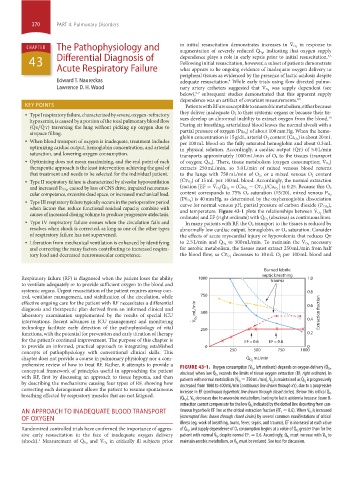
saturation, and lowering oxygen consumption. transports approximately 1000 mL/min of O 2 to the tissues (transport
• Optimizing does not mean maximizing, and the end point of each of oxygen; Q ˙ ). There, tissue metabolism (oxygen consumption; V ˙ )
O 2
O 2
therapeutic approach is the least intervention achieving the goal of extracts 250 mL/min, so 5.0 L/min of mixed venous blood returns
that treatment and needs to be selected for the individual patient. to the lungs with 750 mL/min of O 2, or a mixed venous O 2 content
–
• Type II respiratory failure is characterized by alveolar hypoventilation (Cv O 2 ) of 15 mL per 100 mL blood. Accordingly, the normal extraction
–
, caused by loss of CNS drive, impaired neuromus- ] is 0.25. Because this O 2
O 2
O 2
2
and increased P CO 2 fraction [EF = V ˙ /Q ˙ = (Ca O 2 − Cv O )/Ca O 2
cular competence, excessive dead space, or increased mechanical load. content corresponds to 75% O 2 saturation (15/20), mixed venous P O 2
–
• Type III respiratory failure typically occurs in the perioperative period (Pv O 2 ) is 40 mm Hg, as determined by the oxyhemoglobin dissociation
),
when factors that reduce functional residual capacity combine with curve for normal venous pH, partial pressure of carbon dioxide (P CO 2
and temperature. Figure 43-1 plots the relationships between V ˙ (left
causes of increased closing volume to produce progressive atelectasis. ordinate) and EF (right ordinate) with Q ˙ (abscissa) as continuous lines.
O 2
O 2
• Type IV respiratory failure ensues when the circulation fails and In many patients with RF, the O 2 transport to the tissues is reduced by
resolves when shock is corrected, as long as one of the other types abnormally low cardiac output, hemoglobin, or O 2 saturation. Consider
of respiratory failure has not supervened. the effects of acute myocardial injury or hypovolemia that reduces Q ˙ t
• Liberation from mechanical ventilation is enhanced by identifying to 2.5 L/min and Q ˙ to 500 mL/min. To maintain the V ˙ necessary
O 2
O 2
and correcting the many factors contributing to increased respira- for aerobic metabolism, the tissues must extract 250 mL/min from half
–
tory load and decreased neuromuscular competence. the blood flow, so Cv O 2 decreases to 10 mL O 2 per 100 mL blood and
Burned febrile
septic breathing
Respiratory failure (RF) is diagnosed when the patient loses the ability 1000 trauma 1.0
to ventilate adequately or to provide sufficient oxygen to the blood and
systemic organs. Urgent resuscitation of the patient requires airway con- 0.8
trol, ventilator management, and stabilization of the circulation, while 750
effective ongoing care for the patient with RF necessitates a differential
diagnosis and therapeutic plan derived from an informed clinical and 0.6
laboratory examination supplemented by the results of special ICU V O 2 mL/min 500 Extraction fraction
interventions. Recent advances in ICU management and monitoring 0.4
technology facilitate early detection of the pathophysiology of vital 250
functions, with the potential for prevention and early titration of therapy 0.2
for the patient’s continual improvement. The purpose of this chapter is EF = 0.6 EF = 0.6
to provide an informed, practical approach to integrating established 0 0
concepts of pathophysiology with conventional clinical skills. This 250 500 750 1000
chapter does not provide a course in pulmonary physiology nor a com- Q O 2 mL/min
prehensive review of how to treat RF. Rather, it attempts to provide a FIGURE 43-1. Oxygen consumption (V ˙ , left ordinate) depends on oxygen delivery (Q ˙ ,
O 2
conceptual framework of principles useful in approaching the patient abscissa) when low Q ˙ exceeds the limits of tissue oxygen extraction (EF, right ordinate). In
O 2
with RF, first by discussing an approach to tissue hypoxia, and then patients with normal metabolism (V ˙ = 250 mL/min), V ˙ is maintained as Q ˙ is progressively
O 2
O 2
O 2
by describing the mechanisms causing four types of RF, showing how decreased from 1000 to 400 mL/min (continuous line drawn through x's), due to a progressive
O 2
correcting each derangement allows the patient to resume spontaneous increase in EF (continuous hyperbolic line drawn through closed circles). Below this critical Q ˙
breathing effected by respiratory muscles that are not fatigued. O 2
(Q ˙ ), V ˙ decreases due to anaerobic metabolism, leading to lactic acidemia because tissue O 2
O 2 C
O 2
extraction cannot compensate for the low Q ˙ indicated by the dotted line departing from con-
O 2
AN APPROACH TO INADEQUATE BLOOD TRANSPORT tinuous hyperbolic EF line at the critical extraction fraction (EF c = 0.6). When V ˙ is increased
O 2
OF OXYGEN (interrupted lines drawn through closed circles) by several common manifestations of critical
illness (eg, work of breathing, burns, fever, sepsis, and trauma), EF is increased at each value
Randomized controlled trials have confirmed the importance of aggres- of Q ˙ , and supply dependence of O 2 consumption begins at a value of Q ˙ greater than for the
O 2
O 2
sive early resuscitation in the face of inadequate oxygen delivery patient with normal V ˙ despite normal EF c = 0.6. Accordingly, Q ˙ must increase with V ˙ to
O 2
O 2
O 2
(shock), Measurement of Q ˙ and V ˙ in critically ill subjects prior maintain aerobic metabolism, or V ˙ must be reduced. See text for discussion.
1
O 2
O 2
O 2
section04.indd 370 1/23/2015 2:18:40 PM

