


Page 551 - Hall et al (2015) Principles of Critical Care-McGraw-Hill
P. 551
CHAPTER 43: The Pathophysiology and Differential Diagnosis of Acute Respiratory Failure  371


                    EF increases to 0.50. Because this value corresponds to 50% saturation   aggravating the pulmonary edema. Some patients with chronic severe
                                                           –    is  27 mm Hg.   anemia (eg, chronic renal failure) become acutely ill with low cardiac
                    (10/20)  of  the  normal  hemoglobin  concentration,  Pv O 2
                    When cardiac output is returned toward normal with vasoactive drug or   output and/or hypoxemic RF. Their tissue hypoxia is often ameliorated
                                –   rises again. In another patient with normal cardiac   by prompt, transient increases in their hemoglobin concentration with-
                    volume therapy, Pv O 2
                                                           = 40 mm Hg, O 2   out circulatory overload, as by plasmapheresis. Yet the institution of
                    output (5 L/min) but severe arterial hypoxemia (Pa O 2
                                                          –   must decrease   this  therapy,  like  the  others  mentioned  above,  has  complications  that
                    saturation = 75%, Ca O 2  = 15 mL O 2/100 mL blood), Cv O 2
                    to 10 mL per 100 mL blood to provide the tissues with 250 mL/min     must be weighed against the likely benefit in that patient at that time.
                              –   decreases to 27 mm Hg. When cardiac output increases   Accordingly, this approach to therapy of reduced blood O 2 transport
                    of O 2; again, Pv O 2
                                       –   increases again. In a third patient with   implements early each of the three major interventions (Q ˙ t, hematocrit,
                    in response to hypoxia, Pv O 2
                                    but with reduced concentration of hemoglobin                   ]) in a combination best suited to the
                    normal Q ˙ t and Pa O 2                               and arterial oxygen saturation [Sa O 2
                                         is reduced to 10 mL per 100 mL blood.   condition of each patient. 1,11
                    (7.5 g/100 mL  blood),  Ca O 2
                              –      –   must decrease to 5 mL per 100 mL blood and     Dissolved O 2 contributes a very small amount to Q ˙ . Yet, in critical
                    Accordingly, Cv O 2  and Pv O 2                                                              O 2
                    27 mm Hg,  respectively, to maintain  aerobic metabolism, and  these   hypoxemia, raising the fraction of inspired oxygen (Fi O 2 ) to maximal val-
                    venous values increase again with greater cardiac output or hemoglobin   ues may be effective.  Consider again the patient with acute myocardial
                                                                                        11
                    concentration. In each case, V ˙  was maintained as Q ˙  decreased, creat-  infarction without lung disease in whom low cardiac output has lowered
                                         O 2
                                                          O 2
                                                                           –
                    ing the horizontal continuous line in Figure 43-1 indicating that V ˙  is   Pv O 2  to 27 mm Hg during air breathing. Even though the hemoglobin
                                                                    O 2
                    independent of O 2 delivery in this range; V ˙  was constant because EF   is fully saturated, Ca O 2  may be increased by 1.7 mL per 100 mL blood
                                                   O 2
                                                                                                                           –
                    increased in the hyperbolic manner indicated by the continuous line   when Pa O 2  is increased to 650 mm Hg by ventilation with O 2. Then Cv O 2
                    relating EF to Q ˙ .                                  increases from 10 to 11.7 mL O 2 per 100 mL blood,  raising mixed venous
                               O 2
                     These  considerations  illustrate that one  end point  of reduced  O    –   to about 34 mm Hg; of course, if anaerobic
                                             –       –                 2    saturations to 58% and Pv O 2  –   may not increase as
                    transport in the blood is reduced Pv O 2 . Since Pv O 2  approximates the P O 2  metabolism existed before oxygen therapy, Cv O 2
                    adjacent to the exchange vessels in the tissues, it is the driving pressure    because V ˙  increases with oxygen. These changes tend
                                                                                            O 2
                                                                          much as Ca O 2
                                                                     –     to diminish tissue hypoxia and the adverse consequences of anaero-
                    for O 2 diffusion from the capillaries to the metabolizing cells. When Pv O 2
                    falls too low, insufficient O 2 diffuses to maintain aerobic metabolism,   bic metabolism by an amount equivalent to that achieved by a 1 g%
                    and the cells begin to produce lactic acid as the end point of anaero-  increase in hemoglobin or a 0.2 L/min increase in cardiac output and
                    bic metabolism.  This is illustrated in Figure 43-1 by the decrease in   so complement a combined approach to hypoxia.  Increasing Fi O 2  may
                               11
                                                                                                             11
                    V ˙  as Q ˙  is reduced below 400 mL/min; this supply dependency of   be affected by nasal prongs to deliver O 2 at 1 to 5 L/min (Fi O 2  0.21-0.4),
                     O 2
                          O 2
                    V ˙  occurs when EF exceeds 0.6 and tissue O 2 extraction can no lon-  by rebreathing masks (Fi O 2  0.21-0.6), or by head tent (Fi O 2  0.21-0.8).
                     O 2
                    ger increase along the hyperbolic continuous line relating EF to Q ˙ .   The ranges of Fi O 2  are to indicate that all methods frequently give no O 2
                                                                      O 2
                                     –   and increased serum lactate (or falling pH   enrichment due to inadequate delivery to the patient (lower limit), and
                    Accordingly, reduced Pv O 2
                                                                      ])   that the amount of O 2 delivered is often less than expected (upper limit),
                    with  unchanged  partial  pressure  of  arterial  carbon  dioxide  [Pa CO 2
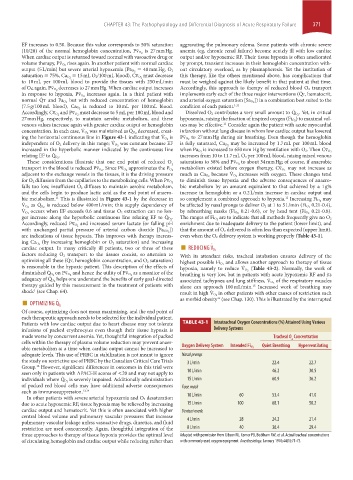
                    are indications of tissue hypoxia. This improves with therapy increas-  even when the O 2 delivery system is working properly (Table 43-1).
                            (by  increasing  hemoglobin  or  O 2 saturation) and increasing
                    ing  Ca O 2                                               ■
                    cardiac  output.  In  many  critically  ill  patients,  two  or  three  of  these   REDUCING V ˙ O2
                    factors reducing O 2 transport to the tissues coexist, so attention to   With its attendant risks, tracheal intubation ensures delivery of the
                    optimizing all these (Q ˙ t, hemoglobin concentration, and O 2 saturation)    and allows another approach to therapy of tissue
                    is reasonable in the hypoxic patient. This description of the effects of   highest possible Fi O 2
                                                                          hypoxia, namely to reduce V ˙  (Table 43-2). Normally, the work of
                                  –                    –   as a monitor of the                  O 2
                             O 2
                    diminished Q ˙  on Pv O 2  and hence the utility of Pv O 2  breathing is very low, but in patients with acute hypoxemic RF and its
                    adequacy of Q ˙  helps one understand the benefits of early goal-directed   associated tachypnea and lung stiffness, V ˙  of the respiratory muscles
                              O 2
                                                                                                        O 2
                    therapy guided by this measurement in the treatment of patients with   alone  can  approach  100 mL/min.   Increased  work  of breathing may
                                                                                                  15
                    shock  (see Chap. 64).                                result in high V ˙  in other patients with other causes of restriction such
                        1
                        ■  OPTIMIZING Q ˙                                 as morbid obesity  (see Chap. 130). This is illustrated by the interrupted
                                                                                     O 2
                                                                                      16
                                O2
                    Of course, optimizing does not mean maximizing, and the end point of
                    each therapeutic approach needs to be selected for the individual patient.
                    Patients with low cardiac output due to heart disease may not tolerate     TABLE 43-1     Intratracheal Oxygen Concentrations (%) Attained Using Various
                    infusions of packed erythrocytes even though their tissue hypoxia is   Delivery Systems
                    made worse by concurrent anemia. Yet, thoughtful integration of packed               Tracheal O  Concentration
                    cells within the therapy of plasma volume reduction may prevent anaer-                      2
                    obic metabolism at a time when cardiac output cannot be increased to   Oxygen Delivery System  Intended Fi O 2    Quiet Breathing  Hyperventilating
                    adequate levels. This use of PRBC in stabilization is not meant to ignore   Nasal prongs
                    the study on restrictive use of PRBC by the Canadian Critical Care Trials     3 L/min  22.4       22.7
                    Group.  However, significant differences in outcomes in this trial were
                         12
                    seen only in patients with APACHE scores of <20 and may not apply to     10 L/min    46.2         30.5
                    individuals where Q ˙  is severely impaired. Additionally administration     15 L/min  60.9       36.2
                                  O 2
                    of packed red blood cells may have additional adverse consequences   Face mask
                    such as immunosuppression. 13,14
                     In other patients with severe arterial hypoxemia and O 2 desaturation     10 L/min  60  53.4     41.0
                    due to acute hypoxemic RF, tissue hypoxia may be relieved by increasing     15 L/min  100  68.1   50.2
                    cardiac output and hematocrit. Yet this is often associated with higher   Venturi mask
                    central blood volume and pulmonary vascular pressures that increase
                    pulmonary vascular leakage unless vasoactive drugs, diuretics, and fluid     4 L/min  28  24.2    21.4
                    restriction are used concurrently. Again, thoughtful integration of the     8 L/min  40  36.4     29.4
                    three approaches to therapy of tissue hypoxia provides the optimal level   Adapted with permission from Gibson RL, Comer PB, Beckham RW, et al. Actual tracheal concentrations
                    of circulating hemoglobin and cardiac output while reducing rather than   with commonly used oxygen equipment. Anesthesiology. January 1976;44(1):71-73.
            section04.indd   371                                                                                       1/23/2015   2:18:41 PM

