


Page 608 - Hall et al (2015) Principles of Critical Care-McGraw-Hill
P. 608
428     PART 4: Pulmonary Disorders


                     cm H O            Pressure-time            s      (see Fig. 49-1D). If this triggering effort comes in a brief, defined inter-
                         2
                     40                                                val before the next mandatory breath is due, the ventilator will deliver
                                                                       the mandatory breath ahead of schedule in order to synchronize (SIMV)
                                                                       with the patient’s inspiratory effort. If a breath is initiated outside the
                                                                       synchronization window, V , V ˙ , and I:E are determined by patient effort
                                                                                           T
                                                                       and respiratory system mechanics (see  Fig.  49-1D), not by ventila-
                                                                       tor  settings.  The  spontaneous  breaths tend to  be  of small volume,  as
                                                                       depicted in Figure 49-1D, and are highly variable from breath to breath.
                     0                                           10    The SIMV mode has been used historically to gradually augment the
                                                                       patient’s work of breathing by lowering the mandatory breath f (or V ),
                                                                                                                         T
                                                                       driving the patient to breathe more rapidly in order to maintain ade-
                      l/s               Flow-time               s
                    1.5                                                quate ventilation, but this approach appears to prolong “weaning.” 23,24
                                                                       Although this mode continues to be used widely (typically with added
                                                                       PSV), there is little rationale for it and SIMV is falling out of favor.
                                                                       Mixed Modes:  Some  ventilators allow combinations  of  modes,  most
                     0                                           10
                                                                       commonly SIMV plus PSV. There is little reason to use such a hybrid
                                                                       mode, although some physicians use the SIMV mode as a means to add
                                                                       sighs to PSV, an option not otherwise generally available. Since SIMV
                                                                       plus PSV guarantees some backup minute ventilation (which PSV does
                   −1.5                                                not), this mode combination may have value in occasional patients at
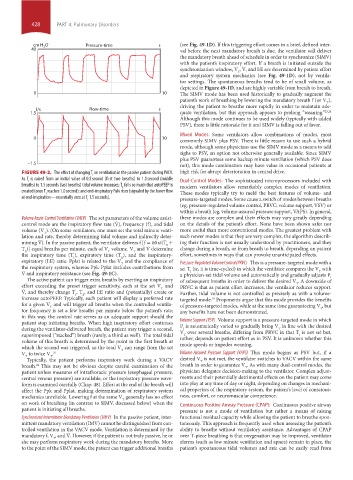
                 FIGURE 49-2.  The effect of changing T on ventilation in the passive patient during PACV.   high risk for abrupt deterioration in central drive.
                                         I
                 As T is raised from an initial value of 0.5 second (first two breaths) to 1.0 second (middle   Dual-Control Modes:  The sophisticated microprocessors included with
                    I
                 breaths) to 1.5 seconds (last breaths) tidal volume increases; T  falls so much that autoPEEP is   modern ventilators allow remarkably complex modes of ventilation.
                                                    E
                 created (once T reaches 1.0 second); and end-inspiratory Palv rises (signaled by the lower flow   These modes typically try to meld the best features of volume- and
                         I
                 at end-inspiration—essentially zero at T 1.5 seconds).  pressure-targeted modes. Some cause a switch of modes between breaths
                                        I
                                                                       (eg, pressure-regulated volume control, PRVC; volume support, VSV) or
                                                                       within a breath (eg, volume-assured pressure support, VAPS). In general,
                 Volume Assist-Control Ventilation (VACV)  The set parameters of the volume assist-  these modes are complex and their effects may vary greatly depending
                 control mode are the inspiratory flow rate (V ˙ ), frequency (f), and tidal   on the details of the patient’s effort. None have been shown safer nor
                 volume (V ). (On some ventilators, one must set the total minute venti-  more useful than more conventional modes. The greatest problem with
                         T
                 lation and rate, thereby determining tidal volume and indirectly deter-  such newer modes is that they are very complex, the algorithm describ-
                 mining V ˙ ). In the passive patient, the ventilator delivers f [f = 60 s/(T  +   ing their function is not usually understood by practitioners, and they
                                                                   I
                 T )] equal breaths per minute, each of V  volume. V  and V ˙   determine   change during a breath, or from breath to breath, depending on patient
                                                       T
                                               T
                  E
                 the inspiratory time (T ), expiratory time (T ), and the inspiratory-  effort, sometimes in ways that can provoke unanticipated effects.
                                                   E
                                   I
                 expiratory (I:E) ratio. Pplat is related to the V  and the compliance of   Pressure-Regulated Volume Control (PRVC)  This is a pressure-targeted mode with a
                                                   T
                 the respiratory system, whereas Ppk-Pplat includes contributions from   set T  (ie, it is time-cycled) in which the ventilator compares the V  with
                                                                           I
                                                                                                                       T
                 V ˙  and inspiratory resistance (see Fig. 49-1C).     a physician-set tidal volume and automatically and gradually adjusts P
                   The active patient can trigger extra breaths by exerting an inspiratory   of subsequent breaths in order to deliver the desired V . A downside of  I
                                                                                                               T
                 effort exceeding the preset trigger sensitivity, each at the set V  and   PRVC is that as patient effort increases, the ventilator reduces support.
                                                                 T
                 V ˙ , and thereby change T , T , and I:E ratio and (potentially) create or   Further, tidal volume is not controlled as precisely as with a volume-
                                      E
                                    I
                 increase autoPEEP. Typically, each patient will display a preferred rate   targeted mode.  Proponents argue that this mode provides the benefits
                                                                                  19
                 for a given V  and will trigger all breaths when the controlled ventila-  of pressure-targeted modes, while at the same time guaranteeing V , but
                           T
                 tor frequency is set a few breaths per minute below the patient’s rate;   any benefits have not been demonstrated.  T
                 in this way, the control rate serves as an adequate support should the
                 patient stop initiating breaths. When high inspiratory effort continues   Volume Support (VSV)  Volume support is a pressure-targeted mode in which
                                                                       P  is automatically varied to gradually bring V  in line with the desired
                 during the ventilator-delivered breath, the patient may trigger a second,   I           T
                 superimposed (“stacked”) breath (rarely, a third as well). The total tidal   V  over several breaths, differing from PRVC in that T  is not set but,
                                                                                                                I
                                                                        T
                                                                       rather, depends on patient effort as in PSV. It is unknown whether this
                 volume of this breath is determined by the point in the first breath at
                 which the second was triggered, so the total V  can range from the set   mode speeds or impedes weaning.
                                                   T
                 V  to twice V . 21                                    Volume-Assured  Pressure  Support  (VAPS)  This mode begins as PSV but, if a
                  T        T
                   Typically, the patient performs inspiratory work during a VACV   desired V  is not met, the ventilator switches to VACV within the same
                                                                              T
                 breath.  This may not be obvious despite careful examination of the   breath in order to guarantee V . As with many dual-control modes, the
                      22
                                                                                             T
                 patient unless measures of intrathoracic pressure (esophageal pressure,   physician delegates decision-making to the ventilator. Complex adjust-
                 central venous pressure) are available, or the inspiratory pressure wave-  ments and their potentially detrimental effects on the patient may come
                 form is examined carefully (Chap. 48). Effort at the end of the breath will   into play at any time of day or night, depending on changes in mechani-
                 affect the Ppk and Pplat, making determination of respiratory system   cal properties of the respiratory system, the patient’s level of conscious-
                 mechanics unreliable. Lowering f at the same V  generally has no effect   ness, comfort, or neuromuscular competence.
                                                    T
                 on work of breathing (in contrast to SIMV, discussed below) when the   Continuous Positive Airway Pressure (CPAP):  Continuous positive airway
                 patient is initiating all breaths.                    pressure is not a mode of ventilation but rather a means of raising
                 Synchronized Intermittent Mandatory Ventilation (SIMV)  In the passive patient, inter-  functional residual capacity while allowing the patient to breathe spon-
                 mittent mandatory ventilation (IMV) cannot be distinguished from con-  taneously. This approach is frequently used when assessing the patient’s
                 trolled ventilation in the VACV mode. Ventilation is determined by the   ability to breathe without ventilatory assistance. Advantages of CPAP
                 mandatory f, V , and V ˙ . However, if the patient is not truly passive, he or   over T-piece breathing is that oxygenation may be improved, ventilator
                            T
                 she may perform respiratory work during the mandatory breaths. More   alarms (such as low minute ventilation and apnea) remain in place, the
                 to the point of the SIMV mode, the patient can trigger additional breaths   patient’s spontaneous tidal volumes and rate can be easily read from
            section04.indd   428                                                                                       1/23/2015   2:19:19 PM

