


Page 611 - Hall et al (2015) Principles of Critical Care-McGraw-Hill
P. 611
CHAPTER 49: Management of the Ventilated Patient  431


                    900 mL, f = 3 − 7. This approach appears to minimize autoPEEP by allow-  strategies for improving the ventilator settings (Fig. 49-5). Some patients
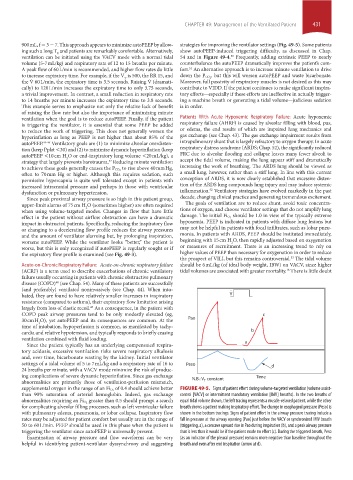
                    ing such a long T  and patients are remarkably comfortable. Alternatively,   show autoPEEP-induced triggering  difficulty, as discussed in Chap.
                                E
                                                                                           50
                    ventilation can be initiated using the VACV mode with a normal tidal   54 and in  Figure 49-4.  Frequently, adding extrinsic PEEP to nearly
                    volume (5-7 mL/kg) and respiratory rate of 12 to 15 breaths per minute.     counterbalance the autoPEEP dramatically improves the patient’s com-
                    A peak flow of 60 L/min is recommended, and higher flow rates do little   fort.  An alternative approach is to increase minute ventilation to drive
                                                                             51
                    to increase expiratory time. For example, if the V  is 500, the RR 15, and   down the P CO 2 , but this will worsen autoPEEP and waste bicarbonate.
                                                       T
                    the V ˙  60 L/min, the expiratory time is 3.5 seconds. Raising V ˙  (dramati-  Moreover, full passivity of respiratory muscles is not desired as this may
                    cally) to 120 L/min increases the expiratory time to only 3.75 seconds,   contribute to VIDD. If the patient continues to make significant inspira-
                    a trivial improvement. In contrast, a small reduction in respiratory rate   tory efforts—especially if these efforts are ineffective in actually trigger-
                    to 14 breaths per minute increases the expiratory time to 3.8 seconds.   ing a machine breath or generating a tidal volume—judicious sedation
                    This example serves to emphasize not only the relative lack of benefit   is in order.
                    of raising the flow rate but also the importance of minimizing minute
                    ventilation when the goal is to reduce autoPEEP. Finally, if the patient   Patients With Acute Hypoxemic Respiratory Failure:  Acute hypoxemic
                    is triggering the ventilator, it is essential that some PEEP be added   respiratory failure (AHRF) is caused by alveolar filling with blood, pus,
                    to reduce the work of triggering. This does not generally worsen the   or edema, the end results of which are impaired lung mechanics and
                    hyperinflation as  long as PEEP  is not higher than about  85% of the   gas exchange (see Chap. 43). The gas exchange impairment results from
                    autoPEEP. 44-46  Ventilatory goals are (1) to minimize alveolar overdisten-  intrapulmonary shunt that is largely refractory to oxygen therapy. In acute
                    tion (keep Pplat <30) and (2) to minimize dynamic hyperinflation (keep   respiratory distress syndrome (ARDS; Chap. 52), the significantly reduced
                    autoPEEP <10 cm H O or end-inspiratory lung volume <20 mL/kg), a   FRC due to alveolar flooding and collapse leaves many fewer alveoli to
                                   2
                    strategy that largely prevents barotrauma.  Reducing minute ventilation   accept the tidal volume, making the lung appear stiff and dramatically
                                                 47
                                                      to rise above 40 mm Hg,     increasing the work of breathing. The ARDS lung should be viewed as
                    to achieve these goals generally causes the P CO 2
                    often to 70 mm Hg or higher. Although this requires sedation, such   a small lung, however, rather than a stiff lung. In line with this current
                    permissive hypercapnia is quite well tolerated except in patients with   conception of ARDS, it is now clearly established that excessive disten-
                    increased intracranial pressure and perhaps in those with ventricular   tion of the ARDS lung compounds lung injury and may induce systemic
                                                                                    52
                    dysfunction or pulmonary hypertension.                inflammation.  Ventilatory strategies have evolved markedly in the past
                     Since peak proximal airway pressure is so high in this patient group,   decade, changing clinical practice and generating tremendous excitement.
                    upper-limit alarms of 75 cm H O (sometimes higher) are often required   The goals of ventilation are to reduce shunt, avoid toxic concentra-
                                         2
                    when  using  volume-targeted  modes.  Changes  in  flow  that  have  little   tions of oxygen, and choose ventilator settings that do not amplify lung
                    effect in the patient without airflow obstruction can have a dramatic   damage. The initial Fi O 2  should be 1.0 in view of the typically extreme
                    impact in obstructed patients. Specifically, reducing the inspiratory flow   hypoxemia. PEEP is indicated in patients with diffuse lung lesions but
                    or changing to a decelerating flow profile reduces the airway pressures   may not be helpful in patients with focal infiltrates, such as lobar pneu-
                    and the amount of ventilator alarming but, by prolonging inspiration,   monia. In patients with ARDS, PEEP should be instituted immediately,
                    worsens autoPEEP. While the ventilator looks “better,” the patient is   beginning with 15 cm H O, then rapidly adjusted based on oxygenation
                                                                                           2
                    worse, but this is only recognized if autoPEEP is regularly sought or if   or measures of recruitment. There is an increasing trend to rely on
                    the expiratory flow profile is examined (see Fig. 49-3).  higher values of PEEP than necessary for oxygenation in order to reduce
                                                                          the prospect of VILI, but this remains controversial.  The tidal volume
                                                                                                               53
                    Acute-on-Chronic Respiratory Failure:  Acute-on-chronic respiratory failure   should be 6 mL/kg (of ideal body weight, IBW) on VACV, since higher
                                                                                                              18
                    (ACRF) is a term used to describe exacerbations of chronic ventilatory   tidal volumes are associated with greater mortality.  There is little doubt
                    failure usually occurring in patients with chronic obstructive pulmonary
                    disease (COPD)  (see Chap. 54). Many of these patients are successfully
                               48
                    (and preferably) ventilated noninvasively (see Chap. 44). When intu-   .
                    bated, they are found to have relatively smaller increases in inspiratory   V
                    resistance (compared to asthma), their expiratory flow limitation arising
                    largely from loss of elastic recoil.  As a consequence, in the patient with
                                           49
                    COPD peak airway pressures tend to be only modestly elevated (eg,                 c
                    30 cm H O), yet autoPEEP and its consequences are common. At the   Pao
                         2
                    time of intubation, hypoperfusion is common, as manifested by tachy-
                    cardia and relative hypotension, and typically responds to briefly ceasing    b
                    ventilation combined with fluid loading.
                     Since the patient typically has an underlying compensated respira-         a
                    tory acidosis, excessive ventilation risks severe respiratory alkalosis
                    and, over time, bicarbonate wasting by the kidney. Initial ventilator
                    settings of a tidal volume of 5 to 7 mL/kg and a respiratory rate of 16 to   Peso
                    24 breaths per minute, with a VACV mode minimize the risk of produc-                 d
                    ing complications of severe dynamic hyperinflation. Since gas exchange          Time
                    abnormalities are primarily those of ventilation-perfusion mismatch,   N.B.: V T  constant
                                                    of 0.4 should achieve  better   FIGURE 49-5.  Signs of patient effort during volume-targeted ventilation (volume assist-
                    supplemental oxygen in the range of an Fi O 2
                    than 90% saturation of arterial hemoglobin. Indeed, gas exchange   control [VACV] or intermittent mandatory ventilation [IMV] breaths). In the two breaths of
                                           greater than 0.5 should prompt a search
                    abnormalities requiring an Fi O 2                     equal tidal volume shown, the left tracing represents a muscle-relaxed patient, while the other
                    for complicating alveolar filling processes, such as left ventricular failure   breath shows a patient making inspiratory effort. The change in esophageal pressure (Peso) is
                    with pulmonary edema, pneumonia, or lobar collapse. Inspiratory flow   shown in the bottom tracings. Signs of patient effort in the airway pressure tracing include a
                    rates may be adjusted for patient comfort but usually are in the range of   fall in pressure at the airway opening (Pao) just before the VACV or synchronized IMV breath
                    50 to 60 L/min. PEEP should be used in this phase when the patient is   (triggering, a), a concave upward rise in Pao during inspiration (b), and a peak airway pressure
                    triggering the ventilator since autoPEEP is universally present.  that is less than it would be if the patient made no effort (c). During the triggered breath, Peso
                     Examination of  airway  pressure and  flow  waveforms  can be  very   (as an indicator of the pleural pressure) remains more negative than baseline throughout the
                    helpful in identifying patient-ventilator dyssynchrony and suggesting   breath and even after end inspiration (arrow at d).


            section04.indd   431                                                                                       1/23/2015   2:19:21 PM

