


Page 612 - Hall et al (2015) Principles of Critical Care-McGraw-Hill
P. 612
432     PART 4: Pulmonary Disorders


                 that lung protection can be achieved using pressure-targeted ventilation,
                 for example as practiced in the Lung Open Ventilation Trial.  Whatever
                                                            54
                 the mode, the respiratory rate should be set at 24 to 36 breaths per
                 minute as long as there is no autoPEEP. An occasional consequence of
                 lung protective ventilation is hypercapnia. This approach of preferring
                 hypercapnia to alveolar overdistention (“permissive hypercapnia”) is   .
                 discussed further in Chaps. 51 and 55. 55,56             V
                 The Patient With Restriction of the Lungs or Chest Wall:  A number of
                 restrictive diseases of the lungs or chest wall can lead to respiratory
                 failure, especially when there is a superimposed ventilatory challenge
                 (eg, pneumonia). These conditions are fully discussed in Chaps. 58, 86,
                 and 114 and include lung disease (eg, advanced pulmonary fibrosis or           Time
                 late-stage ARDS), abdominal disease (eg, massive ascites), and other
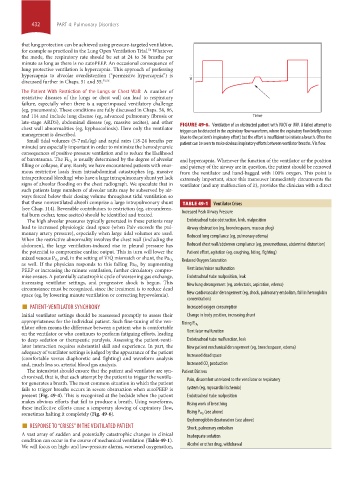
                 chest wall abnormalities (eg, kyphoscoliosis). Here only the ventilator   FIGURE 49-6.  Ventilation of an obstructed patient with VACV or IMV. A failed attempt to
                                                                       trigger can be detected in the expiratory flow waveform, where the expiratory flow briefly ceases
                 management is described.
                   Small tidal volumes (5-7 mL/kg) and rapid rates (18-24 breaths per   (due to the patient’s inspiratory effort) but the effort is insufficient to initiate a breath. Often the
                 minute) are especially important in order to minimize the hemodynamic   patient can be seen to make obvious inspiratory efforts between ventilator breaths. V ˙  is flow.
                 consequences of positive-pressure ventilation and to reduce the likelihood
                                   is usually determined by the degree of alveolar
                 of barotrauma. The Fi O 2                             and hypercapnia. Whenever the function of the ventilator or the position
                 filling or collapse, if any. Rarely, we have encountered patients with enor-  and patency of the airway are in question, the patient should be removed
                 mous  restrictive  loads  from  intraabdominal  catastrophes  (eg,  massive    from the ventilator and hand-bagged with 100% oxygen. This point is
                 intraperitoneal bleeding) who have a large intrapulmonary shunt yet lack   extremely important, since this maneuver immediately circumvents the
                 signs of alveolar flooding on the chest radiograph. We speculate that in   ventilator (and any malfunction of it), provides the clinician with a direct
                 such patients large numbers of alveolar units may be subserved by air-
                 ways forced below their closing volume throughout tidal ventilation so
                 that these nonventilated alveoli comprise a large intrapulmonary shunt     TABLE 49-1    Ventilator Crises
                 (see Chap. 114). Reversible contributors to restriction (eg, circumferen-
                 tial burn eschar, tense ascites) should be identified and treated.  Increased Peak Airway Pressure
                   The high alveolar pressures typically generated in these patients may     Endotracheal tube obstruction, kink, malposition
                 lead to increased physiologic dead space (when Palv exceeds the pul-    Airway obstruction (eg, bronchospasm, mucous plug)
                 monary artery pressure), especially when large tidal volumes are used.
                 When the restrictive abnormality involves the chest wall (including the     Reduced lung compliance (eg, pulmonary edema)
                 abdomen), the large ventilation-induced rise in pleural pressure has     Reduced chest wall/abdomen compliance (eg, pneumothorax, abdominal distention)
                 the potential to compromise cardiac output. This in turn will lower the     Patient effort, agitation (eg, coughing, biting, fighting)

                 mixed venous P O 2  and, in the setting of V ˙ /Q ˙  mismatch or shunt, the Pa O 2  Reduced Oxygen Saturation
                                                           by  augmenting
                 as  well.  If  the  physician  responds  to  this  falling  Pa O 2
                 PEEP or increasing the minute ventilation, further circulatory compro-    Ventilator/mixer malfunction
                 mise ensues. A potentially catastrophic cycle of worsening gas exchange,     Endotracheal tube malposition, leak
                 increasing ventilator settings, and progressive shock is begun. This     New lung derangement (eg, atelectasis, aspiration, edema)
                 circumstance must be recognized, since the treatment is to reduce dead
                 space (eg, by lowering minute ventilation or correcting hypovolemia).     New cardiovascular derangement (eg, shock, pulmonary embolism, fall in hemoglobin
                     ■  PATIENT-VENTILATOR SYNCHRONY                      Increased oxygen consumption
                                                                            concentration)
                 Initial ventilator settings should be reassessed promptly to assess their     Change in body position, increasing shunt
                 appropriateness for the individual patient. Such fine-tuning of the ven-
                 tilator often means the difference between a patient who is comfortable   Rising P CO 2
                 on the ventilator or who continues to perform fatiguing efforts, leading     Ventilator malfunction
                 to deep sedation or therapeutic paralysis. Assessing the patient-venti-    Endotracheal tube malfunction, leak
                 lator interaction requires substantial skill and experience. In part, the     New patient mechanical derangement (eg, bronchospasm, edema)
                 adequacy of ventilator settings is judged by the appearance of the patient
                 (comfortable versus diaphoretic and fighting) and waveform analysis     Increased dead space
                 and, much less so, arterial blood gas analysis.          Increased CO  production
                                                                                 2
                   The intensivist should ensure that the patient and ventilator are syn-  Patient Distress
                 chronized, that is, that each attempt by the patient to trigger the ventila-    Pain, discomfort unrelated to the ventilator or respiratory
                 tor generates a breath. The most common situation in which the patient
                 fails to trigger breaths occurs in severe obstruction when autoPEEP is     system (eg, myocardial ischemia)
                 present (Fig. 49-4). This is recognized at the bedside when the patient     Endotracheal tube malposition
                 makes obvious efforts that fail to produce a breath. Using waveforms,     Rising work of breathing
                 these ineffective efforts cause a temporary slowing of expiratory flow,
                 sometimes halting it completely (Fig. 49-6).             Rising P CO 2  (see above)
                     ■  RESPONSE TO “CRISES” IN THE VENTILATED PATIENT    Oxyhemoglobin desaturation (see above)

                 A vast array of sudden and potentially catastrophic changes in clinical     Shock, pulmonary embolism
                                                                          Inadequate sedation
                 condition can occur in the course of mechanical ventilation (Table 49-1).
                 We will focus on high- and low-pressure alarms, worsened oxygenation,     Alcohol or other drug, withdrawal


            section04.indd   432                                                                                       1/23/2015   2:19:22 PM

