


Page 609 - Hall et al (2015) Principles of Critical Care-McGraw-Hill
P. 609
CHAPTER 49: Management of the Ventilated Patient  429


                    the ventilator panel, and the work of breathing is reduced if autoPEEP   A peak inspiratory flow rate (V ˙ ) of 1 L/s (60 L/min) is a common initial
                    is present. 25,26  A potentially misleading feature of some ventilators is that   setting, but this may require adjustment upward (for patient comfort
                    the display may show the mode as “CPAP” when it actually is PSV. This   or to lengthen expiratory time) or downward. Increased V ˙  may have a
                    could lead health care providers to draw erroneous conclusions about   stimulatory effect on respiratory rate in active patients,  paradoxically
                                                                                                                  27
                    the patient’s ability to sustain spontaneous ventilation.  shortening T , although the impact on respiratory rate and work of
                        ■  EFFECT OF INSPIRATORY FLOW PROFILE             breathing after the first few seconds has not been studied. Lowering the
                                                                                   E
                                                                          peak V ˙  will reduce Ppk when there is significant resistance to airflow but
                    On most ventilators the physician can choose one of several inspira-  in this  setting will usually worsen autoPEEP, as described above. One
                    tory waveforms, most commonly square or decelerating. The ratio-  often overlooked adverse consequence of setting peak V ˙  at less than the
                    nale for the use of decelerating flow is to improve the distribution   patient wishes is that the patient will actively inspire against the ventilator,
                    of ventilation and to minimize Ppk. Peak pressures are indeed lower   increasing the respiratory work.
                    because maximal flow (and therefore,  flow-related pressure) occurs
                    early in the breath when lung volume (and elastic recoil pressure) is     ■  TRIGGERED SENSITIVITY
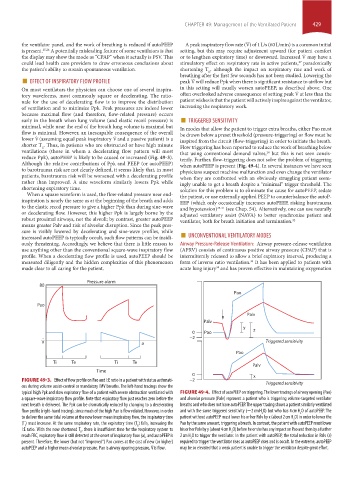
                    minimal, while near the end of the breath lung volume is maximal but   In modes that allow the patient to trigger extra breaths, either Pao must
                    flow is minimal. However, an inescapable consequence of the overall   be drawn below a preset threshold (pressure-triggering) or flow must be
                    lower V ˙  (assuming equal peak inspiratory V ˙  and a passive patient) is a   inspired from the circuit (flow-triggering) in order to initiate the breath.
                    shorter T . Thus, in patients who are obstructed or have high minute   Flow triggering has been reported to reduce the work of breathing below
                           E
                    ventilations (those in whom a decelerating flow pattern will most   that using conventional demand valves,  but this is not seen consis-
                                                                                                       28
                    reduce Ppk), autoPEEP is likely to be caused or increased (Fig. 49-3).   tently. Further, flow-triggering does not solve the problem of triggering
                    Although the relative contributions of Ppk and PEEP (or autoPEEP)   when autoPEEP is present (Fig. 49-4). In several instances we have seen
                    to barotrauma risk are not clearly defined, it seems likely that, in most   physicians suspect machine malfunction and even change the ventilator
                    patients, barotrauma risk will be worsened with a decelerating profile   when they are confronted with an obviously struggling patient seem-
                    rather than improved. A sine waveform similarly lowers Ppk while   ingly unable to get a breath despite a “minimal” trigger threshold. The
                    shortening expiratory time.                           solution for this problem is to eliminate the cause for autoPEEP, sedate
                     When a square waveform is used, the flow-related pressure near end-  the patient, or use externally applied PEEP to counterbalance the autoP-
                    inspiration is nearly the same as at the beginning of the breath and adds   EEP (which only occasionally increases autoPEEP, risking barotrauma
                    to the elastic recoil pressure to give a higher Ppk than during sine-wave   and hypotension) 29-31  (see Chap. 54). Alternatively, one can use neurally
                    or decelerating flow. However, this higher Ppk is largely borne by the   adjusted ventilatory assist (NAVA) to better synchronize patient and
                    robust proximal airways, not the alveoli; by contrast, greater autoPEEP   ventilator, both for breath initiation and termination. 32
                    means greater Palv and risk of alveolar disruption. Since the peak pres-
                    increased autoPEEP is typically occult, such flow patterns can be insidi-  ■  UNCONVENTIONAL VENTILATORY MODES
                    sure is visibly lowered by decelerating and sine-wave profiles, while
                    ously threatening. Accordingly, we believe that there is little reason to   Airway Pressure-Release Ventilation:  Airway pressure-release ventilation
                    use anything other than the conventional square-wave inspiratory flow   (APRV) consists of continuous positive airway pressure (CPAP) that is
                    profile. When a decelerating flow profile is used, autoPEEP should be   intermittently released to allow a brief expiratory interval, producing a
                    measured diligently and the hidden complexities of this phenomenon   form of inverse ratio ventilation.  It has been applied to patients with
                                                                                                  33
                    made clear to all caring for the patient.             acute lung injury  and has proven effective in maintaining oxygenation
                                                                                      34
                                          Pressure alarm
                          80
                                                                                            Pao

                         Pao
                                                                                                Palv
                                                                                  Palv
                                                                                               y
                                                                              0   Pao              z
                           .                                                 −2
                          V                                 a                                          Triggered sensitivity
                                                                                             Pao
                              Ti     Te            Ti     Te
                                                                                                  Palv
                                             Time
                                                                              0                    x
                    FIGURE 49-3.  Effect of flow profile on Pao and I:E ratio in a patient with status asthmati-  −2
                    cus during volume assist-control or mandatory IMV breaths. The left-hand tracings show the   Triggered sensitivity
                    typical high Ppk and slow expiratory flow of a patient with severe obstruction ventilated with   FIGURE 49-4.  Effect of autoPEEP on triggering. The lower tracings of airway opening (Pao)
                    a square-wave inspiratory flow profile. Note that expiratory flow just reaches zero before the   and alveolar pressure (Palv) represent a patient who is triggering volume-targeted ventilator
                    next breath is delivered. The Ppk can be dramatically reduced by changing to a decelerating   breaths and who does not have autoPEEP. The upper tracing shows a patient similarly ventilated
                    flow profile (right-hand tracing), since much of the high Pao is flow related. However, in order   and with the same triggered sensitivity (−2 cm H O) but who has 4 cm H O of autoPEEP. The
                                                                                                                  2
                                                                                                     2
                    to deliver the same tidal volume at the now lower mean inspiratory flow, the inspiratory time   patient without autoPEEP must lower his or her Palv by x (about 2 cm H O) in order to lower the
                                                                                                                2
                    (T) must increase. At the same respiratory rate, the expiratory time (T ) falls, increasing the   Pao by the same amount, triggering a breath. In contrast, the patient with autoPEEP must lower
                     I
                                                           E
                    I:E ratio. With the now shortened T , there is insufficient time for the respiratory system to   his or her Palv by y (about 4 cm H O) before he or she has any impact on Pao and then by a further
                                                                                           2
                                        E
                    reach FRC, expiratory flow is still detected at the onset of inspiratory flow (a), and autoPEEP is   2 cm H O to trigger the ventilator. In the patient with autoPEEP, the total reduction in Palv (z)
                                                                             2
                    present. Therefore, the lower (but not “improved”) Pao comes at the cost of new (or higher)   required to trigger the ventilator rises as autoPEEP rises and is occult. In the extreme, autoPEEP
                    autoPEEP and a higher mean alveolar pressure. Pao is airway opening pressure, V ˙  is flow.  may be so elevated that a weak patient is unable to trigger the ventilator despite great effort.


            section04.indd   429                                                                                       1/23/2015   2:19:20 PM

