


Page 614 - Hall et al (2015) Principles of Critical Care-McGraw-Hill
P. 614
434     PART 4: Pulmonary Disorders


                    Breathing Controlled trial): a randomized controlled trial. Lancet.   INTRODUCTION
                    2008;371:126-134.                                  The overarching goal of positive pressure mechanical ventilation is to
                     • Labeau SO, Van de Vyver K, Brusselaers N, et al. Prevention of   provide adequate gas exchange support while not causing harm. Indeed,
                    ventilator-associated pneumonia with oral antiseptics: a sys-  positive pressure mechanical ventilators are only support technologies,
                    tematic review and meta-analysis.  Lancet Infect Dis. 2011;11:   not therapeutic technologies. As such they cannot be expected to “cure”
                    845-854.                                           disease;  they  can  only  “buy  time”  for  other  therapies  (including  the
                     • Levine S, Nguyen T, Taylor N, et al. Rapid disuse atrophy of dia-  patient’s own defenses) to work.
                    phragm fibers in mechanically ventilated humans. N Engl J Med.   Conventional approaches to positive pressure ventilation involve
                    2008;358:1327-1335.                                applying ventilatory patterns mimicking normal through either masks
                     • Neto AS, Cardoso SO, Manetta JA, et al. Association between use   or artificial airways. This is usually done with modes of support incor-
                                                                       porating assist/control breath triggering mechanisms, gas delivery
                    of lung-protective ventilation with lower tidal volumes and clini-    patterns governed by either a set flow or pressure, and breath cycling
                    cal  outcomes  among  patients  without  acute  respiratory  distress   based on either a set volume, a set inspiratory time or a set flow. Often
                    syndrome: a meta-analysis. JAMA. 2012;308:1651-1659.  this support includes positive end expiratory pressure (PEEP) and
                     • Ranieri VM, Suter PM, Tortorella C, et al. Effect of mechanical   supplemental oxygen. In recent decades a number of novel or uncon-
                    ventilation on inflammatory mediators in patients with acute   ventional approaches to providing mechanical ventilatory support have
                    respiratory distress syndrome: a randomized controlled trial.   been introduced. For these to be considered of value, however, it would
                    JAMA. 1999;282:54-61.                              seem reasonable that they address important clinical challenges and be
                     • The Acute Respiratory Distress Syndrome Network. Ventilation   shown to improve important clinical outcomes (eg, mortality, duration
                    with lower tidal volumes as compared with traditional tidal   of ventilation, sedation needs, complications). The remainder of this
                    volumes for acute lung injury and the acute respiratory distress   chapter will focus on challenges facing clinicians in providing mechani-
                    syndrome. N Engl J Med. 2000;342:1301-1308.        cal ventilatory support and assess several novel approaches introduced
                     • Tobin MJ, Lodato RF.  PEEP, auto-PEEP,  and waterfalls.  Chest.   over the last two decades in the context of these challenges.
                    1989;96:449-451.
                                                                       CLINICAL CHALLENGES FACING CLINICIANS
                                                                       PROVIDING MECHANICAL VENTILATORY SUPPORT

                 REFERENCES                                                ■  VENTILATOR INDUCED LUNG INJURY
                                                                       Probably the most important challenge facing clinicians providing
                 Complete references available online at www.mhprofessional.com/hall  mechanical ventilatory support today is managing the balance between
                                                                       providing  adequate  gas  exchange  and  avoiding  lung  injury  associated
                                                                       with positive airway pressure and oxygen exposure. On the one hand,
                                                                       patients in respiratory failure need adequate tissue oxygenation and acid/
                   CHAPTER   Novel Modes of Mechanical                 base balance; on the other hand, the lungs are fragile structures easily
                                                                       injured by excessive stretch, alveolar collapse-reopening and high oxygen
                    50       Ventilation                               exposure. This challenge is made more difficult by the fact that lung
                                                                       injury is usually heterogeneous and thus what may benefit gas exchange
                             Mashael Al-Hegelan                        in one region (eg, higher pressure) may cause worse injury in another. 1
                             Neil R. MacIntyre                           Lung injury from mechanical ventilatory support is often termed
                                                                       ventilator associated lung injury, or more commonly, ventilator-induced
                                                                       lung injury (VILI).  Pathologically, VILI resembles in many ways the
                                                                                     2-7
                  KEY POINTS                                           inflammatory response seen in other forms of acute lung injury and
                                                                                                               2,3
                     •  Mechanical ventilators are support devices, not therapeutic devices.   the acute respiratory distress syndrome (ALI/ARDS).  The principal
                    The clinical goal is thus to support gas exchange without causing harm.  cause of VILI is alveolar injury induced by alveolar overstretch at end
                                                                       inspiration (overdistension), extended periods of tidal breath delivery
                     •  A number of challenges face clinicians in providing safe and effec-  above normal physiologic values, and cyclic atelectasis-recruitment that
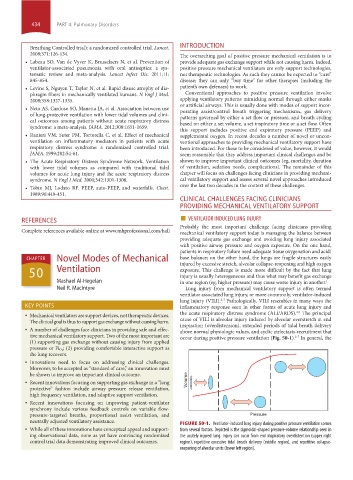
                    tive mechanical ventilatory support. Two of the most important are    occur during positive pressure ventilation (Fig. 50-1).  In general, the
                                                                                                              2-7
                    (1) supporting gas exchange without causing injury from applied
                               ; (2) providing comfortable interactive support as
                    pressure or Fi O 2
                    the lung recovers.
                     •  Innovations need to focus on addressing clinical challenges.
                    Moreover, to be accepted as “standard of care,” an innovation must
                    be shown to improve an important clinical outcome.
                     •  Recent innovations focusing on supporting gas exchange in a “lung   Volume
                    protective”  fashion  include  airway  pressure  release  ventilation,
                    high frequency ventilation, and adaptive support ventilation.
                     •  Recent innovations focusing on improving patient-ventilator
                    synchrony  include  various  feedback  controls  on  variable  flow-
                    pressure-targeted breaths, proportional assist ventilation, and            Pressure
                    neutrally adjusted ventilatory assistance.         FIGURE 50-1.  Ventilator-induced lung injury during positive pressure ventilation comes
                     •  While all of these innovations have conceptual appeal and support-  from several factors. Depicted is the sigmoidal-shaped pressure-volume relationship seen in
                    ing observational data, none as yet have convincing randomized   the acutely injured lung. Injury can occur from end inspiratory overdistention (upper right
                    control trial data demonstrating improved clinical outcomes.  region), repetitive excessive tidal breath delivery (middle region), and repetitive collapse-
                                                                       reopening of alveolar units (lower left region).


            section04.indd   434                                                                                       1/23/2015   2:19:23 PM

