


Page 622 - Hall et al (2015) Principles of Critical Care-McGraw-Hill
P. 622
442     PART 4: Pulmonary Disorders


                 not develop lung edema during ventilation, even with peak airway pres-  as compared to diffuse loss of aeration morphology was associated
                 sures up to 45 cm H O. The concept of volutrauma as opposed to a pure   with a greater risk of overdistension.  Recent studies of ARDS patients
                                                                                                  36
                               2
                 airway pressure-related effect was further supported in a study that com-  showed that limiting tidal volume to <6 mL/kg predicted body weight
                 pared the development of edema using negative-pressure ventilation and   (PBW) and plateau pressure to <30 cm H O may not be sufficient to
                                                                                                      2
                 high tidal volumes, to that using PPV to achieve similar tidal volumes.    limit VILI in patients who have a larger nonaerated compartment, as
                                                                    31
                 The amount of edema obtained using negative-pressure ventilation was   demonstrated by lung CT.  Finally although a relationship between
                                                                                           37
                 comparable to that in the animals ventilated with PPV at the same tidal   decreasing mortality as Pplat declines from high to low levels appears to
                 volumes. These studies first established the importance of lung inflation,   exist, a safe Pplat threshold value has not been established.
                 and second they demonstrated a dose-response relationship, with larger   A  mechanical  ventilation  strategy  that  incorporates  decreased  tidal
                 transpulmonary pressures and tidal volumes producing an increased   volumes and minute ventilation is often accompanied by increased
                 lung injury and edema.  In a very illustrative histologic study using   Pa CO 2  and in this context is termed permissive hypercapnia. Permissive
                                   32
                 electron microscopy, overdistention of the lung increased the number   hypercapnia  does  not  represent  a  method  of  mechanical  ventila-
                 of endothelial and epithelial breaks and contributed to rupture of the   tion per se; rather, it is the consequence of a strategy that limits lung
                 blood-gas barrier and separation of the epithelium from its underlying     volume excursions to minimize alveolar overdistention and hence VILI.
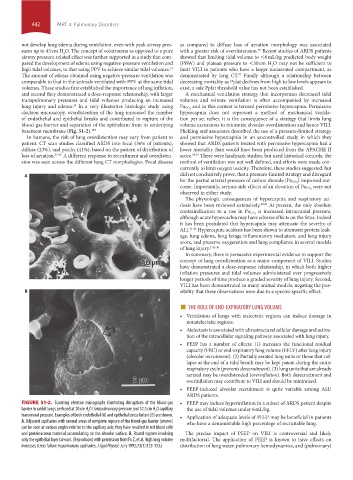
                 basement membrane (Fig. 51-2). 139                    Hickling and associates described the use of a pressure-limited strategy
                   In humans, the risk of lung overdistention may vary from patient to   and permissive hypercapnia in an uncontrolled study in which they
                 patient. CT scan studies classified ARDS into focal (36% of patients),   showed that ARDS patients treated with permissive hypercapnia had a
                 diffuse (23%), and patchy (41%), based on the pattern of distribution of   lower mortality than would have been predicted from the APACHE II
                 loss of aeration. 33-35  A different response to recruitment and overdisten-  score. 38,39  These were landmark studies, but used historical controls, the
                 sion was seen across the different lung CT morphologies. Focal disease   method of ventilation was not well defined, and efforts were made con-
                                                                       currently to limit oxygen toxicity. Therefore, these studies suggested, but
                  A                                                    did not conclusively prove, that a pressure-limited strategy and disregard
                                                                                                               ) improved out-
                                                                       for the partial arterial pressure of carbon dioxide (Pa CO 2
                                                                                                                     were not
                                                                       come. Importantly, serious side effects of an elevation of Pa CO 2
                                                                       observed in either study.
                                                                         The physiologic consequences of hypercapnia and respiratory aci-
                                                                       dosis have been reviewed extensively. 40,41  At present, the only absolute
                                                                                                  is increased intracranial pressure,
                                                                       contraindication to a rise in Pa CO 2
                                                                       although acute hypercarbia may have adverse effects on the fetus. Indeed
                                                                       it has been postulated that hypercapnia may attenuate the severity of
                                                                       ALI. 41-44  Hypercapnic acidosis has been shown to attenuate protein leak-
                                                                       age, lung edema, lung lavage inflammatory mediators, and lung injury
                                                                       score, and preserve oxygenation and lung compliance in several models
                                                                       of lung injury. 1,44-46
                                                                         In summary, there is persuasive experimental evidence to support the
                                                                       concept of lung overdistention as a major component of VILI. Studies
                                                                       have demonstrated a dose-response relationship, in which both higher
                                                                       inflation  pressures  and  tidal  volumes  administered  over  progressively
                                                                       longer periods of time produce a graded severity of lung injury. Second,
                                                                       VILI has been demonstrated in many animal models, negating the pos-
                  B                                                    sibility that these observations were due to a species-specific effect.
                                                                           ■  THE ROLE OF END-EXPIRATORY LUNG VOLUME


                                                                          • Ventilation of lungs with atelectatic regions can induce damage in
                                                                         nonatelectatic regions.
                                                                          • Atelectasis is associated with ultrastructural cellular damage and activa-
                                                                         tion of the intracellular signaling pathway associated with lung injury.
                                                                          • PEEP has a number of effects: (1) increases the functional residual
                                                                         capacity (FRC) or end-expiratory lung volume (EELV) after lung injury
                                                                         (alveolar recruitment). (2) Partially aerated lung units or those that col-
                                                                         lapse at the end of a tidal breath may be kept patent during the entire
                                                                         respiratory cycle (prevents derecruitment). (3) lung units that are already
                                                                         aerated may be overdistended (overinflation). Both derecruitment and
                                                                         overinflation may contribute to VILI and should be minimized.
                                                                          • PEEP-induced alveolar recruitment is quite variable among ALI/
                                                                         ARDS patients.
                 FIGURE 51-2.  Scanning electron micrographs illustrating disruptions of the blood-gas     • PEEP may induce hyperinflation in a subset of ARDS patient despite
                 barrier in rabbit lungs perfused at 20 cm H O transpulmonary pressure and 52.5 cm H O capillary   the use of tidal volumes under 6 mL/kg.
                                        2
                                                               2
                 transmural pressure. Examples of both endothelial (A) and epithelial stress failure (B) are shown.     • Application of adequate levels of PEEP may be beneficial in patients
                 A. Adjacent capillaries with several areas of complete rupture of the blood-gas barrier (arrows)   who have a demonstrable high percentage of recruitable lung.
                 can be seen at various angles relative to the capillary axis; they have resulted in red blood cells
                 and proteinaceous material accumulating on the alveolar surface. B. Round rupture involving   The precise impact of PEEP on VILI is controversial and likely
                 only the epithelial layer (arrow). (Reproduced with permission from Fu Z, et al. High lung volume   multifactorial. The application of PEEP is known to have effects on
                 increases stress failure in pulmonary capillaries. J Appl Physiol. Jul y 1992;73(1):123-133.)  distribution of lung water, pulmonary hemodynamics, and (pulmonary)


            section04.indd   442                                                                                       1/23/2015   2:19:29 PM

