


Page 623 - Hall et al (2015) Principles of Critical Care-McGraw-Hill
P. 623
CHAPTER 51: Ventilator-Induced Lung Injury   443


                    respiratory system compliance. 35,47,48  In addition to lung overdistention,   localization of inflammatory cytokines mRNA expression.  Moreover,
                                                                                                                    56
                    ventilation at low lung volumes may also lead to lung injury.  in an isolated lung injury model it has been demonstrated that lungs
                     In patients with ARDS, providing PEEP may have one of four effects   ventilated with 6 mL/kg and low levels of PEEP had more ultrastructural
                    on the state of lung inflation. First, lung units that are already aerated   evidence of cell damage possibly through mitogen-activated protein
                    may become overdistended, which could contribute to VILI (overdisten-  kinase (MAPK)–mediated pathway compared to those ventilated with
                    sion). Second, partially aerated lung units or those that collapse at the   higher PEEP levels.  In addition to serving as a purely mechanical stent,
                                                                                       57
                    end of a tidal breath may be kept patent during the entire respiratory   PEEP may keep alveoli patent by preserving surfactant function, and in
                    cycle (prevents derecruitment). Third, previously closed alveoli may be   so doing may reduce surface tension and in turn reduce the tendency of
                    recruited, leading to an increase in functional lung and resulting in an   alveoli to close. 58,59
                    increase in total lung compliance (alveolar recruitment). Fourth, in the   PEEP may also potentially improve gas exchange and lung mechan-
                    absence of adequate levels of PEEP, VILI is associated with distal airway   ics by redistributing lung water from the alveolar to the extraalveolar
                    injury in both atelectatic and nonatelectatic lung regions (prevents distal   interstitial  space.   Finally,  PEEP  has  also  significant  hemodynamic
                                                                                      60
                    airways injury). The latter two points deserve further emphasis.  effects and typically results in a reduction in ventricular preload and a
                     To understand the physiological effects of PEEP on the lung and respi-  reduction in cardiac output. Dreyfuss and Saumon postulated that the
                    ratory system, it is useful to consider the respiratory system pressure-  benefits of PEEP in ARDS stem from its effect on pulmonary perfusion,
                    volume (P-V) curve, which plots changes in volume versus changes in   and demonstrated that the reduction of lung edema produced by PEEP
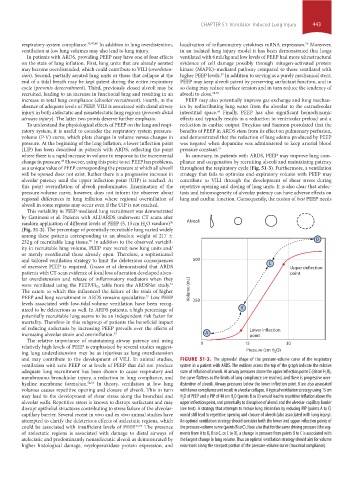
                    pressure. At the beginning of the lung inflation, a lower inflection point   was negated when dopamine was administered to keep arterial blood
                    (LIP) has been described in patients with ARDS, reflecting the point   pressure constant. 31
                    where there is a rapid increase in volume in response to the incremental   In summary, in patients with ARDS, PEEP may improve lung com-
                    change in pressure.  However, using this point to set PEEP has problems,   pliance and oxygenation by recruiting alveoli and maintaining patency
                                 49
                    as a unique value of PEEP corresponding the pressure at which all alveoli   throughout the respiratory cycle (Fig. 51-3). Furthermore, a ventilation
                    will be opened does not exist. Rather there is a progressive increase in   strategy that fails to optimize end-expiratory volume with PEEP may
                    alveolar patency until the upper inflection point (UIP) is reached. At   contribute to VILI through the development of shear stress during
                    this point overinflation of alveoli predominates. Examination of the   repetitive opening and closing of lung units. It is also clear that atelec-
                    pressure-volume curve, however, does not inform the observer about   tasis and inhomogeneity of alveolar patency can have adverse effects on
                    regional differences in lung inflation where regional overinflation of   lung and cardiac function. Consequently, the notion of best PEEP needs
                    alveoli in some regions may occur even if the UIP is not reached.
                     This variability in PEEP-mediated lung recruitment was demonstrated
                    by Gattinoni et al. Patients with ALI/ARDS underwent CT scans after
                    random application of different levels of PEEP (5, 15 cm H O  random)    Alveoli
                                                                      50
                                                              2
                    (Fig. 51-2). The percentage of potentially recruitable lung varied widely
                    among these patients corresponding to an absolute weight of 217  ±
                    232 g of recruitable lung tissue.  In addition to the observed variabil-                            D
                                           50
                    ity in recruitable lung volume, PEEP may recruit new lung units and/
                    or merely overdistend those already open. Therefore, a sophisticated
                    and tailored ventilation strategy to limit the deleterious consequences   500
                    of excessive PEEP is required. Grasso et al demonstrated that ARDS                  C      Upper deflection
                    patients with CT-scan evidence of focal loss of aeration developed alveo-                  point
                    lar overdistension and release of inflammatory mediators when they
                                               table from the ARDSNet study.
                                                                      51
                    were ventilated using the PEEP/Fi O 2
                    The extent to which this influenced the failure of the trials of higher   Volume (mL)
                    PEEP and lung recruitment in ARDS remains speculative.  Low PEEP
                                                              52
                    levels associated with low-tidal-volume ventilation have been recog-  250
                    nized to be deleterious as well. In ARDS patients, a high percentage of   B
                    potentially recruitable lung seems to be an independent risk factor for
                    mortality. Therefore in this subgroup of patients the beneficial impact
                    of reducing atelectasis by increasing PEEP prevails over the effects of      Lower inflection
                    increasing alveolar strain and overinflation. 53              A              point
                     The relative importance of maintaining airway patency and using
                    relatively high levels of PEEP is emphasized by several studies suggest-  0  15           30
                    ing lung underdistension may be as injurious as lung overdistension         Pressure (cm H 2 O)
                    and may contribute to the development of VILI. In animal studies,   FIGURE 51-3.  The sigmoidal shape of the pressure-volume curve of the respiratory
                    ventilation with zero PEEP or at levels of PEEP that did not produce     system in a patient with ARDS. The outlines across the top of the graph indicate the relative
                    adequate lung recruitment has been shown to cause respiratory and   state of inflation of  alveoli. At airway pressures above the upper inflection point C (30 cm H O),
                                                                                                                           2
                    membranous bronchiolar injury, a reduction in lung compliance, and   the curve flattens as the limits of lung compliance are reached, and there is progressive over-
                    hyaline  membrane  formation. 54,55   In  theory,  ventilation  at  low  lung   distention of alveoli. Airway pressures below the lower inflection point B are also associated
                    volumes causes repetitive opening and closure of alveoli. This in turn   with lower compliance and result in alveolar collapse. A typical ventilation strategy using 15 cm
                    may  lead  to  the  development  of  shear  stress  along  the  bronchial  and   H O of PEEP and a PIP of 40 cm H O (points B to D) would lead to repetitive inflation above the
                                                                          2
                                                                                            2
                    alveolar walls. Repetitive stress is known to disrupt surfactant and may   upper inflection point, and potentially to  disruption of alveoli and the alveolar-capillary barrier
                    disrupt epithelial structures contributing to stress failure of the alveolar-  (see text). A strategy that attempts to reduce lung distention by reducing PIP (points A to C)
                    capillary barrier. Several recent in vivo and ex vivo animal studies have   would still lead to repetitive opening and closure of alveoli (also associated with lung injury).
                    attempted to clarify the deleterious effects of atelectatic regions, which   An optimal ventilation strategy should consider both the lower and upper inflection points of
                    could be associated with insufficient levels of PEEP. 56,57  The presence   the pressure-volume curve (points B to C). Note also that for the same driving  pressure (the seg-
                    of atelectatic regions is associated with damage to distal airways of   ments from A to B, B to C, or C to D), a change in pressure from points B to C is associated with
                    atelectatic and predominantly nonatelectatic alveoli as demonstrated by   the largest change in lung volume. Thus an optimal ventilation strategy should aim for volume
                    higher histological damage, myeloperoxidase protein expression, and   excursions along the steepest portion of the pressure-volume curve (maximal compliance).


            section04.indd   443                                                                                       1/23/2015   2:19:29 PM

