


Page 619 - Hall et al (2015) Principles of Critical Care-McGraw-Hill
P. 619
CHAPTER 51: Ventilator-Induced Lung Injury   439


                        • Fessler HE, Hager DN, Brower RG. Feasibility of very high-
                      frequency ventilation in adults with acute respiratory distress     •  Permissive hypoventilation (hypercapnia) may be a necessary
                      syndrome. Crit Care Med. April 2008;36(4):1043-1048.  component of a lung-protective ventilator strategy.
                        • Iotti GA, Polito A, Belliato M, et al. Adaptive support versus con-    •  The penetrance of lung-protective ventilation strategies into clini-
                       ventional ventilation for total ventilator support in acute respira-  cal practice is improving.
                       tory failure. Int Care Med. 2010;36:1371-1379.
                        • Lellouche F, Mancebo J, Jolliet P, et al. A multicenter randomized
                       trial of computer-driven protocolized weaning from mechanical   There is consistent and convincing evidence that mechanical ventilation,
                       ventilation. Am J Respir Crit Care Med. 2006;174:894-900.  particularly in the setting of lung injury, can contribute to functional
                        • Levine S, Nguyen T, Taylor N, et al. Rapid disuse atrophy of dia-  and structural alterations in the lung. The experimental evidence has
                       phragm fibers in mechanically ventilated humans.  New Engl J   also led to the notion that mechanical ventilation not only perpetuates
                       Med. 2008;358:1327-1335.                           lung injury, but also contributes to both the morbidity and mortality of
                        • MacIntyre NR, Sessler CN. Are there benefits or harm from pres-  the acute respiratory distress syndrome (ARDS). Concern surrounding
                       sure targeting during lung-protective ventilation?  Respir Care.   ventilator-induced lung injury (VILI) culminated in a consensus con-
                       2010;55(2):175-180.                                ference in 1993 that recommended (based solely on studies in animal
                        • Maxwell R, Green J, Waldrop J, et al. A randomized prospective   models of ARDS) tidal volumes be limited to the range of 5 to 7 mL/kg
                                                                                                        1
                       trial of airway pressure release ventilation and low tidal volume   and plateau pressures less than 35 cm H O.  It would be 8 years until the
                                                                                                      2
                       ventilation in adult trauma patients with acute respiratory failure.   recommendations of the consensus group were affirmed by a random-
                       J Trauma. 2010;69(3):501-510.                      ized controlled trial demonstrating that a lung-protective strategy led to
                                                                                                                    2
                        • Raneri VM. Optimization of patient ventilator interactions: closed   a decrease in mortality in patients with acute lung injury.  After initial
                                                                          hesitations about the incorporation of these concepts into widespread
                       loop technology. Intensive Care Med. 1997;23:936-939.  clinical practice,  lower tidal volumes and higher levels of positive end-
                                                                                     3
                        • Terzi N, Pelieu I, Guittet L, et al. Neurally adjusted ventilatory   expiratory pressure (PEEP) are being used widely to minimize VILI. 4,5
                       assist in patients recovering spontaneous breathing after acute   The objectives of this chapter are to review current concepts of VILI
                       respiratory distress syndrome: physiological evaluation. Crit Care   and provide the rationale for lung-protective ventilation strategies.
                       Med. 2010;38(9):1830-1837.                         Since most studies evaluating VILI have focused on ARDS, the relevant
                        • Thille AW, Rodriguez P, Cabello B, Lellouche F, Brochard L.     features of ARDS as it pertains to VILI will be reviewed first. Then,
                       Patient-ventilator asynchrony during assisted mechanical ventila-  the concept of lung-protective ventilation strategies will be discussed,
                       tion. Inten Care Med. 2006;32:1515-1522.           and pertinent studies evaluating these newer strategies in patients with
                                                                          ARDS will be presented. Recommendations based on current clinical
                                                                          evidence, and when this is lacking best experimental evidence, will also
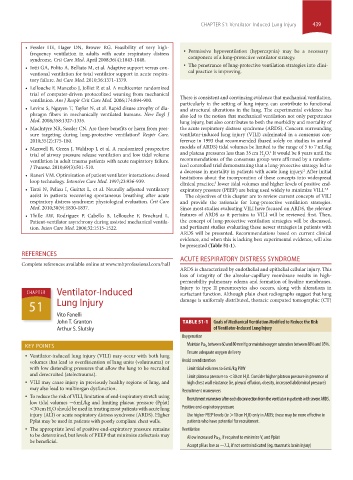
                                                                          be presented (Table 51-1).
                    REFERENCES
                                                                          ACUTE RESPIRATORY DISTRESS SYNDROME
                    Complete references available online at www.mhprofessional.com/hall
                                                                          ARDS is characterized by endothelial and epithelial cellular injury. This
                                                                          loss of integrity of the alveolar-capillary membrane results in high-
                                                                          permeability pulmonary edema and formation of hyaline membranes.
                     CHAPTER    Ventilator-Induced                        Injury to type II pneumocytes also occurs, along with alterations in
                                                                          surfactant function. Although plain chest radiographs suggest that lung
                      51        Lung Injury                               damage is uniformly distributed, thoracic computed tomographic (CT)

                                Vito Fanelli
                                John T. Granton                             TABLE 51-1     Goals of Mechanical Ventilation Modified to Reduce the Risk
                                Arthur S. Slutsky                                    of Ventilator-Induced Lung Injury
                                                                          Oxygenation
                     KEY POINTS                                             Maintain Pa O 2  between 60 and 80 mm Hg or maintain oxygen saturation between 88% and 95%.
                                                                            Ensure adequate oxygen delivery
                        •  Ventilator-induced lung injury (VILI) may occur with both lung
                      volumes that lead to overdistention of lung units (volutrauma) or   Avoid overdistention
                      with low distending pressures that allow the lung to be recruited     Limit tidal volumes to 6 mL/kg PBW
                      and derecruited (atelectrauma).                        Limit plateau pressure to <30 cm H O. Consider higher plateau pressure in presence of
                                                                                                2
                        •  VILI may cause injury in previously healthy regions of lung, and   high chest wall elastance (ie, pleural effusion, obesity, increased abdominal pressure)
                      may also lead to multiorgan dysfunction.            Recruitment maneuvers
                       •  To reduce the risk of VILI, limitation of end-inspiratory stretch using     Recruitment maneuver after each disconnection from the ventilator in patients with severe ARDS.
                      low tidal volumes ∼6 mL/kg and limiting plateau pressure (Pplat)
                      <30 cm H O should be used in treating most patients with acute lung   Positive end-expiratory pressure
                              2
                      injury (ALI) or acute respiratory distress syndrome (ARDS). Higher      Use higher PEEP levels (ie >10 cm H O) only in ARDS; these may be more effective in
                                                                                                2
                      Pplat may be used in patients with poorly compliant chest walls.  patients who have potential for recruitment.
                        •  The appropriate level of positive end-expiratory pressure remains   Ventilation
                      to be determined, but levels of PEEP that minimize atelectasis may    if required to minimize V t  and Pplat
                      be  beneficial.                                       Allow increased Pa CO 2
                                                                            Accept pH as low as ∼7.2, if not contraindicated (eg, traumatic brain injury)


            section04.indd   439                                                                                       1/23/2015   2:19:26 PM

