


Page 621 - Hall et al (2015) Principles of Critical Care-McGraw-Hill
P. 621
CHAPTER 51: Ventilator-Induced Lung Injury   441


                      injury (ALI)/ARDS. Moreover, in  established ARDS,  tidal  volume   A  Average  Average
                      reduction associated with the application of PEEP attenuates these   lung weight,  lung weight,
                      phenomena.                                                   59 ± 51 g      374 ± 236 g
                                                                                    Lower           Higher
                     Shortly after the institution of invasive positive pressure ventilation,
                    the development of lung damage was observed in animals ventilated   24
                                                                               22
                    for prolonged periods. The term “respirator lung” was coined to   5% ± 4%  21% ±10%   Patients with acute lung
                    describe the functional and histologic features.  In 1974, Webb and   20              injury without ARDS
                                                       26
                                                                               18
                    Tierney graphically illustrated the deleterious effects of mechanical   16            Patients with ARDS
                    ventilation  in  rats  using  varying  levels  of  peak  airway  pressure  and   14
                    PEEP.   Animals  ventilated  using  low  peak  airway  pressures  (14 cm   No. of patients  12
                        27
                    H O and no PEEP) had no pathologic or physiologic changes. In con-  10
                     2
                    trast, rats ventilated with peak pressures of 30 cm H O and no PEEP   8
                                                           2
                    had perivascular edema and alveolar edema. These findings were mag-  6
                    nified in rats ventilated with peak pressures of 45 cm H O. Alveolar   4
                                                              2
                    and perivascular edema developed, along with severe hypoxemia,   2
                    decreased dynamic compliance, and obvious gross anatomic changes   0
                    (Fig. 51-1). Interestingly, rats ventilated using 10 cm H O of PEEP and   −5 to 0 0 to 5 5 to 10 10 to 15 15 to 20 20 to 25 25 to 30 30 to 35 35 to 40 40 to 45 45 to 50 50 to 55 55 to 60 60 to 65 65 to 70 70 to 75 75 to 80
                                                            2
                    peak pressures of 45 cm H O had no alveolar edema (see Fig. 51-1,   −10 to −5
                                        2
                    center). This latter finding led to the concept of a protective effect of   Amount of potentially recruitable lung (% total lung weight)
                    PEEP, which will be discussed later.
                     Subsequent investigations have demonstrated that mechanical ven-  B  Lower percentage of potentially recruitable lung
                    tilation,  even  at  modest  airway  pressures,  is  capable  of  producing   5 cm of water  45 cm of water
                    functional impairment of the lung with loss of integrity of the alveolar-
                    capillary barrier, surfactant dysfunction, and parenchymal damage that
                    mimics the histologic appearance of ARDS. These observations have
                    led investigators to speculate that mechanical ventilation itself could be
                    contributing to the lung injury, morbidity, and mortality in patients with
                    acute respiratory failure.
                     Numerous human studies demonstrate that mechanical ventilation
                    with large tidal volumes is capable of inciting lung inflammation and
                    may lead to the development of ALI/ARDS. 28,29  Patients with underlying   C  Higher percentage of potentially recruitable lung
                    lung disease are particularly prone to the development of macroscopic   5 cm of water     45 cm of water
                    barotrauma. Asthma, chronic obstructive pulmonary disease (COPD),
                    and pneumonia have all been identified as risk factors. 12
                        ■  HIGH AIRWAY PRESSURES/LARGE TIDAL VOLUMES AND LUNG INJURY


                      • Transpulmonary pressure—the pressure difference between the alve-
                      oli and the pleural space is the effective alveolar distending pressure
                      and is the pressure most closely related to the development of VILI.
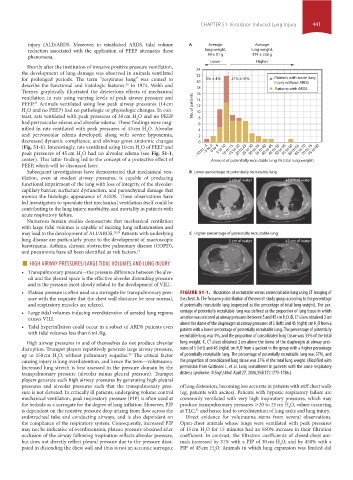
                      • Plateau pressure is often used as a surrogate for transpulmonary pres-  FIGURE 51-1.  Illustration of recruitable versus nonrecruitable lung using CT imaging of
                      sure with the requisite that the chest wall elastance be near normal,   the chest. A. The frequency distribution of the overall study group according to the percentage
                      and respiratory muscles are relaxed.                of potentially recruitable lung (expressed as the percentage of total lung weight). The per-
                      • Large tidal volumes inducing overdistension of aerated lung regions   centage of potentially recruitable lung was defined as the proportion of lung tissue in which
                      causes VILI.                                        aeration was restored at airway pressures between 5 and 45 cm H O. B. CT slices obtained 2 cm
                                                                                                             2
                      • Tidal hyperinflation could occur in a subset of ARDS patients even   above the dome of the diaphragm at airway pressures of 5 (left) and 45 (right) cm H O from a
                                                                                                                        2
                                                                          patient with a lower percentage of potentially recruitable lung. The percentage of potentially
                      with tidal volumes less than 6 mL/kg.
                                                                          recruitable lung was 4%, and the proportion of consolidated lung tissue was 33% of the total
                     High airway pressures in and of themselves do not produce alveolar   lung weight. C. CT slices obtained 2 cm above the dome of the diaphragm at airway pres-
                    disruption. Trumpet players repetitively generate large airway pressure,   sures of 5 (left) and 45 (right) cm H O from a patient in the group with a higher percentage
                                                                                              2
                    up  to  150 cm  H O,  without  pulmonary  sequelae.   The  critical  factor   of potentially recruitable lung. The percentage of potentially recruitable lung was 37%, and
                                                        30
                                2
                    causing injury is lung overdistention, and hence the term—volutrauma.   the proportion of consolidated lung tissue was 27% of the total lung weight. (Modified with
                    Increased lung stretch is best assessed in the pressure domain by the   permission from Gattinoni L, et al. Lung recruitment in patients with the acute respiratory
                    transpulmonary  pressure  (alveolar  minus  pleural  pressure).  Trumpet   distress syndrome. N Engl J Med. April 27, 2006;354(17):1775-1786.)
                    players generate such high airway pressures by generating high pleural
                    pressures  and  alveolar  pressures  such  that  the  transpulmonary  pres-  of lung distension, becoming less accurate in patients with stiff chest walls
                    sure is not elevated. In critically ill patients, undergoing volume control   (eg, patients with ascites). Patients with hypoxic respiratory failure are
                    mechanical ventilation, peak inspiratory pressure (PIP) is often used at   commonly ventilated with very high inspiratory pressures, which may
                    the bedside as a surrogate for the degree of lung inflation. However, PIP   produce transpulmonary pressures >20 to 25 cm H O, values occurring
                                                                                                               2
                    is dependent on the resistive pressure drop arising from flow across the   at TLC,  and hence lead to overdistention of lung units and lung injury.
                                                                               11
                    endotracheal tube and conducting airways, and is also dependent on   Direct evidence for volutrauma stems from several observations.
                    the compliance of the respiratory system. Consequently, increased PIP   Open-chest animals whose lungs were ventilated with peak pressures
                    may not be indicative of overdistension; plateau pressure obtained after   of 15 cm H O for 15 minutes had an 850% increase in their filtration
                                                                                  2
                    occlusion of the airway following inspiration reflects alveolar pressure,   coefficient. In contrast, the filtration coefficients of closed-chest ani-
                    but does not directly reflect pleural pressure due to the pressure dissi-  mals increased by 31% with a PIP of 30 cm H O, and by 450% with a
                                                                                                            2
                    pated in distending the chest wall and thus is not an accurate  surrogate   PIP of 45 cm H O. Animals in which lung expansion was limited did
                                                                                     2


            section04.indd   441                                                                                       1/23/2015   2:19:27 PM

