


Page 618 - Hall et al (2015) Principles of Critical Care-McGraw-Hill
P. 618
438     PART 4: Pulmonary Disorders


                                            70   a)     b)        c)       d)      e)       f)
                                         P ET CO 2  mm Hg  35

                                             0
                                            20
                                        Paw  cm H 2 O  10
                                             0
                                             2
                                         Volume  L  0


                                            −2
                                                      PAV            PSV            VACV
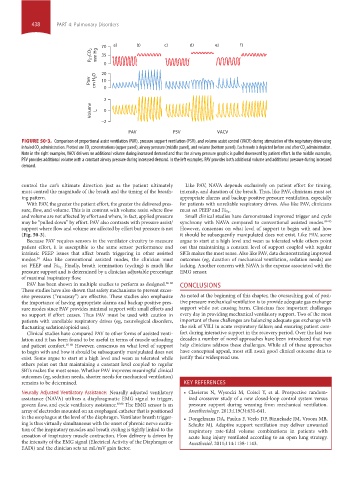
                 FIGURE 50-3.  Comparison of proportional assist ventilation (PAV), pressure support ventilation (PSV), and volume assist control (VACV) during stimulation of the respiratory drive using
                 inhaled CO  administration. Plotted are CO  concentrations (upper panel), airway pressure (middle panel), and volume (bottom panel). Each mode is depicted before and after CO  administration.
                       2
                                                                                                                  2
                                        2
                 Note in the right examples, VACV delivers no additional volume during increased demand and thus the airway pressure graphic is pulled downward by patient effort. In the middle examples,
                 PSV provides additional volume with a constant airway pressure during increased demand. In the left examples, PAV provides both additional volume and additional pressure during increased
                 demand.
                 control the  car’s  ultimate direction  just  as the patient ultimately     Like PAV, NAVA depends exclusively on patient effort for timing,
                 must control the magnitude of the breath and the timing of the breath-  intensity, and duration of the breath. Thus, like PAV, clinicians must set
                 ing pattern.                                          appropriate alarms and backup positive pressure ventilation, especially
                   With PAV, the greater the patient effort, the greater the delivered pres-  for patients with unreliable respiratory drives. Also like PAV, clinicians
                 sure, flow, and volume. This is in contrast with volume assist where flow   must set PEEP and Fi O 2 .
                 and volume are not affected by effort and where, in fact, applied pressure   Small clinical studies have demonstrated improved trigger and cycle
                 may be “pulled down” by effort. PAV also contrasts with pressure assist/  synchrony with NAVA compared to conventional assisted modes. 89-93
                 support where flow and volume are affected by effort but pressure is not   However, consensus on what level of support to begin with and how
                 (Fig. 50-3).                                          it should be subsequently manipulated does not exist. Like PAV, some
                   Because PAV requires sensors in the ventilator circuitry to measure   argue to start at a high level and wean as tolerated while others point
                 patient effort, it is susceptible to the same sensor performance and   out that maintaining a constant level of support coupled with regular
                 intrinsic PEEP issues that affect breath triggering in other assisted   SBTs makes the most sense. Also like PAV, data demonstrating improved
                 modes.   Also like conventional assisted modes,  the  clinician must   outcomes (eg, duration of mechanical ventilation, sedation needs) are
                      24
                               . Finally, breath termination (cycling) is much like   lacking. Another concern with NAVA is the expense associated with the
                 set PEEP and Fi O 2
                   pressure support and is determined by a clinician adjustable percentage   EMG sensor.
                 of maximal inspiratory flow.
                   PAV has been shown in multiple studies to perform as designed. 86-88    CONCLUSIONS
                 These studies have also shown that safety mechanisms to prevent exces-
                 sive pressures (“runaway”) are effective. These studies also emphasize   As noted at the beginning of this chapter, the overarching goal of posi-
                 the importance of having appropriate alarms and backup positive pres-  tive pressure mechanical ventilation is to provide adequate gas exchange
                 sure modes since PAV provides minimal support with small efforts and   support while not causing harm. Clinicians face important challenges
                 no support if effort ceases. Thus PAV must be used with caution in   every day in providing mechanical ventilatory support. Two of the most
                 patients with unreliable respiratory drives (eg, neurological disorders,   important of these challenges are balancing adequate gas exchange with
                 fluctuating sedation/opioid use).                     the risk of VILI in acute respiratory failure; and ensuring patient com-
                   Clinical studies have compared PAV to other forms of assisted venti-  fort during interactive support in the recovery period. Over the last two
                 lation and it has been found to be useful in terms of muscle unloading   decades a number of novel approaches have been introduced that may
                 and patient comfort. 85-88  However, consensus on what level of support   help clinicians address these challenges. While all of these approaches
                 to begin with and how it should be subsequently manipulated does not   have conceptual appeal, most still await good clinical outcome data to
                 exist. Some argue to start at a high level and wean as tolerated while   justify their widespread use.
                 others point out that maintaining a constant level coupled to regular
                 SBTs makes the most sense. Whether PAV improves meaningful clinical
                 outcomes (eg, sedation needs, shorter needs for mechanical ventilation)
                 remains to be determined.                               KEY REFERENCES
                 Neurally Adjusted Ventilatory Assistance:  Neurally adjusted ventilatory     • Clavieras N, Wysocki M, Coisel Y, et al. Prospective random-
                 assistance (NAVA) utilizes a diaphragmatic EMG signal to trigger,   ized crossover study of a new closed-loop control system versus
                   govern flow, and cycle ventilatory assistance. 89,90  The EMG sensor is an   pressure support during weaning from mechanical ventilation.
                 array of electrodes mounted on an esophageal catheter that is positioned   Anesthesiology. 2013;119(3):631-641.
                 in the esophagus at the level of the diaphragm. Ventilator breath trigger-    • Dongelmans DA, Paulus F, Veelo DP, Binnekade JM, Vroom MB,
                 ing is thus virtually simultaneous with the onset of phrenic nerve excita-  Schultz MJ. Adaptive support ventilation may deliver unwanted
                 tion of the inspiratory muscles and breath cycling is tightly linked to the   respiratory rate-tidal volume combinations in patients with
                 cessation of inspiratory muscle contraction. Flow delivery is driven by   acute lung injury ventilated according to an open lung strategy.
                 the intensity of the EMG signal (Electrical Activity of the Diaphragm or   Anesthesiol. 2011;114:1138-1143.
                 EADi) and the clinician sets an mL/mV gain factor.


            section04.indd   438                                                                                       1/23/2015   2:19:26 PM

