


Page 620 - Hall et al (2015) Principles of Critical Care-McGraw-Hill
P. 620
440     PART 4: Pulmonary Disorders


                 examination of the thorax of patients with ARDS has demonstrated that     TABLE 51-2    The Scope of Ventilator-Induced Lung Injury
                 the airspace disease is patchy,  with marked heterogeneity and regional
                                      6,7
                 differences in lung injury. Regions of lung with airspace disease are jux-  Oxygen toxicity
                 taposed to adjacent areas with normal-appearing alveoli. In addition, an   Tracheal and upper airway injury
                 exaggerated vertical gradient of lung inflation has been demonstrated     Macroscopic
                 in ARDS, with compression of alveoli and a decrease in aerated lung as
                 one progresses from nondependent to more dependent lung regions.       Pneumothorax
                                                                    8
                 As emphasized by Mead and coworkers in the early 1970s, it is likely      Pneumomediastinum
                 this  degree  of heterogeneity  of  the lung  injury  that  makes the  lung      Pneumopericardium
                 particularly susceptible to the effects of ventilator-induced injury.  The
                                                                 9
                 heterogeneity of the injury is also responsible for the decrease in lung      Pneumoperitoneum
                 compliance that characterizes ARDS. It is worth emphasizing that this      Subcutaneous emphysema
                 loss of compliance is due to a functional reduction in alveolar units and      Parenchymal emphysema
                 not due to the development of “stiff” lungs. Indeed the recognition that
                 ARDS is characterized by a loss of functional lung units with preserva-      Cystic lung spaces
                 tion of other alveoli resulting in normal lung specific lung compliance     Microscopic
                 is central to the current notion of lung-protection strategies.  In many      Regional
                                                             10
                 respects owing to the reduction in effective lung volume, the 70-kg adult         Epithelial/endothelial activation (inflammatory mediators release) and injury
                 patient with ARDS must be treated, from the pulmonary point of view,
                 as a 30-kg pediatric patient. Consequently the use of traditional tidal          Damage to the alveolar-capillary barrier and vascular permeability decreases
                 volumes of 10 to 15 mL/kg (700-900 mL in our 70-kg patient) would be   alveolar fluid clearance
                 inappropriate and will result in overdistention of lung units with rela-      Surfactant dysfunction
                 tively normal compliance.                                  Bronchiolar injury
                   The need to modify the approach to mechanical ventilation in ARDS
                 is further emphasized by three decades of investigations that demon-        Leukocytes sequestration and activation
                 strate that overdistention of lung units may itself lead to lung injury         Fibrosis (late phase of ARDS)
                 identical to that seen in ARDS. ARDS is also a syndrome characterized      Biotrauma
                 by inflammation of the lung with various cytokines and other mediators
                 thought to play a major role. In recent years, there has been a large body      Systemic
                 of evidence indicating that mechanical ventilation may have an impact       Multisystem organ dysfunction
                 on this aspect of the pathophysiology of ARDS, and indeed there is the
                 suggestion that the improvement in mortality with lung-protective strat-
                 egies may be partly due to a reduction in release of various mediators
                 by these strategies.                                  correlation between air leaks and PEEP levels. Eisner and colleagues,
                                                                       using data from the ARDS Network trial, reported that higher PEEP was
                 VENTILATOR-INDUCED LUNG INJURY                        associated with an increased risk of barotrauma (relative risk = 1.5; 95%
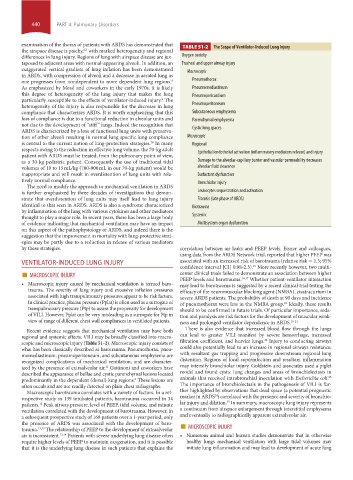
                     ■  MACROSCOPIC INJURY                             center clinical trials failed to demonstrate an association between higher
                                                                       confidence interval [CI] 0.98-2.3).  More recently however, two multi-
                                                                                                15
                    • Macroscopic injury caused by mechanical ventilation is termed baro-  PEEP levels and barotrauma. 16,17  Whether patient-ventilator interaction
                                                                       may lead to barotrauma is suggested by a recent clinical trial testing the
                   trauma. The severity of lung injury and excessive inflation pressures   efficacy of the neuromuscular blocking agent (NMBA), cisatracurium in
                   associated with high transpulmonary pressures appear to be risk factors.   severe ARDS patients. The probability of death at 90 days and incidence
                   In clinical practice, plateau pressure (Pplat) is often used as a surrogate of   of pneumothorax were less in the NMBA group.  Ideally, these results
                                                                                                           18
                   transpulmonary pressure (Ptp) to assess the propensity for development   should to be confirmed in future trials. Of particular importance, seda-
                   of VILI. However, Pplat can be very misleading as a surrogate for Ptp in   tion and paralysis are risk factors for the development of muscular weak-
                   view of range of different chest wall compliances in ventilated patients.  ness and prolonged ventilator dependence in ARDS. 19-21
                   Recent evidence suggests that mechanical ventilation may have both   There is also evidence that increased blood flow through the lungs
                 regional and systemic effects. VILI may be broadly classified into macro-  can lead to greater VILI manifest by severe hemorrhage, increased
                                                                                                    22
                 scopic and microscopic injury (Table 51-2). Macroscopic injury consists of   filtration coefficient, and heavier lungs.  Injury to conducting airways
                 what has been classically described as barotrauma. Pneumothorax, pneu-  could also potentially lead to an increase in regional airways resistance,
                 momediastinum, pneumoperitoneum, and subcutaneous emphysema are   with resultant gas trapping and progressive downstream regional lung
                 recognized complications of mechanical ventilation, and are character-  distention. Regions of local superinfection and resultant inflammation
                 ized by the presence of extraalveolar air.  Gattinoni and coworkers have   may intensify bronchiolar injury. Goldstein and associates used a piglet
                                              11
                 described the appearance of bullae and cystic parenchymal lesions located   model and found cystic lung changes and areas of bronchiolectasis in
                                                                                                                          23
                 predominantly in the dependent (dorsal) lung regions.  These lesions are   animals that received intrabronchial inoculation with Escherichia coli.
                                                        6
                 often occult and are not readily detected on plain chest radiographs.  The importance of bronchiolectasis in the pathogenesis of VILI is fur-
                   Macroscopic barotrauma correlates with a variety of factors. In a ret-  ther highlighted by observations that dead space (a potential prognostic
                                                                                   24
                 rospective study in 139 intubated patients, barotrauma occurred in 34   marker in ARDS ) correlated with the presence and severity of bronchio-
                                                                                       25
                 patients.  Peak airway pressure, level of PEEP, tidal volume, and minute   lar injury and dilation.  In summary, macroscopic lung injury represents
                       12
                 ventilation correlated with the development of barotrauma. However, in   a continuum from airspace enlargement through interstitial emphysema
                 a subsequent prospective study of 168 patients over a 1-year period, only   and eventually to radiographically apparent extraalveolar air.
                          The relationship of PEEP to the development of extraalveolar   ■
                 the presence of ARDS was associated with the development of baro-
                 trauma. 12,13                                            MICROSCOPIC INJURY
                 air is inconsistent. 13,14  Patients with severe underlying lung disease often     • Numerous animal and human studies demonstrate that in otherwise
                 require higher levels of PEEP to maintain oxygenation, and it is  possible   healthy lungs mechanical ventilation with large tidal volumes may
                 that it is the underlying lung disease in such patients that explains the     initiate lung inflammation and may lead to development of acute lung


            section04.indd   440                                                                                       1/23/2015   2:19:26 PM

