


Page 637 - Hall et al (2015) Principles of Critical Care-McGraw-Hill
P. 637
456     PART 4: Pulmonary Disorders


                 APPROACH TO DIAGNOSIS OF ALI AND ARDS                 Clinical Setting:  The clinical setting in which the disorder develops can
                     ■  CLINICAL PRESENTATION AND DIFFERENTIAL DIAGNOSIS  often accompanied by systolic left ventricular or valvular dysfunction,
                                                                       provide important diagnostic information. Cardiogenic edema is most

                 AHRF has many etiologies besides ALI and ARDS (Table 52-3).   and the abnormal heart sounds and murmurs associated with each
                 However, the bedside appearance of patients with various forms of AHRF   should be sought. Electrocardiographic (ECG) and serum enzyme evi-
                                                                       dence of ischemia should be considered and suggest an obvious cause
                 is remarkably similar. Marked tachypnea and dyspnea are invariably
                   present. Physical examination reveals diffuse crackles in cases of cardio-  for cardiogenic edema. Review of intravascular volume administration
                                                                       often will supply information suggesting the explanation for pulmonary
                 genic pulmonary edema and focal findings of consolidation in cases of
                 lobar pneumonia. Cardiogenic pulmonary edema may be accompanied   edema in patients with left ventricular or renal dysfunction.
                                                                         ALI and ARDS commonly arise in a typical clinical context (see
                 by evidence of airflow obstruction, including wheezing and hypercap-
                 nia.  The presence of crackles, a radiologic appearance of high-pressure   Table  52-2). Sepsis, pneumonia, trauma, transfusion of blood prod-
                    215
                                                                       ucts, and acid aspiration account for the majority of cases of ALI and
                 edema (see below), and hypoxemia refractory to oxygen therapy, all   3,4,13,38
                   suggest cardiogenic pulmonary edema as the primary process. Cough   ARDS.   Less common causes include pancreatitis, near-drowning,
                                                                       leukoagglutination reactions, lung infections with viral agents or
                 and purulent sputum are hallmarks of infectious processes, while copious                              38
                 clear or pink-colored airway secretions result from fulminant (“flash”)   Pneumocystis jiroveci, fat embolism syndrome, and drug toxicities.
                 cardiogenic pulmonary edema.                          Chest Radiograph:  The chest radiograph is a simple and widely available
                   Distressed patients with AHRF typically have initial room air arte-  test used to assess patients with AHRF. Unfortunately, the accuracy of
                                         in the 30 to 55 mm Hg range and pulse
                 rial blood gas results with Pa O 2                    the routine radiograph in distinguishing hydrostatic from increased
                 oximetry less than 85% of arterial O  saturation. If supplemental oxygen   permeability edema is not high. 216,217  Criteria that have been suggested
                                           2
                 by mask or cannula raises arterial saturation to above 95%, a large intra-  to support a diagnosis of hydrostatic edema include increased heart size,
                 pulmonary shunt is unlikely. Other causes of respiratory distress should   increased width of the vascular pedicle, vascular redistribution toward
                 then be considered, including airways disease, pulmonary embolus, or   upper lobes, septal lines, and a centrifugal pattern of spread with a peri-
                 severe metabolic acidosis. Failure to achieve >95% saturation of arterial   hilar bat’s-wing distribution of the edema. The lack of these findings and
                 blood with supplemental oxygen indicates the presence of a large right-  patchy peripheral infiltrates that extend to the lateral lung margins sug-
                 to-left shunt. The specific process should be investigated via physical   gest ARDS. However, all these signs overlap, and in the best of hands this
                 examination and chest radiograph. In the rare instances that the chest   test is unlikely to yield better than a 60% to 80% accuracy of diagnosis
                 radiograph is entirely clear of alveolar infiltrates, one should consider   when applied without other diagnostic tools. 216
                 that the blood gas data are erroneous, that there is an anatomic right-
                 to-left shunt at another site (eg, pulmonary arteriovenous malforma-  Echocardiography:  Echocardiography is a useful noninvasive diagnostic
                 tions or intracardiac shunt), or that there is continued perfusion of an   tool to obtain information regarding cardiovascular function 218,219  and
                 unventilated lung due to recent complete or nearly complete occlusion of   may provide useful diagnostic and/or therapeutic information in ALI
                 its main bronchus (but before the lung has collapsed due to absorption   patients.  Left ventricular dilation, regional or global wall motion
                                                                             220
                 atelectasis) (see Table 52-3).                        abnormalities, and substantial mitral regurgitation on Doppler imaging
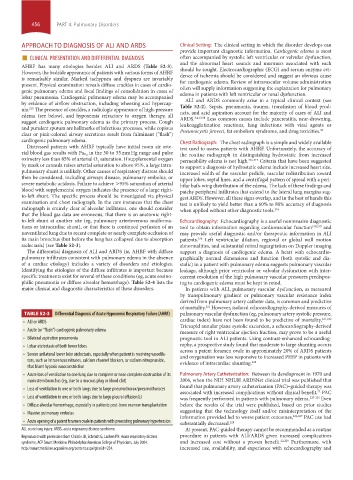
                   The differential diagnosis of ALI and ARDS (ie, AHRF with diffuse   support a diagnosis of cardiogenic edema. A heart with echocardio-
                 pulmonary infiltrates consistent with pulmonary edema in the absence   graphically  normal  dimensions  and  function  (both  systolic  and  dia-
                 of a cardiac etiology) includes a variety of disorders and etiologies.   stolic) in a patient with pulmonary edema suggests pulmonary vascular
                 Identifying the etiologies of the diffuse infiltrates is important because   leakage, although prior ventricular or valvular dysfunction with inter-
                 specific treatments exist for several of these conditions (eg, acute eosino-  current resolution of the high pulmonary vascular pressures predispos-
                 philic pneumonia or diffuse alveolar hemorrhage). Table 52-4 lists the   ing to cardiogenic edema must be kept in mind.
                 major clinical and diagnostic characteristics of these disorders.  In patients with ALI, pulmonary vascular dysfunction, as measured
                                                                       by transpulmonary gradient or pulmonary vascular resistance index
                                                                       derived from pulmonary artery catheter data, is common and predictive
                                                                       of mortality.  However, isolated echocardiography-derived measures of
                                                                                221
                   TABLE 52-3    Differential Diagnosis of Acute Hypoxemic Respiratory Failure (AHRF)  pulmonary vascular dysfunction (eg, pulmonary artery systolic pressure,
                  •  ALI or ARDS                                       cardiac index) have not been found to be predictive of mortality, 221,222
                                                                       Tricuspid annular plane systolic excursion, a echocardiography-derived
                  •  Acute (or “flash”) cardiogenic pulmonary edema
                                                                       measure of right ventricular ejection fraction, may prove to be a useful
                  •  Bilateral aspiration pneumonia                    prognostic tool in ALI patients. Using contrast-enhanced echocardiog-
                  •  Lobar atelectasis of both lower lobes             raphy, a prospective study found that moderate to large shunting occurs
                                                                       across a patent foramen ovale in approximately 20% of ARDS patients
                  •  Severe unilateral lower lobe atelectasis, especially when patient is receiving vasodila-  and oxygenation was less responsive to increased PEEP in patients with
                   tors, such as intravenous nitrates, calcium channel blockers, or sodium nitroprusside,   evidence of intracardiac shunting. 220
                   that blunt hypoxic vasoconstriction
                  •  Acute loss of ventilation to one lung due to complete or near-complete obstruction of its   Pulmonary Artery Catheterization:  Between its development in 1970 and
                   main stem bronchus (eg, due to a mucous plug or blood clot)  2006, when the NIH NHLBI ARDSNet clinical trial was published that
                                                                       found that pulmonary artery catheterization (PAC)–guided therapy was
                  •  Loss of ventilation to one or both lungs due to large pneumothorax/pneumothoraces
                                                                       associated with increased complications without clinical benefit,  PAC
                                                                                                                      22
                  •  Loss of ventilation to one or both lungs due to large pleural effusion(s)  was frequently performed in patients with pulmonary edema. 223-225  Even
                  •  Diffuse alveolar hemorrhage, especially in patients post-bone marrow transplantation  before the results of the trial were published, based on prior studies
                  •  Massive pulmonary embolus                         suggesting that the technology itself and/or misinterpretation of the
                                                                       information provided led to worse patient outcomes, 226,227  PAC use had
                  •  Acute opening of a patent foramen ovale in patients with preexisting pulmonary hypertension  substantially decreased. 228
                 ALI, acute lung injury; ARDS, acute respiratory distress syndrome.  At present, PAC-guided therapy cannot be recommended as a routine
                 Reproduced with permission from Christie JD, Schmidt G, Lanken PN: Acute respiratory distress   procedure in patients with ALI/ARDS given increased complications
                   syndrome, ACP Smart Medicine, Philadelphia:American College of Physicians, July 2004.    and increased cost without a proven benefit. 22,229  Furthermore, with
                 http://smartmedicine.acponline.org/content.aspx?gbosid=234.  increased use, availability, and experience with echocardiography and


            section04.indd   456                                                                                       1/23/2015   2:19:40 PM

