


Page 64 - Hall et al (2015) Principles of Critical Care-McGraw-Hill
P. 64
CHAPTER 5: Preventing Morbidity in the ICU   33


                        Basic        Human       Knowledge                  2. Identify local barriers to practice compliance: Once key inter-
                      Biomedical     Clinical    Translation                  ventions are identified, the next step is to actively investigate and
                      Research      Research      Research                    remedy local barriers to effective implementation (walking through
                                                                Improved      the process). This is achieved by attempting to implement the prac-
                                                                 Health       tice (documenting all necessary steps), observing others doing it,
                    Understanding  Identifying  Ensuring patients             and asking them about difficulties. Such a process can reveal where
                       disease      effective    get the right                defects are likely to occur or where specific systems do not support
                       biology      therapies     therapies
                                                                              evidence-based practice—in short, identifying why it is sometimes
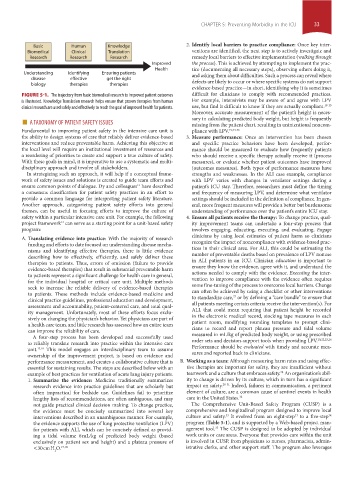
                    FIGURE 5-1.  The trajectory from basic biomedical research to improved patient outcomes   difficult for clinicians to comply with recommended practices.
                    is illustrated. Knowledge Translation research helps ensure that proven therapies from human   For  example,  intensivists  may  be  aware  of  and  agree  with  LPV
                    clinical research are used safely and effectively to reach the goal of improved health for patients.  use, but find it difficult to know if they are actually compliant. 19-25
                                                                              Moreover, accurate measurement of the patient’s height is neces-
                        ■  A TAXONOMY OF PATIENT SAFETY ISSUES                sary in calculating predicted body weight, but height is frequently
                                                                              missing from the patient chart, resulting in unintentional noncom-
                    Fundamental to improving patient safety in the intensive care unit is   pliance with LPV. 19,24-26
                    the ability to design systems of care that reliably deliver evidence-based     3. Measure performance: Once an intervention has been chosen
                    interventions and reduce preventable harm. Achieving this objective at   and specific practice behaviors have been developed, perfor-
                    the local level will require an institutional investment of resources and   mance should be measured to evaluate how frequently patients
                    a reordering of priorities to create and support a true culture of safety.   who should receive a specific therapy actually receive it (process
                    With these goals in mind, it is imperative to use a systematic and multi-  measures), or evaluate whether patient outcomes have improved
                    disciplinary approach and involve all stakeholders.       (outcomes measures). Both types of performance measures have
                     In strategizing such an approach, it will help if a conceptual frame-  strengths and weaknesses. In the ALI case example, compliance
                    work of safety issues and solutions is created to guide team efforts and   with LPV varies with changes in ventilator settings during a
                    ensure common points of dialogue. Dy and colleagues  have described   patient’s ICU stay. Therefore, researchers must define the timing
                                                           13
                    a consensus classification for patient safety practices in an effort to   and frequency of measuring LPV, and determine what ventilator
                    provide  a  common  language  for  interpreting  patient  safety  literature.   settings should be included in the definition of compliance. In gen-
                    Another approach, categorizing patient safety efforts into general   eral, more frequent measures will provide a better but burdensome
                    themes, can be useful in focusing efforts to improve the culture of   understanding of performance over the patient’s entire ICU stay.
                    safety within a particular intensive care unit. For example, the following     4. Ensure all patients receive the therapy: To change practice, qual-
                    project framework  can serve as a starting point for a unit-based safety   ity improvement teams can undertake a four-step process that
                                 14
                    program:                                                  involves engaging, educating, executing, and evaluating.  Engage
                    A. Translating evidence into practice: With the majority of research   clinicians by using local estimates of patient harm so clinicians
                      funding and efforts to date focused on understanding disease mecha-  recognize the impact of noncompliance with evidence-based prac-
                      nisms and identifying effective therapies, there is little evidence   tices in their clinical area. For ALI, this could be estimating the
                      describing how to effectively, efficiently, and safely deliver these   number of preventable deaths based on prevalence of LPV nonuse
                      therapies to patients. Thus, errors of omission (failure to provide   in ALI patients in an ICU. Clinician  education is important to
                      evidence-based therapies) that result in substantial preventable harm   ensure they know the evidence, agree with it, and understand the
                      to patients represent a significant challenge for health care in general,   actions needed to comply with the evidence. Executing the inter-
                      for the individual hospital or critical care unit. Multiple methods   vention to improve compliance with the evidence often requires
                      seek to increase the reliable delivery of evidence-based therapies   some fine-tuning of the process to overcome local barriers. Change
                      to patients. These methods include evidence-based medicine and   can often be achieved by using a checklist or other interventions
                                                                                            27
                      clinical practice guidelines, professional education and development,   to standardize care,  or by defining a “care bundle” to ensure that
                      assessment and accountability, patient-centered care, and total qual-  all patients meeting certain criteria receive the intervention(s). For
                      ity management. Unfortunately, most of these efforts focus exclu-  ALI, that could mean requiring that patient height be recorded
                      sively on changing the physician’s behavior. Yet physicians are part of   in the electronic medical record, stocking tape measures in each
                      a health care team, and little research has assessed how an entire team   patient room, modifying rounding templates to prompt clini-
                      can improve the reliability of care.                    cians to record and report plateau pressure and tidal volume
                       A four-step process has been developed and successfully used   measured in mL/kg of predicted body weight, or using prescribed
                                                                                                                        20,22,25,26
                      to reliably translate research into practice within the intensive care   order sets and decision-support tools when providing LPV.
                      unit. 15,16   This  model  engages  an  interdisciplinary  team  to  assume   Performance should be evaluated with timely and accurate mea-
                      ownership of the improvement project, is based on evidence and   sures and reported back to clinicians.
                      performance measurement, and creates a collaborative culture that is   B.  Working as a team: Although measuring harm rates and using effec-
                      essential for sustaining results. The steps are described below with an   tive therapies are important for safety, they are insufficient without
                                                                                                            28
                      example of best practices for ventilation of acute lung injury patients.  teamwork and a culture that embraces safety.  An organization’s abil-
                      1. Summarize the evidence: Medicine traditionally summarizes   ity to change is driven by its culture, which in turn has a significant
                        research evidence into practice guidelines that are scholarly but   impact on safety. 29-31  Indeed, failures in communication, a pertinent
                        often  impractical  for  bedside  use.  Guidelines  fail  to  prioritize   element of culture, are a common cause of sentinel events in health
                        lengthy lists of recommendations, are often ambiguous, and may   care in the United States. 32
                        not guide practical clinical decision making. To change practice,   The Comprehensive Unit-Based Safety Program (CUSP) is a
                        the evidence must be concisely summarized into several key   comprehensive and longitudinal program designed to improve local
                                                                                         33
                                                                                                                 33
                                                                                                                            34
                        interventions described in an unambiguous manner. For example,   culture and safety.  It evolved from an eight-step  to a five-step
                        the evidence supports the use of lung protective ventilation (LPV)   program (Table 5-1), and is supported by a Web-based project man-
                                                                                      35
                        for patients with ALI, which can be concisely defined as provid-  agement tool.  The CUSP is designed to be adopted by individual
                        ing a tidal volume 6 mL/kg of predicted body weight (based   work units or care areas. Everyone that provides care within the unit
                        exclusively on patient sex and height) and a plateau pressure of   is involved in CUSP, from physicians to nurses, pharmacists, admin-
                        <30 cm H O. 17,18                                   istrative clerks, and other support staff. The program also leverages
                               2


            Section01.indd   33                                                                                        1/22/2015   9:36:50 AM

