


Page 648 - Hall et al (2015) Principles of Critical Care-McGraw-Hill
P. 648
CHAPTER 52: Acute Lung Injury and the Acute Respiratory Distress Syndrome  467


                    Inhaled Nitric Oxide and Inhaled Prostacyclin (Epoprostenol)  Since Roissant and   A  I  Expiration  I  Expiration
                    colleagues published their initial experience using inhaled nitric oxide
                    as a therapy for ARDS, there has been a rapid expansion of interest
                    and literature in this field. 328-333  Given via inhalation, NO has several   Pprox
                    potentially salutary effects in ARDS. It selectively vasodilates pulmo-  0  Applied-PEEP −
                    nary capillaries and arterioles that subserve ventilated alveoli, diverting
                    blood flow to these alveoli (and away from areas of shunting). The
                    vasodilating effect, signaled by a fall in pulmonary artery pressure and
                    pulmonary vascular resistance, appears maximal at very low concentra-
                    tions (0.1 ppm) in patients with ARDS.  The beneficial effects on oxy-  Flow  0
                                                332
                    genation take place at somewhat higher inspired concentrations of NO
                    (1-10 ppm).  The rapid inactivation of NO via hemoglobin binding
                            332
                    prevents unwanted systemic hemodynamic side effects, but also man-
                    dates the continuous delivery of gas to the ventilator circuit. Thus, if   1.0
                    continuous delivery of NO is interrupted (eg, during patient transport   Volume (L)  above FRC
                    or due to supply exhaustion), precipitous and life-threatening hypox-  0.5  PEEP-induced  FRC −
                                                     334
                    emia and right-sided heart failure may occur.  A recent large clinical   0
                    trial compared the use of NO to placebo in subjects with ALI not due
                    to sepsis, with no other organ failures.  The trial showed no benefit
                                                335
                    in survival with use of NO despite some patients having a transient   B
                    improvement in oxygenation. Trials in other subgroups of ALI may be   I  E    I     E
                    the focus of future investigations, but there is no consensus evidence
                    for routine use of NO in ALI.                             Pprox
                     Even as a salvage intervention, inhaled NO is unattractive since there   0
                    is a reasonable alternative available at much less expense. Whereas the
                    cost of inhaled NO for 1 day is in the thousands of dollars, the daily
                    cost of inhaled prostacyclin (epoprostenol) is in the hundreds of dollars.
                    Inhaled prostacyclin, although less well studied, appears to provide the
                    same degree of improvement in oxygenation in a majority of patients
                    with ALI and ARDS at much less expense. 336-339           Flow  0
                    Corticosteroids  Although it is commonly accepted that steroids have little
                    or no role to play in treating the early acute phase of ARDS, 340,341  their
                    role in later phases remains controversial. A number of anecdotal reports
                    and small series have suggested that high-dose corticosteroids may be of
                    some benefit during the proliferative phase of ARDS. 342-344  The rationale   1.0
                    behind this therapy is that much of the scarring that occurs during this   Volume (L)  above FRC  0.5  Dynamic hyperinflation −
                    phase of the illness is a consequence of unattentuated inflammation that   0  PEEP-induced  FRC −
                    can cause severe damage to the affected alveoli.  There is an obvious
                                                       345
                    risk, however, of administering an immunosuppressant to already debili-  FIGURE 52-10.  Schematic pressure, flow, and volume waveforms during pressure control
                    tated patients who are still in an environment in which they are exposed   ventilation (PCV) with applied PEEP. A. The inspiratory-to-expiratory (I:E) time is about 1:2. The
                    to multiple resistant organisms (and frequently have multiple indwell-  pressure waveform resembles pressure support mode with the patient triggering each breath, but
                    ing appliances), as well as a potential risk for long-term neuromuscular   with a marked decelerating flow pattern. The applied PEEP increases the functional residual capac-
                    sequelae. The NHLBI ARDSNet conducted a double-blind RCT (Late   ity (FRC) by about 500 mL (PEEP-induced ΔFRC). B. In pressure-controlled inverse ratio ventilation
                    Steroid Rescue Study or LaSRS) designed to evaluate the benefits and   (PC-IRV), the I:E time is “reversed,” with I > E. Because of this, the next breath starts before expira-
                    risks of this therapy in 180 patients with ARDS lasting 7 to 21 days. The   tory flow has returned to zero (open arrows), resulting in auto-PEEP and dynamic hyperinflation of
                    study found that high-dose methylprednisolone succinate (MPSS) was   about 300 mL. The latter is in addition to the increased FRC due to the applied PEEP (PEEP-induced
                    associated with improved oxygenation, increased shock-free days and   ΔFRC). The patient is not initiating any breaths. E, expiration; I, inspiration; PEEP, positive end-
                    ventilator-free days, but there was no difference in 60-day or 180-day   expiratory pressure; Pprox, pressure at the proximal end of the endotracheal tube. (Reproduced
                    mortality.  MPSS was not associated with an increased rate of infec-  with permission from Lanken PN. Acute respiratory distress syndrome. In: Lanken PN, Hanson
                           346
                    tious complications; however, it was associated with an increased rate of   CW III, Manaker S, eds. The Intensive Care Unit Manual. Philadelphia, PA: WB Saunders; 2001:829.)
                    neuromuscular weakness and, in the subgroup of patients enrolled 14 or
                    more days after ALI onset, MPSS was associated with increased 60-day
                    and 180-day mortality. As such, corticosteroids should not be routinely   Although one could possibly mimic the tidal volumes and end-
                    used in either phase of ARDS.                         inspiratory pressures that were used in the ARDSNet low-tidal-volume
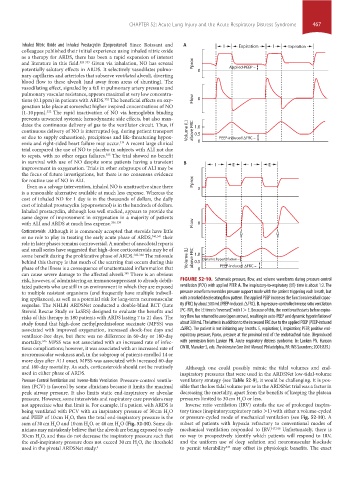
                    Pressure-Control Ventilation and Inverse-Ratio Ventilation  Pressure-control ventila-  ventilatory strategy (see Table 52-9), it would be challenging. It is pos-
                    tion (PCV) is favored by some clinicians because it limits the maximal   sible that the low tidal volume per se in the ARDSNet trial was a factor in
                    peak airway pressure. It also limits static end-inspiratory or alveolar   decreasing the mortality, apart from the benefits of keeping the plateau
                    pressure. However, some intensivists and respiratory care providers may   pressures limited to 30 cm H O or less.
                                                                                              2
                    not appreciate what that limit is. For example, if a patient with ARDS is   Inverse ratio ventilation (IRV) entails the use of prolonged inspira-
                    being ventilated with PCV with an inspiratory pressure of 30 cm H O   tory times (inspiratory:expiratory ratio >1) with either a volume-cycled
                                                                     2
                    and PEEP of 10 cm H O, then the total end-inspiratory pressure is the   or pressure-cycled mode of mechanical ventilation (see Fig. 52-10). A
                                    2
                    sum of 30 cm H O and 10 cm H O, or 40 cm H O (Fig. 52-10). Some cli-  subset  of patients with  hypoxia  refractory to conventional modes of
                                                     2
                               2
                                          2
                    nicians may mistakenly believe that the alveoli are being exposed to only   mechanical ventilation responded to IRV. 347,348  Unfortunately, there is
                    30 cm H O, and thus do not decrease the inspiratory pressure such that   no way to prospectively identify which patients will respond to IRV,
                          2
                    the end-inspiratory pressure does not exceed 30 cm H O, the threshold   and the uniform use of deep sedation and neuromuscular blockade
                                                           2
                                                                                         347
                    used in the pivotal ARDSNet study. 3                  to permit tolerability  may offset its physiologic benefits. The exact

            section04.indd   467                                                                                       1/23/2015   2:19:48 PM

