


Page 652 - Hall et al (2015) Principles of Critical Care-McGraw-Hill
P. 652
CHAPTER 53: Extracorporeal Lung Support  471


                      TABLE 53-1     Respiratory Conditions Requiring ECMO for Severe Hypoxemia  TYPES OF EXTRACORPOREAL LUNG SUPPORT
                    Bacterial pneumonia                                       ■  ECMO
                    Viral pneumonia
                                                                          ECMO is a pump-driven, veno-venous, or veno-arterial circuit with an
                    Aspiration pneumonitis                                oxygenator to provide both oxygenation and ventilation.
                    Aspiration pneumonia
                    Acute respiratory distress syndrome                       ■  EXTRACORPOREAL CO  REMOVAL
                                                                                           2
                    Pulmonary embolus                                     Selective CO  removal can be accomplished with low blood flow rates
                                                                                   2
                                                                          (10 cc/kg/min) with the device attached with arteriovenous access (arte-
                        ■  INCREMENTAL APPROACH TO THE MANAGEMENT         rial cannula inserted into femoral artery, membrane oxygenator with
                      OF PATIENTS WITH SEVERE HYPOXEMIA                   venous cannula return to femoral vein, driving force is patient’s blood
                                                                          pressure).
                                                                                    A potential complication is distal limb ischemia in the
                                                                                 27-31
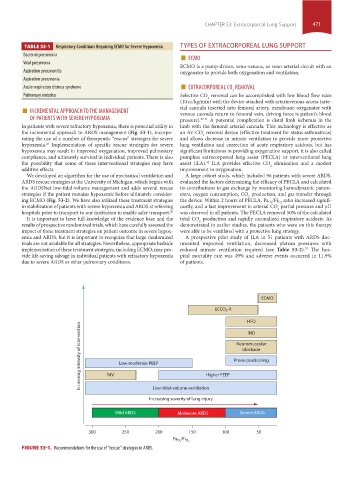
                    In patients with severe refractory hypoxemia, there is potential utility in   limb with the femoral arterial cannula. This technology is effective as
                    the incremental approach to ARDS management (Fig. 53-1), incorpo-  an AV-CO  removal device (effective treatment for status asthmaticus)
                                                                                 2
                    rating the use of a number of therapeutic “rescue” strategies for severe   and allows decrease in minute ventilation to provide more protective
                    hypoxemia.  Implementation of specific rescue strategies for severe   lung ventilation and correction of acute respiratory acidosis, but has
                            25
                    hypoxemia may result in improved oxygenation, improved pulmonary   significant limitations in providing oxygenation support. It is also called
                    compliance, and ultimately survival in individual patients. There is also   pumpless extracorporeal lung assist (PECLA) or interventional lung
                    the possibility that some of these interventional strategies may have   assist (iLA).  ILA provides effective CO  elimination and a modest
                                                                                   32
                                                                                                        2
                    additive effects.                                     improvement in oxygenation.
                     We developed an algorithm for the use of mechanical ventilation and   A large cohort study, which included 96 patients with severe ARDS,
                    ARDS rescue strategies at the University of Michigan, which begins with   evaluated the factors determining the efficacy of PECLA and calculated
                    the ARDSNet low-tidal-volume management and adds several rescue   its contributions to gas exchange by monitoring hemodynamic param-
                    strategies if the patient remains hypoxemic before ultimately consider-  eters, oxygen consumption, CO  production, and gas transfer through
                                                                                                 2
                    ing ECMO (Fig. 53-2). We have also utilized these treatment strategies   the device. Within 2 hours of PECLA, Pa O 2 /Fi O 2  ratio increased signifi-
                    in stabilization of patients with severe hypoxemia and ARDS at referring   cantly, and a fast improvement in arterial CO  partial pressure and pH
                                                                                                           2
                    hospitals prior to transport to our institution to enable safer transport. 26  was observed in all patients. The PECLA removed 50% of the calculated
                     It is important to have full knowledge of the evidence base and the   total CO  production and rapidly normalized respiratory acidosis. As
                                                                                2
                    results of prospective randomized trials, which have carefully assessed the   demonstrated in earlier studies, the patients who were on this therapy
                    impact of these treatment strategies on patient outcome in severe hypox-  were able to be ventilated with a protective lung strategy.
                    emia and ARDS, but it is important to recognize that large randomized   A prospective pilot study of ILA in 51 patients with ARDS doc-
                    trials are not available for all strategies. Nevertheless, appropriate bedside   umented improved  ventilation,  decreased  plateau  pressures with
                    implementation of these treatment strategies, including ECMO, may pro-  reduced minute ventilation required (see  Table 53-2).  The hos-
                                                                                                                    33
                    vide life-saving salvage in individual patients with refractory hypoxemia   pital mortality rate was 49% and adverse events occurred in 11.9%
                    due to severe ARDS or other pulmonary conditions.     of patients.


                                                                                                     ECMO

                                                                                     ECCO -R
                                                                                         2
                                                                                                HFO
                                        Increasing intensity of intervention  NIV  Low-moderate PEEP  Higher PEEP  Prone positioning
                                                                                                 iNO
                                                                                             Neuromuscular
                                                                                               blockade


                                                                Low-tidal-volume ventilation
                                                               Increasing severity of lung injury

                                                   Mild ARDS             Moderate ARDS        Severe ARDS


                                          300         250        200        150         100         50
                                                                       Pa /Fi
                                                                         O 2  O 2
                    FIGURE 53-1.  Recommendations for the use of “rescue” strategies in ARDS.


            section04.indd   471                                                                                       1/23/2015   2:19:50 PM

