


Page 653 - Hall et al (2015) Principles of Critical Care-McGraw-Hill
P. 653
472     PART 4: Pulmonary Disorders


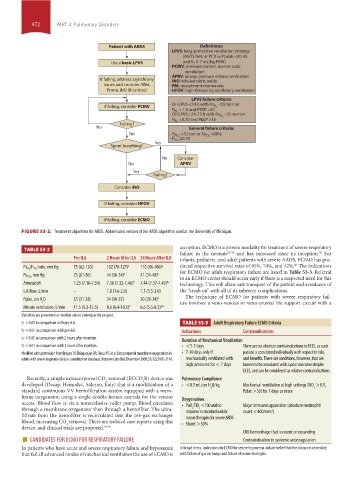
                                               Patient with ARDS              Definitions:
                                                                    - LPVS: lung-protective ventilation strategy
                                                                                  (ARDS Net, or PCV w/Ppeak <30-35
                                                Use a basic LPVS                  and V T  5-7 mL/kg PBW)
                                                                    - PCIRV: pressure control, inverse ratio
                                                                                    ventilation
                                                                    - APRV: airway pressure release ventilation
                                            If failing, address asynchrony  - iNO: inhaled nitric oxide
                                             issues and consider: RMs,  - RM: recruitment maneuvers
                                              Prone, iNO (if cardiac)  - HFOV: high-frequency oscillatory ventilation
                                                                           LPVS failure criteria:
                                             If failing, consider PCIRV  - On LPVS <24 h with Pa O 2  <55 torr on
                                                                        = 1.0 and PEEP >20
                                                                      Fi O 2
                                                                                       <55 torr on
                                                                    - On LPVS >24-72 h with Pa O 2
                                                                        >0.70 and PEEP >15
                                                                      Fi O 2
                                                   Failing?
                                           No                             General failure criteria:
                                                      Yes                         <88%
                                                                    - Pa O 2  <55 torr or Sp O 2
                                                                        ≥0.70
                                                                    - Fi O 2
                                                               Yes
                                                Spont breathing?
                                                                 No   Consider
                                                      No               APRV
                                                       Yes
                                                              Failing?
                                                 Consider iNO
                                             If failing, consider HFOV


                                             If failing, consider ECMO
                 FIGURE 53-2.  Treatment algorithm for ARDS. Abbreviated version of the ARDS algorithm used at the University of Michigan.

                                                                       an option. ECMO is a proven modality for treatment of severe  respiratory
                   TABLE 53-2
                                                                       failure in the neonate 37,38  and has increased since its inception.  For
                                                                                                                       39
                                   Pre-ILA    2 Hours After ILA 24 Hours After ILA  infants, pediatric, and adult patients with severe ARDS, ECMO has pro-
                                                                                                              40
                       ratio, mm Hg  75 (62-130)  102 (70-127) a  110 (86-160) a  duced respective survival rates of 85%, 74%, and 52%.  The indications
                  Pa O 2 /Fi O 2
                                                                       for ECMO for adult respiratory failure are listed in Table 53-3. Referral
                    , mm Hg        73 (61-86)  44 (36-54) b  41 (34-48) b
                                                                       to an ECMO center should occur early if there is a suspected need for this
                  Pa CO 2
                  Arterial pH      7.23 (7.16-7.30)  7.38 (7.32-7.46) b  7.44 (7.37-7.49) b,c  technology. This will allow safe transport of the patient and avoidance of
                  iLA flow, L/min  –          1.8 (1.6-2.0)  1.7 (1.5-2.0)  the “crash on” with all of its inherent complications.
                                                                         The technique of ECMO for patients with severe respiratory fail-
                  Pplat, cm H O    35 (31-38)  34 (30-37)  30 (26-34) b
                        2                                              ure involves a veno-venous or veno-arterial life support circuit with a
                  Minute ventilation, L/min  11.5 (9.3-12.5)  8.6 (6.4-10.5) b  6.6 (5.5-8.3) b,d
                 Variables are presented as median values (interquartile ranges).
                 a p <0.05 in comparison with pre-iLA.                   TABLE 53-3    Adult Respiratory Failure ECMO Criteria
                 b p <0.01 in comparison with pre-iLA.                  Indications          Contraindications
                 c p <0.05 in comparison with 2 hours after insertion.  Duration of Mechanical Ventilation
                 d p <0.01 in comparison with 2 hours after insertion.  •  <5-7 days         There are no absolute contraindications to ECLS, as each
                 Modified with permission from Brogan TV, Thiagarajan RR, Rycus PT, et al. Extracorporeal membrane  oxygenation in   •  7-10 days only if    patient is considered individually with respect to risks
                 adults with severe respiratory failure: a multicenter database. Intensive Care Med. December 2009;35(12):2105-2114.  mechanically ventilated with   and benefits. There are conditions, however, that are
                                                                         high pressures for < 7 days  known to be associated with a poor outcome despite
                                                                                             ECLS, and can be considered as relative contraindications
                   Recently, a simple extracorporeal CO  removal (ECCO R) device was   Pulmonary Compliance
                                                          2
                                              2
                 developed (Decap, Hemodec, Salerno, Italy) that is a modification of a   •  <0.5 mL/cm H O/kg  Mechanical ventilation at high settings (FiO  >0.9,
                 standard continuous VV hemofiltration system equipped with a mem-  2        Pplat >30) for 7 days or more  2
                 brane oxygenator, using a single double-lumen cannula for the venous   Oxygenation
                 access. Blood flow is via a nonocclusive roller pump. Blood circulates   •  PaO /FiO  <100 and no    Major immunosuppression (absolute neutrophil
                                                                              2
                                                                           2
                 through a membrane oxygenator then through a hemofilter. The ultra-  response to standard and/or    count <400/mm ) 3
                 filtrate from the hemofilter is recirculated into the pre-gas exchanger   rescue therapies for severe ARDS
                 blood, increasing CO  removal. There are isolated case reports using this   •  Shunt >30%
                                2
                 device, and clinical trials are proposed. 34-36                             CNS hemorrhage that is recent or expanding
                     ■  CANDIDATES FOR ECMO FOR RESPIRATORY FAILURE                          Contraindication to systemic anticoagulation
                 In patients who have acute and severe respiratory failure and hypoxemia   In broad terms, indications for ECMO for severe hypoxemia include belief that the disease is reversible,
                 that fail all advanced modes of mechanical ventilation the use of ECMO is   with failure of gas exchange and failure of rescue strategies.


            section04.indd   472                                                                                       1/23/2015   2:19:51 PM

