


Page 644 - Hall et al (2015) Principles of Critical Care-McGraw-Hill
P. 644
CHAPTER 52: Acute Lung Injury and the Acute Respiratory Distress Syndrome  463


                                                                          conventional ventilation (see Table 52-6), it was unclear which interven-
                          Priority of higher       Priority of lower PEEP
                       PEEP ventilatory approach   ventilatory approach   tion or combination of interventions was responsible for the observed
                         To keep alveoli open      To decrease the risk of  improvement. Was the lower mortality due to the low-tidal-volume
                        during respiratory cycle   ventilator-induced lung  ventilatory strategy, the higher-than-traditional levels of PEEP, or the
                        and prevent lung injury      injury (VILI) due to  recruitment maneuvers, or a combination of two or all three?
                           due to repeated         overdistension of alveoli  To try to answer these questions, which had also been raised in an
                         opening and closing         during inspiration   earlier report by Amato and colleagues,  the NHLBI ARDSNet investi-
                                                                                                      276
                           (”atelectrauma”)                               gators decided to study one intervention at a time in separate RCTs. As
                                                                          noted above, the first ARDSNet RCT compared a lower-tidal-volume
                                                                          ventilatory strategy to a strategy using traditional tidal volumes.  This
                                                                                                                         3
                                                                          RCT found a significant decrease in mortality in the group treated
                          Use higher PEEP ±         Use low tidal volumes  with the lower-tidal-volume ventilatory strategy (see Table 52-6). After
                           add recruitment          with traditional levels  completion of this RCT, the ARDSNet investigators conducted a second
                            maneuvers                    of PEEP
                                                                          RCT (ALVEOLI) to try to answer the question: When used in addition
                                                                          to the lower-tidal-volume strategy of ventilation, do higher PEEP levels
                                                                          improve survival?
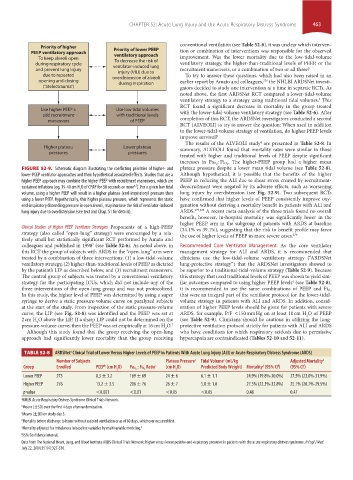
                                                                           The results of the ALVEOLI study  are presented in Table 52-8. In
                                                                                                     4
                           Higher plateau             Lower plateau       summary,  ALVEOLI  found  that  mortality  rates  were  similar  in  those
                             pressures                  pressures
                                                                          treated with higher and traditional levels of PEEP despite significant
                                                                                          . The higher-PEEP group had a higher mean
                                                                          increases in Pa O 2  : Fi O 2
                    FIGURE 52-9.  Schematic diagram illustrating the conflicting priorities of higher- and   plateau pressure despite a lower mean tidal volume (see Table 52-8).
                    lower-PEEP ventilator approaches and their hypothetical associated effects. Studies that use a   Although hypothetical, it is possible that the benefits of the higher
                    higher PEEP approach may combine the higher PEEP with recruitment maneuvers, which are   PEEP in reducing the ALI due to shear stress created by recruitment-
                    sustained inflations (eg, 35-40 cm H O of CPAP for 30 seconds or more ). For a given low tidal   derecruitment were negated by its adverse effects, such as worsening
                                                          4,7
                                       2
                    volume, using a higher PEEP will result in a higher plateau (end-inspiratory) pressure than   lung injury by overdistension (see  Fig.  52-9). Two subsequent RCTs
                    using a lower PEEP. Hypothetically, this higher plateau pressure, which represents the static   have confirmed that higher levels of PEEP consistently improve oxy-
                    end-inspiratory distending pressure in open alveoli, may increase the risk of ventilator-induced   genation without deriving a mortality benefit in patients with ALI and
                    lung injury due to overdistension (see text and Chap. 51 for details).  ARDS. 277,278  A recent meta-analysis of the three trials found no overall
                                                                          benefit; however, in-hospital mortality was significantly lower in the
                                                                          higher PEEP arm in the subgroup of patients with ARDS at baseline
                    Clinical Studies of Higher PEEP Ventilator Strategies  Proponents of a high-PEEP   (34.1% vs 39.1%), suggesting that the risk to benefit profile may favor
                    strategy (also called “open-lung” strategy) were encouraged by a rela-  the use of higher levels of PEEP in more severe cases. 279
                    tively small but statistically significant RCT performed by Amato and
                    colleagues and published in 1998  (see Table 52-6). As noted above, in   Recommended Core Ventilator Management:  As the core ventilator
                                            7
                    this RCT the group of subjects with ARDS in the “open-lung” arm were   management strategy for ALI and ARDS, it is recommended that
                    treated by a combination of three interventions: (1) a low-tidal-volume   clinicians use the low-tidal-volume ventilatory strategy (“ARDSNet
                    ventilatory strategy, (2) higher-than-traditional levels of PEEP as dictated   lung- protective strategy”) that the ARDSNet investigators showed to
                    by the patient’s LIP as described below, and (3) recruitment maneuvers.   be superior to a traditional-tidal-volume strategy (Table 52-9). Because
                    The control group of subjects was treated by a conventional ventilatory   this strategy that used traditional levels of PEEP was shown to yield sim-
                    strategy for the participating ICUs, which did not include any of the     ilar outcomes compared to using higher PEEP levels  (see Table 52-8),
                                                                                                                4
                    three interventions of the open-lung group and was not protocolized.   it  is  recommended to  use  the  same  combinations of  PEEP  and  Fi O 2
                    In this study, the higher level of PEEP was determined by using a super   that were an integral part of the ventilator protocol for the lower-tidal-
                    syringe to derive a static pressure-volume curve on paralyzed subjects   volume strategy in patients with ALI and ARDS. In addition, consid-
                    at the start of the study. From inspection of the static pressure-volume   eration of higher PEEP levels should be given for patients with severe
                    curve, the LIP (see Fig. 52-8) was identified and the PEEP was set at     ARDS, for example, P/F <150 mm Hg on at least 10 cm H O of PEEP
                                                                                                                     2
                    2 cm H O above the LIP. If a sharp LIP could not be determined on the   (see  Table  52-9). Clinicians should be cautious in utilizing the lung-
                         2
                    pressure-volume curve, then the PEEP was set empirically at 16 cm H O. 7  protective ventilation protocol strictly for patients with ALI and ARDS
                                                                     2
                     Although this study found that the group receiving the open-lung   who have conditions for which respiratory acidosis due to permissive
                    approach had significantly lower mortality than the group receiving   hypercapnia are contraindicated (Tables 52-10 and 52-11).
                      TABLE 52-8    ARDSNet  Clinical Trial of Lower Versus Higher Levels of PEEP in Patients With Acute Lung Injury (ALI) or Acute Respiratory Distress Syndrome (ARDS)
                                    a
                               Number of Subjects                    Plateau Pressure   Tidal Volume  (mL/kg   Adjusted Mortality   e
                                                                               c
                                                                                        c
                                                                                                      d
                                                b
                    Group      Enrolled      PEEP  (cm H O)    Ratio c  (cm H O)  Predicted Body Weight) Mortality  (95% CI ) f  (95% CI ) f
                                                    2   Pa O 2  : Fi O 2  2
                    Lower PEEP  273          8.3 ± 3.2  169 ± 69     24 ± 6      6.1 ± 1.1      24.9% (19.8%-30.0%)  27.5% (23.0%-31.9%)
                    Higher PEEP  276         13.2 ± 3.5  206 ± 76    26 ± 7      5.8 ± 1.0      27.5% (22.3%-32.8%)  25.1% (20.7%-29.5%)
                    p value                  <0.001     <0.01        <0.05       <0.05          0.48           0.47
                    a NHLBI Acute Respiratory Distress Syndrome Clinical Trials Network.
                    b Means (±SD) over the first 4 days after randomization.
                    c Means (±SD) on study day 3.
                    d Mortality before discharge to home without assisted ventilation or as of 60 days, whichever occurred first.
                    e Mortality adjusted for imbalances in baseline variables by multivariable modeling. 4
                    f 95% Confidence interval.
                    Data from The National Heart, Lung, and Blood Institute ARDS Clinical Trials Network: higher versus lower positive end-expiratory pressures in patients with the acute respiratory distress syndrome. N Engl J Med.
                    July 22, 2004;351(4):327-336.


            section04.indd   463                                                                                       1/23/2015   2:19:46 PM

