


Page 70 - Hall et al (2015) Principles of Critical Care-McGraw-Hill
P. 70
CHAPTER 6: Assessing Cost-Effectiveness in the Intensive Care Unit  39


                                                                                    ProbabilityCost
                                                                                Alive

                                                    Inhaled nitric oxide


                                                                               Dead
                                  https://kat.cr/user/tahir99/

                                                                                Alive
                                                       Standard
                                                        Therapy


                                                                               Dead


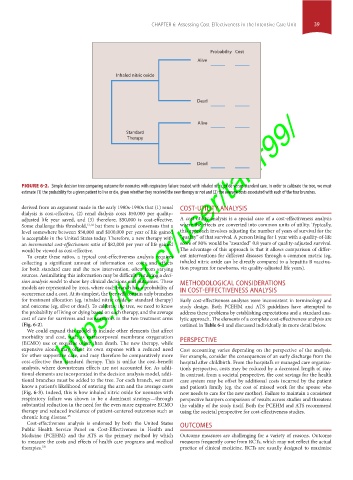
                    FIGURE 6-2.  Simple decision tree comparing outcome for neonates with respiratory failure treated with inhaled nitric oxide versus standard care. In order to calibrate the tree, we must
                    estimate (1) the probability for a given patient to live or die, given whether they received the new therapy or not and (2) the average costs associated with each of the four branches.

                    derived from an argument made in the early 1980s-1990s that (1) renal   COST-UTILITY ANALYSIS
                    dialysis is cost-effective, (2) renal dialysis costs $50,000 per quality-
                    adjusted life year saved, and (3) therefore, $50,000 is cost-effective.   A cost-utility analysis is a special case of a cost-effectiveness analysis
                    Some challenge this threshold, 13,14  but there is general consensus that a   where the effects are converted into common units of utility. Typically,
                    level somewhere between $50,000 and $100,000 per year of life gained   this approach involves adjusting the number of years of survival for the
                    is acceptable in the United States today. Therefore, a new therapy with   “quality” of that survival. A person living for 1 year with a quality-of-life
                    an incremental cost-effectiveness ratio of $82,000 per year of life gained   score of 80% would be “awarded” 0.8 years of quality-adjusted survival.
                    would be viewed as cost-effective.                    The advantage of this approach is that it allows comparison of differ-
                     To create these ratios, a typical cost-effectiveness analysis requires   ent interventions for different diseases through a common metric (eg,
                    collecting a significant amount of information on costs and effects   inhaled nitric oxide can be directly compared to a hepatitis B vaccina-
                    for both standard care and the new intervention, often from varying   tion program for newborns, via quality-adjusted life years).
                    sources. Assimilating this information may be difficult, requiring a deci-
                    sion analysis model to show key clinical decisions and outcomes. These   METHODOLOGICAL CONSIDERATIONS
                    models are represented by trees, where each branch has a probability of   IN COST-EFFECTIVENESS ANALYSIS
                    occurrence and a cost. At its simplest, the tree will contain only branches
                    for treatment allocation (eg, inhaled nitric oxide or standard therapy)   Early cost-effectiveness analyses were inconsistent in terminology and
                    and outcome (eg, alive or dead). To calibrate the tree, we need to know   study design. Both PCEHM and ATS guidelines have attempted to
                    the probability of living or dying based on each therapy, and the average   address these problems by establishing expectations and a standard ana-
                    cost of care for survivors and nonsurvivors in the two treatment arms   lytic approach. The elements of a complete cost-effectiveness analysis are
                    (Fig. 6-2).                                           outlined in Table 6-1 and discussed individually in more detail below.
                     We could expand this model to include other elements that affect
                    morbidity and cost, such as extracorporeal membrane oxygenation
                    (ECMO) use or sequelae other than death. The new therapy, while   PERSPECTIVE
                    expensive alone, may offset its own expense with a reduced need   Cost accounting varies depending on the perspective of the analysis.
                    for other supportive care, and may therefore be comparatively more   For example, consider the consequences of an early discharge from the
                    cost-effective than standard therapy. This is unlike the cost-benefit   hospital after childbirth. From the hospital’s or managed care organiza-
                    analysis, where downstream effects are not accounted for. As addi-  tion’s perspective, costs may be reduced by a decreased length of stay.
                    tional elements are incorporated in the decision analysis model, addi-  In contrast, from a societal perspective, the cost savings for the health
                    tional branches must be added to the tree. For each branch, we must   care system may be offset by additional costs incurred by the patient
                    know a patient’s likelihood of entering the arm and the average costs   and patient’s family  (eg, the  cost of missed work  for  the spouse who
                    (Fig. 6-3). Indeed, this is how inhaled nitric oxide for neonates with   now needs to care for the new mother). Failure to maintain a consistent
                    respiratory failure was shown to be a dominant strategy—through   perspective hampers comparison of results across studies and threatens
                    substantial reduction in the need for the even more expensive ECMO   the validity of the study itself. Both the PCEHM and ATS recommend
                    therapy and reduced incidence of patient-centered outcomes such as   using the societal perspective for cost-effectiveness studies.
                    chronic lung disease. 15
                     Cost-effectiveness analysis is endorsed by both the United States   OUTCOMES
                    Public Health Service Panel on Cost-Effectiveness in Health and
                    Medicine  (PCEHM)  and  the  ATS  as  the  primary  method  by  which   Outcome measures are challenging for a variety of reasons. Outcome
                    to measure the costs and effects of health care programs and medical   measures frequently come from RCTs, which may not reflect the actual
                    therapies. 7,8                                        practice of clinical medicine. RCTs are usually designed to maximize


            Section01.indd   39                                                                                        1/22/2015   9:36:53 AM

