


Page 71 - Hall et al (2015) Principles of Critical Care-McGraw-Hill
P. 71
40      PART 1: An Overview of the Approach to and Organization of Critical Care


                                 Patients                   Care Process                      Outcome
                                             Reference case    Base case
                                             Decision (yes/no) to  Decision (yes/no) to
                                             initiate iNO      initiate iNO
                                                                                                Alive; well

                                                                                                Alive with sequelae
                                                                           Yes                  Dead


                                https://kat.cr/user/tahir99/
                                                                           ECMO

                                                         Yes                                    Alive; well
                                                                           No
                                Term infants                                                    Alive with sequelae
                                with hypoxic
                                respiratory             Transfer to                             Dead
                                failure or             ECMO center
                                mechanical
                                ventilation

                                                         No
                                                                                                Alive; well
                                                                                                Alive with sequelae
                                                                                                Dead
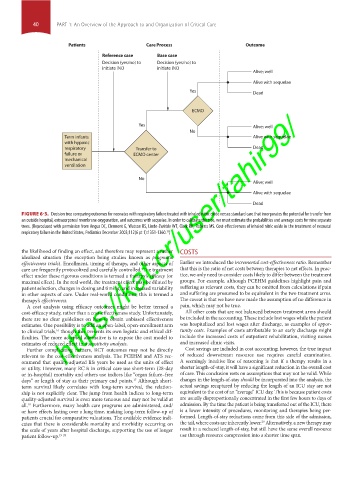
                 FIGURE 6-3.  Decision tree comparing outcomes for neonates with respiratory failure treated with inhaled nitric oxide versus standard care that incorporates the potential for transfer from
                 an outside hospital, extracorporeal membrane oxygenation, and outcomes with sequelae. In order to calibrate the tree, we must estimate the probabilities and average costs for nine separate
                 trees. (Reproduced with permission from Angus DC, Clermont G, Watson RS, Linde-Zwirble WT, Clark RH, Roberts MS. Cost-effectiveness of inhaled nitric oxide in the treatment of neonatal
                                                                   15
                 respiratory failure in the United States, Pediatrics December 2003;112(6 pt 1):1351-1360. )

                 the likelihood of finding an effect, and therefore may represent a rather   COSTS
                 idealized situation (the exception being studies known as  pragmatic
                 effectiveness trials). Enrollment, timing of therapy, and other aspects of   Earlier we introduced the incremental cost-effectiveness ratio. Remember
                 care are frequently protocolized and carefully controlled. The treatment   that this is the ratio of net costs between therapies to net effects. In prac-
                 effect under these rigorous conditions is termed a therapy’s efficacy (or   tice, we only need to consider costs likely to differ between the treatment
                 maximal effect). In the real world, the treatment effect may be diluted by   groups. For example, although PCEHM guidelines highlight pain and
                 patient selection, changes in dosing and timing, and increased variability   suffering as relevant costs, they can be omitted from calculations if pain
                 in other aspects of care. Under real-world conditions, this is termed a   and suffering are presumed to be equivalent in the two treatment arms.
                 therapy’s effectiveness.                              The caveat is that we have now made the assumption of no difference in
                   A cost analysis using efficacy outcomes might be better termed a   pain, which may not be true.
                 cost-efficacy study, rather than a cost-effectiveness study. Unfortunately,   All other costs that are not balanced between treatment arms should
                 there are no clear guidelines on how to obtain unbiased effectiveness   be included in the accounting. These include lost wages while the patient
                 estimates. One possibility is to add an open-label, open-enrollment arm   was hospitalized and lost wages after discharge, as examples of oppor-
                 to clinical trials,  though this presents its own logistic and ethical dif-  tunity costs. Examples of costs attributable to an early discharge might
                             16
                 ficulties. The more accepted alternative is to expose the cost model to   include the increased costs of outpatient rehabilitation, visiting nurses
                 estimates of reduced effect in a sensitivity analysis.  and increased clinic visits.
                   Further complicating matters, RCT outcomes may not be directly   Cost savings are included in cost accounting; however, the true impact
                 relevant to the cost-effectiveness analysis. The PCEHM and ATS rec-  of reduced downstream resource use  requires careful examination.
                 ommend that quality-adjusted life years be used as the units of effect   A  seemingly  intuitive  line  of  reasoning  is  that  if  a  therapy  results  in  a
                 or utility. However, many RCTs in critical care use short-term (28-day   shorter length-of-stay, it will have a significant reduction in the overall cost
                 or in-hospital) mortality and others use indices like “organ failure–free   of care. This conclusion rests on assumptions that may not be valid. While
                 days” or length of stay as their primary end points.  Although short-  changes in the length-of-stay should be incorporated into the analysis, the
                                                       17
                 term survival likely correlates with long-term survival, the relation-  actual savings recaptured by reducing the length of an ICU stay are not
                 ship is not explicitly clear. The jump from health indices to long-term   equivalent to the cost of an “average” ICU day. This is because patient costs
                 quality-adjusted survival is even more tenuous and may not be valid at   are usually disproportionally concentrated in the first few hours to days of
                 all.  Furthermore, many health care programs are administered, and/  admission. By the time the patient is being transferred out of the ICU, there
                   18
                 or have effects lasting over a long time, making long-term follow-up of   is a lower intensity of procedures, monitoring and therapies being per-
                 patients crucial for comparative valuations. The available evidence indi-  formed. Length-of-stay reductions come from this side of the admission,
                                                                                                   29
                 cates that there is considerable mortality and morbidity occurring on   the tail, where costs are inherently lower.  Alternatively, a new therapy may
                 the scale of years after hospital discharge, supporting the use of longer   result in a reduced length-of-stay, but still have the same overall resource
                 patient follow-up. 19-28                              use through resource compression into a shorter time span.


            Section01.indd   40                                                                                        1/22/2015   9:36:54 AM

