


Page 847 - Hall et al (2015) Principles of Critical Care-McGraw-Hill
P. 847
578     PART 5: Infectious Disorders


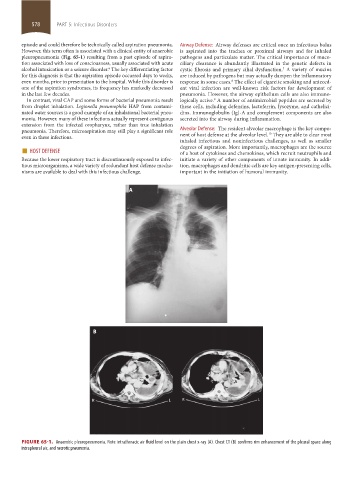
                 episode and could therefore be technically called aspiration pneumonia.   Airway Defense:  Airway defenses are critical once an infectious bolus
                 However, this term often is associated with a clinical entity of anaerobic   is aspirated into the trachea or proximal airways and for inhaled
                 pleuropneumonia (Fig. 65-1) resulting from a past episode of aspira-  pathogens and particulate matter. The critical importance of muco-
                 tion associated with loss of consciousness, usually associated with acute   ciliary clearance is abundantly illustrated in the genetic defects in
                 alcohol intoxication or a seizure disorder.  The key differentiating factor   cystic fibrosis and primary cilial dysfunction.  A variety of mucins
                                               6
                                                                                                          7
                 for this diagnosis is that the aspiration episode occurred days to weeks,   are induced by pathogens but may actually dampen the inflammatory
                 even months, prior to presentation to the hospital. While this disorder is   response in some cases.  The effect of cigarette smoking and anteced-
                                                                                         8
                 one of the aspiration syndromes, its frequency has markedly decreased   ent viral infection are well-known risk factors for development of
                 in the last few decades.                              pneumonia. However, the airway epithelium cells are also immuno-
                   In contrast, viral CAP and some forms of bacterial pneumonia result   logically active.  A number of antimicrobial peptides are secreted by
                                                                                   9
                 from droplet inhalation.  Legionella pneumophila HAP from contami-  these cells, including defensins, lactoferrin, lysozyme, and cathelici-
                 nated water sources is a good example of an inhalational bacterial pneu-  dins. Immunoglobulin (Ig)-A and complement components are also
                 monia. However, many of these infections actually represent contiguous   secreted into the airway during inflammation.
                 extension from the infected oropharynx, rather than true inhalation
                 pneumonia. Therefore, microaspiration may still play a significant role   Alveolar Defense:  The resident alveolar macrophage is the key compo-
                                                                                                     10
                 even in these infections.                             nent of host defense at the alveolar level.  They are able to clear most
                                                                       inhaled infectious and noninfectious challenges, as well as smaller
                     ■  HOST DEFENSE                                   degrees of aspiration. More importantly, macrophages are the source
                                                                       of a host of cytokines and chemokines, which recruit neutrophils and
                 Because the lower respiratory tract is discontinuously exposed to infec-  initiate a variety of other components of innate immunity. In addi-
                 tious microorganisms, a wide variety of redundant host defense mecha-  tion, macrophages and dendritic cells are key antigen-presenting cells,
                 nisms are available to deal with this infectious challenge.  important in the initiation of humoral immunity.


                                                      A


                                          B


                                         R                         L    R                         L


                 FIGURE 65-1.  Anaerobic pleuropneumonia. Note intrathoracic air fluid level on the plain chest x-ray (A). Chest CT (B) confirms rim enhancement of the pleural space along
                 intrapleural air, and necrotic pneumonia.


            section05_c61-73.indd   578                                                                                1/23/2015   12:47:54 PM

