


Page 848 - Hall et al (2015) Principles of Critical Care-McGraw-Hill
P. 848
CHAPTER 65: Pneumonia   579


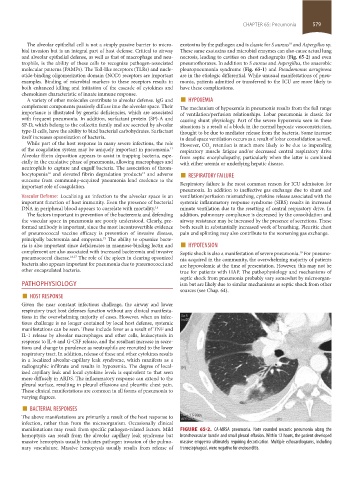
                     The alveolar epithelial cell is not a simply passive barrier to micro-  exotoxins by the pathogen and is classic for S aureus  and Aspergillus sp.
                                                                                                               18
                    bial invasion but is an integral part of host defense. Critical to airway   These same exotoxins and microbial enzymes can also cause actual lung
                    and alveolar epithelial defense, as well as that of macrophage and neu-  necrosis, leading to cavities on chest radiographs (Fig. 65-2) and even
                    trophils, is the ability of these cells to recognize pathogen-associated   pneumothoraxes. In addition to S aureus and Aspergillus, the anaerobic
                    molecular patterns (PAMPs). The Toll-like receptors (TLRs) and nucle-  pleuropneumonia syndrome (Fig. 65-1) and Pseudomonas aeruginosa
                    otide-binding oligomerization domain (NOD) receptors are important   are in the etiologic differential. While unusual manifestations of pneu-
                    examples. Binding of microbial markers to these receptors results in   monia, patients admitted or transferred to the ICU are more likely to
                    both enhanced killing  and initiation of the  cascade of cytokines and   have these complications.
                    chemokines characteristic of innate immune response.
                     A variety of other molecules contribute to alveolar defense. IgG and     ■  HYPOXEMIA
                    complement components passively diffuse into the alveolar space. Their   The mechanism of hypoxemia in pneumonia results from the full range
                    importance is illustrated by genetic deficiencies, which are associated   of ventilation/perfusion relationships. Lobar pneumonia is classic for
                    with frequent pneumonia. In addition, surfactant protein (SP)-A and   causing shunt physiology. Part of the severe hypoxemia seen in these
                    SP-D, which belong to the collectin family and are secreted by alveolar   situations is a result of a block in the normal hypoxic vasoconstriction,
                    type-II cells, have the ability to bind bacterial carbohydrates. Surfactant   thought to be due to mediator release from the bacteria. Some increase
                    itself increases opsonization of bacteria.            in dead space ventilation occurs as a result of lobar consolidation as well.
                     While part of the host response in many severe infections, the role   However, CO  retention is much more likely to be due to impending
                                                                                    2
                    of the coagulation system may be uniquely important in pneumonia.    respiratory muscle fatigue and/or decreased central respiratory drive
                                                                      11
                    Alveolar fibrin deposition appears to assist in trapping bacteria, espe-  from  septic  encephalopathy,  particularly  when  the  latter  is  combined
                    cially in the exudative phase of pneumonia, allowing macrophages and   with either uremia or underlying hepatic disease.
                    neutrophils to capture and engulf bacteria. The association of throm-
                    bocytopenia   and elevated fibrin degradation  products   and  adverse     ■  RESPIRATORY FAILURE
                                                             13
                             12
                    outcome from community-acquired pneumonia lend credence to the
                    important role of coagulation.                        Respiratory failure is the most common reason for ICU admission for
                                                                          pneumonia. In addition to ineffective gas exchange due to shunt and
                    Vascular Defense:  Localizing an infection to the alveolar space is an   ventilation/perfusion mismatching, cytokine release associated with the
                    important function of host immunity. Even the presence of bacterial   systemic inflammatory response syndrome (SIRS) results in increased
                    DNA in peripheral blood appears to correlate with mortality. 14  minute ventilation due to the resetting of central respiratory drive. In
                     The factors important in prevention of the bacteremia and defending   addition, pulmonary compliance is decreased by the consolidation and
                    the vascular space in pneumonia are poorly understood. Clearly, pre-  airway resistance may be increased by the presence of secretions. These
                    formed antibody is important, since the most incontrovertible evidence   both result in substantially increased work of breathing. Pleuritic chest
                    of  pneumococcal  vaccine  efficacy  is  prevention  of  invasive  disease,   pain and splinting may also contribute to the worsening gas exchange.
                    principally bacteremia and empyema.  The ability to opsonize bacte-    ■
                                               15
                    ria is also important since deficiencies in mannose-binding lectin and   HYPOTENSION
                    complement are also associated with increased bacteremia and invasive   Septic shock is also a manifestation of severe pneumonia.  For pneumo-
                                                                                                                  19
                    pneumococcal disease. 16,17  The role of the spleen in clearing opsonized   nia acquired in the community, the overwhelming majority of patients
                    bacteria also appears important for pneumonia due to pneumococci and   are hypovolemic at the time of presentation. However, this may not be
                    other encapsulated bacteria.                          true for patients with HAP. The pathophysiology and mechanisms of
                                                                          septic shock from pneumonia probably vary somewhat by microorgan-
                    PATHOPHYSIOLOGY                                       ism but are likely due to similar mechanisms as septic shock from other
                        ■  HOST RESPONSE                                  sources (see Chap. 64).


                    Given the near constant infectious challenge, the airway and lower
                    respiratory tract host defenses function without any clinical manifesta-
                    tions in the overwhelming majority of cases. However, when an infec-
                    tious challenge is no longer contained by local host defense, systemic
                    manifestations can be seen. These include fever as a result of TNF and
                    IL-1 release by alveolar macrophages and other cells, leukocytosis in
                    response to IL-6 and G-CSF release, and the resultant increase in secre-
                    tions and change to purulence as neutrophils are recruited to the lower
                    respiratory tract. In addition, release of these and other cytokines results
                    in a localized alveolar-capillary leak syndrome, which manifests as a
                    radiographic infiltrate and results in hypoxemia. The degree of local-
                    ized capillary leak and local cytokine levels is equivalent to that seen
                    more diffusely in ARDS. The inflammatory response can extend to the
                    pleural surface, resulting in pleural effusions and pleuritic chest pain.
                    These clinical manifestations are common in all forms of pneumonia to
                    varying degrees.
                        ■  BACTERIAL RESPONSES

                    The above manifestations are primarily a result of the host response to
                    infection, rather than from the microorganism. Occasionally clinical
                    manifestations may result from specific pathogen-related factors. Mild   FIGURE 65-2.  CA-MRSA  pneumonia.  Note  rounded  necrotic  pneumonia  along  the
                    hemoptysis can result from the alveolar capillary leak syndrome but   bronchovascular bundle and small pleural effusion. Within 12 hours, the patient developed
                    massive hemoptysis usually indicates pathogen invasion of the pulmo-  massive empyema ultimately requiring decortication. Multiple echocardiograms, including
                    nary  vasculature.  Massive  hemoptysis  usually  results  from  release  of   transesophageal, were  negative for endocarditis.


            section05_c61-73.indd   579                                                                                1/23/2015   12:47:55 PM

