


Page 862 - Hall et al (2015) Principles of Critical Care-McGraw-Hill
P. 862
CHAPTER 67: Endocarditis and Other Intravascular Infections  593


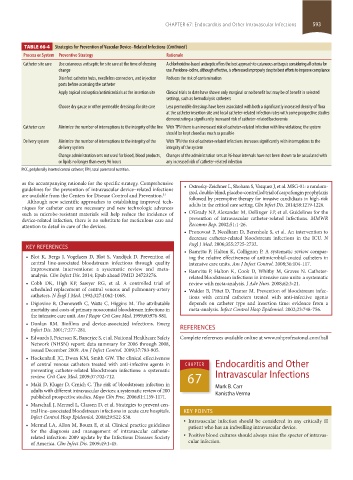
                      TABLE 66-4    Strategies for Prevention of Vascular Device–Related Infections (Continued )
                    Process or System Preventive Strategy            Rationale
                    Catheter site care  Use cutaneous antiseptic for site care at the time of dressing   A chlorhexidine-based antiseptic offers the best approach to cutaneous antisepsis considering all criteria for
                                change                               use. Povidone-iodine, although effective, is often used improperly despite best efforts to improve compliance
                                Disinfect catheter hubs, needleless connectors, and injection   Reduces the risk of contamination
                                ports before accessing the catheter
                                Apply topical antiseptics/antimicrobials at the insertion site  Clinical trials to date have shown only marginal or no benefit but may be of benefit in selected
                                                                     settings, such as hemodialysis catheters
                                Choose dry gauze or other permeable dressings for site care  Less permeable dressings have been associated with both a significantly increased density of flora
                                                                     at the catheter insertion site and local catheter-related infection rates with some prospective studies
                                                                     demonstrating a significantly increased risk of catheter-related bacteremia
                    Catheter care  Minimize the number of interruptions to the integrity of the line With TPN there is an increased risk of catheter-related infection with line violations; the system
                                                                     should be kept closed as much as possible
                    Delivery system  Minimize the number of interruptions to the integrity of the   With TPN the risk of catheter-related infections increases significantly with interruptions to the
                                delivery system                      integrity of the system
                                Change administration sets not used for blood, blood products,  Changes of the administration sets at 96-hour intervals have not been shown to be associated with
                                or lipids no longer than every 96 hours  any increased risk of catheter-related infection
                    PICC, peripherally inserted central catheter; TPN, total parenteral nutrition.

                    as the accompanying rationale for the specific strategy. Comprehensive
                    guidelines for the prevention of intravascular device–related infections     • Ostrosky-Zeichner L, Shoham S, Vazquez J, et al. MSG-01: a random-
                                                                             ized, double-blind, placebo-controlled trial of caspofungin prophylaxis
                    are available from the Centers for Disease Control and Prevention. 51
                     Although  new  scientific  approaches  to  establishing  improved  tech-  followed by preemptive therapy for invasive candidiasis in high-risk
                    niques  for  catheter  care  are  necessary and  new technologic  advances   adults in the critical care setting. Clin Infect Dis. 2014;58:1219-1226.
                    such as microbe-resistant materials will help reduce the incidence of     • O’Grady NP, Alexander M, Dellinger EP, et al. Guidelines for the
                    device-related infection, there is no substitute for meticulous care and   prevention of  intravascular catheter-related infections.  MMWR
                    attention to detail in care of the devices.              Recomm Rep. 2002;51:1-26.
                                                                              • Pronovost P, Needham D, Berenholz S, et al. An intervention to
                                                                             decrease catheter-related bloodstream infections in the ICU.  N
                                                                             Engl J Med. 2006;355:2725-2732.
                     KEY REFERENCES
                                                                              • Ramritu P, Halton K, Collignon P. A systematic review compar-
                        • Blot  K,  Bergs  J,  Vogelaers  D,  Blot S,  Vandijck  D.  Prevention  of   ing the relative effectiveness of antimicrobial-coated catheters in
                       central line-associated bloodstream infections through quality     intensive care units. Am J Infect Control. 2008;36:104-117.
                       improvement interventions: a systematic review and meta-     • Ramritu P, Halton K, Cook D, Whitby M, Graves N. Catheter-
                       analysis. Clin Infect Dis. 2014; Epub ahead PMID 24723276.  related bloodstream infections in intensive care units: a systematic
                        • Cobb DK, High KP, Sawyer RG, et al. A controlled trial of   review with meta-analysis. J Adv Nurs. 2008;62:3-21.
                       scheduled replacement of central venous and pulmonary-artery       • Walder B, Pittet D, Tramer M. Prevention of bloodstream infec-
                       catheters. N Engl J Med. 1992;327:1062-1068.          tions with central catheters treated with anti-infective agents
                        • Digiovine B, Chenoweth C, Watts C, Higgins M. The attributable   depends on catheter type and insertion time: evidence from a
                       mortality and costs of primary nosocomial bloodstream infections in   meta-analysis. Infect Control Hosp Epidemiol. 2002;23:748-756.
                       the intensive care unit. Am J Respir Crit Care Med. 1999;60:976-981.
                        • Donlan RM. Biofilms and device-associated infections.  Emerg
                       Infect Dis. 2001;7:277-281.                        REFERENCES
                        • Edwards J, Peterson K, Banerjee S, et al. National Healthcare Safety   Complete references available online at www.mhprofessional.com/hall
                       Network (NHSN) report: data summary for 2006 through 2008,
                       issued December 2009. Am J Infect Control. 2009;37:783-805.
                        • Hockenhull JC, Dwan KM, Smith GW. The clinical effectiveness
                       of central venous catheters treated with anti-infective agents in   CHAPTER  Endocarditis and Other
                       preventing catheter-related bloodstream infections: a systematic
                       review. Crit Care Med. 2009;37:702-712.              67        Intravascular Infections
                        • Maki D, Kluger D, Crnich C. The risk of bloodstream infection in   Mark B. Carr
                       adults with different intravascular devices: a systematic review of 200   Kanistha Verma
                       published prospective studies. Mayo Clin Proc. 2006;81:1159-1171.
                        • Marschall J, Mermel L, Classen D, et al. Strategies to prevent cen-
                       tral line–associated bloodstream infections in acute care hospitals.   KEY POINTS
                       Infect Control Hosp Epidemiol. 2008;29:S22-S30.        • Intravascular infection should be considered in any critically ill
                        • Mermel LA, Allon M, Bouza E, et al. Clinical practice guidelines   patient who has an indwelling intravascular device.
                       for the diagnosis and management of intravascular catheter-
                       related infection: 2009 update by the Infectious Diseases Society     • Positive blood cultures should always raise the specter of intravas-
                       of America. Clin Infect Dis. 2009;49:1-45.           cular infection.


            section05_c61-73.indd   593                                                                                1/23/2015   12:48:00 PM

