


Page 898 - Hall et al (2015) Principles of Critical Care-McGraw-Hill
P. 898
CHAPTER 69: Human Immunodeficiency Virus (HIV) and AIDS in the Intensive Care Unit  629


                    unexplained extensive herpes zoster, or persistent generalized lymph-
                    adenopathy combined with a history (or clinical evidence) of high-risk
                    activities must trigger consideration of HIV infection in the differen-
                    tial diagnosis. Furthermore, laboratory abnormalities found commonly
                    among HIV-infected individuals can provide the clues to consider HIV
                    infection. Common laboratory abnormalities in HIV-infected patients
                    include lymphopenia, anemia, thrombocytopenia, and hypergamma-
                    globulinemia. It must be emphasized, however, that HIV infection should
                    not be diagnosed unless HIV has been confirmed using specific serologic
                    tests, most commonly, enzyme-linked immunosorbent assay (ELISA) and
                    Western blot. We reemphasize that universal precautions must be followed
                                  https://kat.cr/user/tahir99/
                    by all clinical staff caring for ICU (and indeed all hospitalized) patients.
                    APPROACH TO THE HIV-INFECTED PATIENT IN THE ICU
                        ■  RESPIRATORY DISEASE COMPLICATING HIV INFECTION

                    Pulmonary and radiologic manifestations of HIV infection are diverse and
                    include both infectious and noninfectious conditions (see Table 69-3).
                                                                      62
                    Bacterial pneumonias remain most common causes of pulmonary infec-
                    tion and cause considerable morbidity and mortality worldwide. 63,64
                    The most common etiology of bacterial pneumonia in HIV-infected
                    individuals is  Streptococcus pneumoniae, followed by  Haemophilus
                    influenzae. 63,65,66  Other bacterial agents identified in the setting of
                    HIV-related bacterial pneumonia include  Pseudomonas aeruginosa,
                    Staphylococcus aureus, and less commonly Legionella pneumophila. 65,67-69
                     The rates of hospitalization for pneumonia have decreased. Population-
                    based national data from Denmark demonstrated that hospitalization
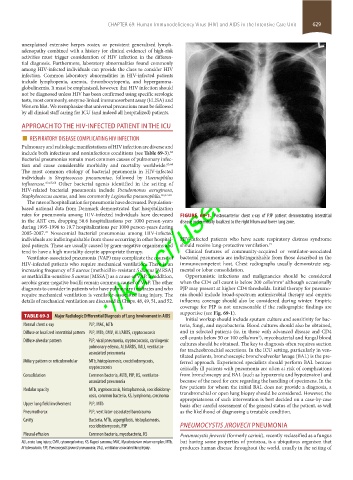
                    rates for pneumonia among HIV-infected individuals have decreased   FIGURE 69-1.  Posteroanterior  chest x-ray of PJP patient demonstrating  interstitial
                    in the ART era, dropping 50.6 hospitalizations per 1000 person-years   disease preferentially localized to the right hilum and lower lung zone.
                    during 1995-1996 to 19.7 hospitalizations per 1000 person-years during
                    2005-2007.  Nosocomial bacterial pneumonias among HIV-infected
                            70
                    individuals are indistinguishable from those occurring in other hospital-  HIV-infected patients who have acute respiratory distress syndrome
                    ized patients. These are usually caused by gram-negative organisms and   should receive lung-protective ventilation. 71
                    tend to have a high mortality despite appropriate therapy.  Clinical features of community-acquired or ventilator-associated
                     Ventilator-associated pneumonia (VAP) may complicate the course of   bacterial pneumonia are indistinguishable from those described in the
                    HIV-infected patients who require mechanical ventilation. There is an   immunocompetent  host.  Chest radiographs  usually  demonstrate  seg-
                    increasing frequency of S aureus (methicillin-resistant S aureus [MRSA]   mental or lobar consolidation.
                    or methicillin-sensitive S aureus [MSSA]) as a cause of VAP. In addition,   Opportunistic infections and malignancies should be considered
                    aerobic gram-negative bacilli remain common causes of VAP. The other   when the CD4 cell count is below 200 cells/mm  although occasionally
                                                                                                            3
                    diagnosis to consider in patients who have pulmonary infiltrates and who   PJP may present at higher CD4 thresholds. Initial therapy for pneumo-
                    require mechanical ventilation is ventilator-associated lung injury. The   nia should include broad-spectrum antimicrobial therapy and empiric
                    details of mechanical ventilation are discussed in Chaps. 48, 49, 51, and 52.    influenza coverage should also be considered during winter. Empiric
                                                                          coverage for PJP is not unreasonable if the radiographic findings are
                                                                          supportive (see Fig. 69-1).
                      TABLE 69-3    Major Radiologic Differential Diagnosis of Lung Involvement in AIDS
                                                                           Initial workup should include sputum culture and sensitivity for bac-
                    Normal chest x-ray     PJP, MAC, MTb                  teria, fungi, and mycobacteria. Blood cultures should also be obtained,
                    Diffuse or localized interstitial pattern PJP, MTb, CMV, ALI/ARDS, cryptococcosis  and in selected patients (ie, in those with advanced disease and CD4
                                                                          cell counts below 50 or 100 cells/mm ), mycobacterial and fungal blood
                                                                                                    3
                    Diffuse alveolar pattern  PJP, viral pneumonia, cryptococcosis, cardiogenic   cultures should be obtained. The key to diagnosis often requires suction
                                             pulmonary edema, ALI/ARDS, VALI, ventilator-  for tracheobronchial secretions. In the ICU setting, particularly in ven-
                                           associated pneumonia
                                                                          tilated patients, bronchoscopic bronchoalveolar lavage (BAL) is the pre-
                    Miliary pattern or reticulonodular  MTb, histoplasmosis, coccidiodomycosis,    ferred approach. Experienced specialists should perform BAL because
                                           cryptococcosis                 critically ill patients with pneumonia are often at risk of complications
                    Consolidation          Common bacteria, MTB, PJP, KS, ventilator-  from bronchoscopy and BAL (such as hypoxemia and hypotension) and
                                           associated pneumonia           because of the need for care regarding the handling of specimens. In the
                                                                          few patients for whom the initial BAL does not provide a diagnosis, a
                    Nodular opacity        MTb, cryptococcosis, histoplasmosis, coccidioidomy-
                                           cosis, common bacteria, KS, lymphoma, carcinoma  transbronchial or open lung biopsy should be considered. However, the
                                                                          appropriateness of such intervention is best decided on a case-by-case
                    Upper lung field involvement  PJP, MTb                basis after careful assessment of the general status of the patient, as well
                    Pneumothorax           PJP, ventilator-associated barotrauma  as the likelihood of diagnosing a treatable condition.
                    Cavity                 Bacteria, MTb, aspergillosis, histoplasmosis,
                                           coccidioidomycosis, PJP        PNEUMOCYSTIS JIROVECII PNEUMONIA
                    Pleural effusion       Common bacteria, mycobacteria, KS  Pneumocystis jirovecii (formerly carinii), recently reclassified as a fungus
                    ALI, acute lung injury; CMV, cytomegalovirus; KS, Kaposi sarcoma; MAC, Mycobacterium avium complex; MTb,    but having some properties of protozoa, is a ubiquitous organism that
                    M tuberculosis; PJP, Pneumocystis jirovecii pneumonia; VALI, ventilator-associated lung injury.  produces human disease throughout the world, usually in the setting of


            section05_c61-73.indd   629                                                                                1/23/2015   12:48:15 PM

