


Page 92 - Hall et al (2015) Principles of Critical Care-McGraw-Hill
P. 92
60      PART 1: An Overview of the Approach to and Organization of Critical Care


                 the community’s plan for mass casualty and medical surge augments   trained in and assigned roles within HICS. A general understanding of
                 the process of scarce resource management. This optimizes health care   how processes differ when HICS is utilized for incident management
                 delivery to both the local ICU and the critically ill patients within a com-  and how the ICU integrates into those efforts with proper communica-
                 munity or region during a catastrophe.                tion ensures adequate health care delivery in the management of poten-
                     ■  ORGANIZING THE HOSPITAL FOR DISASTER RESPONSE  tially scarce resources. The use of HICS within hospitals also provides
                                                                       the common and accepted organization and language for incident man-
                 The US National Incident Management System (NIMS)  is the frame-  agement to streamline interaction with supporting community agencies.
                                                          40
                 work by which local, state, and federal agencies organize to prepare for
                 and respond to emergencies. NIMS provides a standard structure and
                 terminology so that responders across multiple agencies utilize the same
                 organizational construct for Incident Command System (ICS) and pro-    TABLE 9-5    Hospital Incident Command System (HICS) Sections
                 cesses for emergency management; ICS standardizes response agencies’   Position  Description
                 command and control organization to streamline and coordinate their   Incident Commander  •  Overall responsibility for managing incident
                 efforts. The Hospital Incident Command System (HICS)  is a NIMS-      •  Sets objectives, devises strategies and priorities
                                                           41
                 compliant modified ICS structure for hospital emergency response and
                 planned operations requiring complex resource management. HICS is   Operations  •  Directs resources
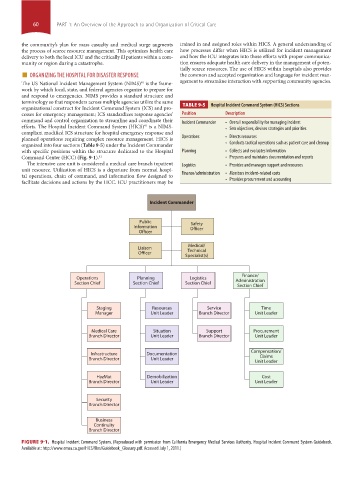
                 organized into four sections (Table 9-5) under the Incident Commander   •  Conducts tactical operations such as patient care and cleanup
                 with specific positions within the structure dedicated to the Hospital   Planning  •  Collects and evaluates information
                 Command Center (HCC) (Fig. 9-1). 41                                   •  Prepares and maintains documentation and reports
                   The intensive care unit is considered a medical care branch inpatient   Logistics  •  Provides and manages support and resources
                 unit resource. Utilization of HICS is a departure from normal hospi-
                 tal operations, chain of command, and information flow designed to   Finance/administration  •  Monitors incident-related costs
                   facilitate decisions and actions by the HCC. ICU practitioners may be   •  Provides procurement and accounting


                                                             Incident Commander


                                                         Public            Safety
                                                       Information         Officer
                                                         Officer

                                                                          Medical/
                                                         Liaison          Technical
                                                         Officer
                                                                         Specialist(s)


                                                                                            Finance/
                                    Operations           Planning         Logistics       Administration
                                   Section Chief       Section Chief     Section Chief
                                                                                           Section Chief


                                           Staging            Resources         Service            Time
                                          Manager            Unit Leader      Branch Director    Unit Leader

                                         Medical Care         Situation         Support         Procurement
                                        Branch Director      Unit Leader      Branch Director    Unit Leader

                                                                                               Compensation/
                                         Infrastructure     Documentation                         Claims
                                        Branch Director      Unit Leader
                                                                                                 Unit Leader
                                           HazMat           Demobilization                         Cost
                                        Branch Director      Unit Leader                         Unit Leader


                                           Security
                                        Branch Director

                                          Business
                                          Continuity
                                        Branch Director
                 FIGURE 9-1.  Hospital Incident Command System. (Reproduced with permission from California Emergency Medical Services Authority. Hospital Incident Command System Guidebook.
                 Available at: http://www.emsa.ca.gov/HICS/files/Guidebook_Glossary.pdf. Accessed July 1, 2011.)


            Section01.indd   60                                                                                        1/22/2015   9:37:06 AM

