


Page 97 - Hall et al (2015) Principles of Critical Care-McGraw-Hill
P. 97
CHAPTER 10: Telemedicine and Regionalization  65


                                                      A


                                                      B


                                                      C                                         D


                                                                          A


                                                              B                                 C


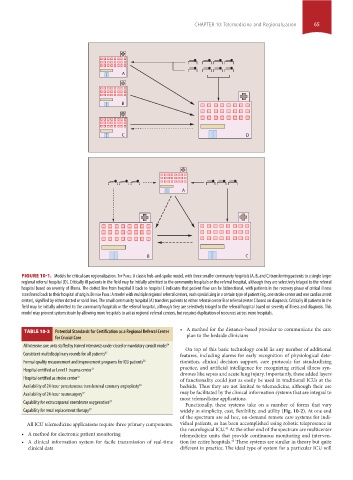
                    FIGURE 10-1.  Models for critical care regionalization. Top panel: A classic hub-and-spoke model, with three smaller community hospitals (A, B, and C) transferring patients to a single larger
                    regional referral hospital (D). Critically ill patients in the field may be initially admitted to the community hospitals or the referral hospital, although they are selectively triaged to the referral
                    hospital based on severity of illness. The dotted line from hospital D back to hospital C indicates that patient flow can be bidirectional, with patients in the recovery phase of critical illness
                    transferred back to their hospital of origin. BoTTom panel: A model with multiple regional referral centers, each specializing in a certain type of patient (eg, one stroke center and one cardiac arrest
                    center), signified by either dotted or solid lines. The small community hospital (A) transfers patients to either referral center B or referral center C based on diagnosis. Critically ill patients in the
                    field may be initially admitted to the community hospitals or the referral hospital, although they are selectively triaged to the referral hospital based on severity of illness and diagnosis. This
                    model may prevent system strain by allowing more hospitals to act as regional referral centers, but requires duplication of resources across more hospitals.


                                                                            • A method for the distance-based provider to communicate the care
                      TABLE 10-2     Potential Standards for Certification as a Regional Referral Center
                               for Crucial Care                             plan to the bedside clinicians
                    All intensive care units staffed by trained intensivists under closed or mandatory consult model 34
                                                                           On top of this basic technology could lie any number of additional
                    Consistent multidisciplinary rounds for all patients 35  features, including alarms for early recognition of physiological dete-
                    Formal quality measurement and improvement programs for ICU patients 36  rioration, clinical decision support, care protocols for standardizing
                    Hospital certified as Level 1 trauma center 11        practice, and artificial intelligence for recognizing critical illness syn-
                                                                          dromes like sepsis and acute lung injury. Importantly, these added layers
                    Hospital certified as stroke center 37                of functionality could just as easily be used in traditional ICUs at the
                    Availability of 24-hour percutaneous transluminal coronary angioplasty 38  bedside. Thus they are not limited to telemedicine, although their use
                    Availability of 24-hour neurosurgery 37               may be facilitated by the clinical information systems that are integral to
                                                                          most telemedicine applications.
                    Capability for extracorporeal membrane oxygenation 23  Functionally, these systems take on a number of forms that vary
                    Capability for renal replacement therapy 39           widely in simplicity, cost, flexibility, and utility (Fig. 10-2). At one end
                                                                          of the spectrum are ad hoc, on-demand remote care systems for indi-
                     All ICU telemedicine applications require three primary components.  vidual patients, as has been accomplished using robotic telepresence in
                                                                                         42
                                                                          the neurological ICU.  At the other end of the spectrum are multicenter
                      • A method for electronic patient monitoring        telemedicine units that provide continuous monitoring and interven-
                                                                                           43
                      • A clinical information system for facile transmission of real-time   tion for entire hospitals.  These systems are similar in theory but quite
                      clinical data                                       different in practice. The ideal type of system for a particular ICU will


            Section01.indd   65                                                                                        1/22/2015   9:37:08 AM

