


Page 96 - Hall et al (2015) Principles of Critical Care-McGraw-Hill
P. 96
64      PART 1: An Overview of the Approach to and Organization of Critical Care


                 and the impact on total census was marginal. The study concluded that   disease-specific referral centers (Fig.  10-1). These different models
                 regionalizing care was feasible and might result in a significant mortality   may suit different regions to varying degrees. Next, policy makers must
                 benefit for these patients.                           explicitly define the methods to identify regional referral centers and
                   Although this study provides some conceptual support for regional-  the method to identify patients in need to transfer to a regional care
                 ization, there are a number of important limitations. The study assumed   center. It is essential that these criteria be objective to avoid subjective
                 that patients transferred to regional referral centers would receive the   and necessarily arbitrary decisions that may hurt hospital economies or
                 same mortality benefit as patients originally admitted to those centers,   allow for gaming of the system. Potential structural criteria for referral
                 an untested assumption. Additionally, the study assumed a perfect tri-  center certification include intensivist physician staffing and the avail-
                 age model whereby all eligible patients were successfully triaged to a   ability of definitive surgical, coronary, and cardiac care, among others
                 regional referral center. In reality, triage is extremely difficult under the   (Table 10-2). 11,23,34-39  Certification as a regional referral center should be
                 best of circumstances, even in trauma where triage criteria are relatively   voluntary, yet certification should be regulated by existing governmen-
                 standardized and objective.  In the broader world of critical care, there   tal bodies in order to ensure that the number and location of regional
                                     30
                 are no commonly accepted strategies for triaging patients at high risk for   referral centers best meet population needs. The goal is not only to
                 death. There are several strategies under development, although early   improve access but also to make access as equitable as possible—equity
                 evidence suggests that none are adequate for immediate use. 31  may be harmed if some areas are overserved by regional centers and
                     ■  BARRIERS                                       other areas are underserved.
                                                                         Practically, regionalization will require the dedicated, coordinated
                 Regionalization faces several key barriers to implementation   efforts of clinicians and policy makers. Support from all relevant
                 (Table 10-1). In a 2009 survey of intensive care physicians, the most   stakeholders is needed, with leadership likely coming from profes-
                 significant perceived barrier to regionalization was the lack of a strong   sional medical societies who are in the best position to develop
                 centralized authority to regulate and enforce the system.  In the   evidence-based standards for hospital certification, and governmental
                                                              32
                 United States, there is no central health authority to oversee such a sys-  accreditation  bodies  who  are  in  the  best  position  to  enforce  those
                 tem—even trauma regionalization is a patchwork of mechanisms and   standards. Regionalization will also require demonstration products
                 authorities that varies across regions. There is also substantial hospital   supporting  both  feasibility  and  effectiveness.  Given  the  large-scale
                 competition in the United States, which might preclude standardization   system changes that regionalization involves, it is unlikely that we can
                 of critical care delivery across hospitals in a region. Some countries such   proceed  until  initial  studies  demonstrate  improvements  in  patient-
                 as the United Kingdom, Canada, and Australia have public health sys-  centered outcomes.
                 tems and regional health authorities capable of regulating a regionalized     ■
                 critical care system; however, even in these countries hospitals may resist   ROLE OF INTENSIVISTS
                 efforts to dictate the services they can provide.     Practicing intensivists should be aware of the key roles they will play in a
                   Another major barrier to regionalization is the personal strain on   regionalized system. If critical care is regionalized, it will likely occur as
                 families that regionalization may cause. Under a regionalized scenario,   an inclusive system, whereby all hospitals are capable of providing some
                 patients and families may be forced to travel long distances to receive   level  of  critical  care,  but  more  seriously ill  patients  are  systematically
                 critical care, often by unfamiliar clinicians in unfamiliar settings. The   transferred to higher levels. This is in contrast to an exclusive system,
                 system may therefore place undue burden on families and compromise   whereby only some hospitals can provide critical care and triage occurs
                 the patient-physician relationship, leading to adverse consequences   entirely outside the hospital. The distinction is important because exclu-
                 such as cognitive and emotional dysfunction among family members.    sive systems place the burden of triage and initial treatments both on
                                                                    33
                 Patients and families may be willing to accept a higher risk of death if it   emergency medical personnel and emergency physicians and intensiv-
                 means receiving critical care closer to home.         ists practicing in small community centers. Although these clinicians
                   Other barriers to regionalization include capacity constraints at large-  may not need extensive experience in caring for patients with severe
                 volume hospitals, the difficulty in accurately identifying patients in need   multiple organ dysfunction, they will still need the ability to quickly
                 of transfer, and providers’ (both hospitals and physicians) potential   recognize emerging critical care syndromes and activate the necessary
                 unwillingness to sacrifice income when patients are transferred to other   treatment and transfer protocols. Intensivists will also be responsible
                 hospitals for care.                                   for helping to inform overall system design, including the outcomes by
                     ■  IMPLEMENTATION STRATEGIES                      which accountable care systems will be evaluated and benchmarked.
                                                                       Ultimately, it is essential that intensivists take an active role in the devel-
                 To  overcome  these  barriers  and  effectively  implement  regionalized   opment of regional critical care systems, lest regionalization proceed
                 care will require both intelligent system design and a coordinated   without significant intensivist input.
                 effort  among  stakeholders.  Several  issues  around  the  design  of  a
                 regionalized care system must be addressed by careful comparative-  TELEMEDICINE
                 effectiveness research. First, regional systems can be designed around
                 either a traditional hub-and-spoke model or a model with multiple   ICU  telemedicine  refers  to  the  use  of  audiovisual  technology to  pro-
                                                                       vide critical care from a remote location. Telemedicine itself is a broad
                                                                         concept that has been in use for decades in several medical fields.  In
                                                                                                                        40
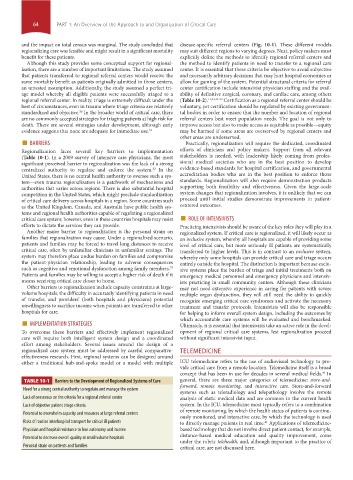
                   TABLE 10-1    Barriers to the Development of Regionalized Systems of Care  general, there are three major categories of telemedicine:  store-and-
                                                                       forward,  remote  monitoring, and  interactive  care. Store-and-forward
                  Need for a strong central authority to regulate and manage the system
                                                                       systems such as teleradiology and telepathology involve the remote
                  Lack of consensus on the criteria for a regional referral center  analysis of static medical data and are common in the current health
                  Lack of objective patient triage criteria            system. In the ICU, telemedicine most typically refers to a combination
                                                                       of remote monitoring, by which the health status of patients is continu-
                  Potential to overwhelm capacity and resources at large referral centers
                                                                       ously monitored, and interactive care, by which the technology is used
                  Risks of routine interhospital transport for critical ill patients  to directly manage patients in real time.  Applications of telemedicine-
                                                                                                    41
                  Physician and hospital resistance to lose autonomy and income  based technology that do not involve direct patient contact, for example,
                                                                       distance-based medical education and quality improvement, come
                  Potential to decrease overall quality at small volume hospitals
                                                                       under the rubric telehealth, and, although important to the practice of
                  Personal strain on patients and families             critical care, are not discussed here.


            Section01.indd   64                                                                                        1/22/2015   9:37:08 AM

