


Page 921 - Hall et al (2015) Principles of Critical Care-McGraw-Hill
P. 921
652     PART 5: Infectious Disorders


                                                                         TABLE 71-1    Etiology of Bacterial Meningitis in the United States
                     • A short course of corticosteroids may be useful in patients with brain
                    abscess who have deteriorating neurologic status and increased intra-             Percent of Total
                    cranial pressure.                                   Organism          1978-1981     1995       1998-2003
                     • Cranial subdural empyema should be suspected in patients with   Haemophilus influenzae  48  7  7
                    headache, vomiting, fever, change in mental  status, and rapid
                    progression of focal neurologic signs.              Neisseria meningitidis  20       25          14
                     • Spinal epidural abscess may develop acutely or chronically, with   Streptococcus pneumoniae  13  47  58
                    symptoms and signs of focal vertebral pain, nerve root pain, motor or   Streptococcus agalactiae  3  12  18
                    sensory defects, and paralysis; the transition to paralysis may be rapid,   Listeria monocytogenes  2  8  3
                    indicating the need for emergent evaluation, diagnosis, and treatment.  Other a  8   —           —
                     • Surgical therapy is essential for the management of subdural   Unknown  6         —           —
                    empyema because antibiotics do not reliably sterilize these lesions.  a
                                                                        Includes Escherichia coli, other Enterobacteriaceae, staphylococci, Pseudomonas species, and other
                     • Rapid surgical decompression should be performed in patients   streptococcal and Haemophilus species.
                    with spinal epidural abscess who have increasing neurologic deficit,    Data from Schlech WF, Ward JI, Band JD, et al. Bacterial meningitis in the United States, 1978 through
                    persistent severe pain, or increasing temperature or peripheral   1981. The national bacterial meningitis surveillance study. JAMA. 1985;253:1749-1754.
                    white blood cell count.
                     • Lateral gaze palsy may be an early clue to the diagnosis of cav-  Schuchat A, Robinson K, Wenger JD, et al. Bacterial meningitis in the United States in 1995. N Engl J Med.
                                                                       1997;337:970-976.
                    ernous sinus thrombosis because the abducens nerve is the only
                    cranial nerve traversing the interior of the cavernous sinus.  Thigpen MC, Whitney CG, Messonnier NE, et al. Bacterial meningitis in the United States—1998-2007.
                                                                       N Engl J Med. 2011;364:2016-2025.
                     • The noninvasive diagnostic procedure of choice for suppurative
                    intracranial thrombophlebitis is magnetic resonance imaging, which   Before the development of effective vaccines against it, H influenzae
                    can differentiate between thrombus and normally flowing blood.  type b was isolated in almost half of all cases of bacterial meningitis in
                                                                       the United States, but this microorganism currently accounts for only
                                                                       7% of cases.  About 40% to 60% of cases were seen in children ages
                                                                                4,5
                 Bacterial infections of the central nervous system (CNS) are frequently   2 months to 6 years; of these, 90% were due to capsular type b strains.
                 devastating. The brain possesses several defense mechanisms (eg, intact   Disease is most likely initiated after nasopharyngeal acquisition of a
                 cranium and blood-brain barrier) to prevent entry of bacterial species, but   virulent organism with subsequent systemic invasion.  Haemophilus
                 once microorganisms have gained entry to the CNS, host defense mecha-  influenzae is unusual after age 6 years; isolation of the organism in this
                 nisms are inadequate to control the infection. Antimicrobial therapy is   older group should suggest the possible presence of certain predispos-
                 limited by the poor penetration of many agents into the CNS and by the   ing factors, including sinusitis, otitis media, epiglottitis, pneumonia,
                 ability of antibiotics to induce inflammation in the CNS via their bacte-  head trauma with a cerebrospinal fluid (CSF) leak, diabetes mellitus,
                 riolytic action, thereby contributing to brain damage. We review menin-  alcoholism, splenectomy or asplenic states, and immune deficiency (eg,
                                                                                           7
                 gitis, brain abscess, subdural empyema, epidural abscess, and suppurative   hypogammaglobulinemia).  In a prospective evaluation of adult patients
                   intracranial thrombophlebitis, with an emphasis on recent developments in   with community-acquired bacterial meningitis in the Netherlands,
                                                                                                               8
                 diagnosis and therapy as they pertain to the care of the critically ill patient.  H influenzae accounted for 2% of culture-proven cases.
                                                                         Meningitis due to  Neisseria meningitidis is most often found in
                                                                       children and young adults and may occur in epidemics, although
                 MENINGITIS                                            more  than  98% of cases are sporadic.   Nasopharyngeal  carriage of
                                                                                                     9
                     ■  EPIDEMIOLOGY AND ETIOLOGY                      virulent organisms accounts for initiation of infection. In the United
                                                                       States, 32% of cases are caused by serogroup B, 32% by serogroup
                                                                                            6
                 The rates of morbidity and mortality from bacterial meningitis remain unac-  C, and 24% by serogroup Y.  Infection is more likely in persons who
                 ceptably high despite the availability of effective antimicrobial therapy. In a   have deficiencies in the terminal complement components (C5, C6,
                 surveillance study of all cases of bacterial meningitis in 27 states of the United   C7, C8, and perhaps C9), the so-called membrane attack complex;
                 States from 1978 through 1981, the overall annual attack rate of bacterial   the incidence of neisserial infections is more than 8000-fold greater
                                                                                                      10
                 meningitis was approximately 3.0 cases per 100,000 population, although   in this group than among other persons.  An increased risk has also
                 there was variability according to geographic area, sex, and race;  incidences   been observed in patients with dysfunctional properdin, suggesting
                                                             1
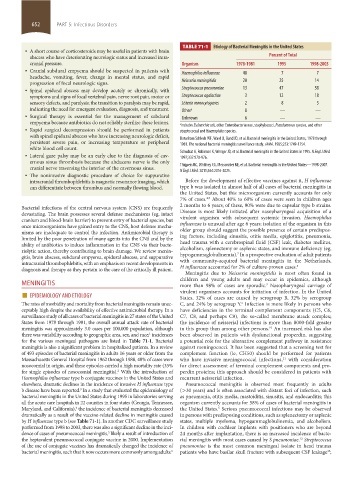
                 for the various meningeal pathogens are listed in  Table 71-1. Bacterial   a potential role for the alternative complement pathway in resistance
                 meningitis is also a significant problem in hospitalized patients. In a review   against meningococci. It has been suggested that a screening test for
                 of 493 episodes of bacterial meningitis in adults 16 years or older from the   complement function (ie, CH50) should be performed for patients
                 Massachusetts General Hospital from 1962 through 1988, 40% of cases were   who have invasive meningococcal  infections,  with consideration
                                                                                                          11
                 nosocomial in origin, and these episodes carried a high mortality rate (35%   for direct assessment of terminal complement components and pro-
                 for single episodes of nosocomial meningitis).  With the introduction of   perdin proteins; this approach should be considered in patients with
                                                  2
                 Haemophilus influenzae type b conjugate vaccines in the United States and   recurrent neisserial infection.
                 elsewhere, dramatic declines in the incidence of invasive H influenzae type   Pneumococcal meningitis is observed most frequently in adults
                 b disease have been reported.  In a study that evaluated the epidemiology of   (>30 years) and is often associated with distant foci of infection, such
                                     3
                 bacterial meningitis in the United States during 1995 in laboratories serving    as pneumonia, otitis media, mastoiditis, sinusitis, and endocarditis; this
                 all the acute care hospitals in 22 counties in four states (Georgia, Tennessee,   organism currently accounts for 58% of cases of bacterial meningitis in
                 Maryland, and California),  the incidence of bacterial meningitis decreased   the United States.  Serious pneumococcal infections may be observed
                                    4
                                                                                    5
                 dramatically as a result of the vaccine-related decline in meningitis caused   in persons with predisposing conditions, such as splenectomy or asplenic
                 by H influenzae type b (see Table 71-1). In another CDC surveillance study   states, multiple myeloma, hypogammaglobulinemia, and alcoholism.
                 performed from 1998 to 2003, there was also a significant decline in the inci-  In children with cochlear implants with positioners who are beyond
                 dence of cases of pneumococcal meningitis,  likely a result of introduction of    24 months after implantation, there is an increased incidence of bacte-
                                               5
                                                                                                                12
                 the heptavalent pneumococcal conjugate vaccine in 2000. Implementation   rial meningitis with most cases caused by S pneumoniae.  Streptococcus
                 of the use of conjugate vaccines has dramatically changed the incidence of   pneumoniae is the most common meningeal isolate in head trauma
                                                                                                                         13
                 bacterial meningitis, such that it now occurs more commonly among adults. 6  patients who have basilar skull fracture with subsequent CSF leakage ;


            section05_c61-73.indd   652                                                                                1/23/2015   12:48:34 PM

