


Page 923 - Hall et al (2015) Principles of Critical Care-McGraw-Hill
P. 923
654     PART 5: Infectious Disorders


                 of meningeal irritation, and no fever. In this subgroup, altered mental   amplification test, loop-mediated isothermal amplification, is a promis-
                 status should not be ascribed to other causes until bacterial meningitis   ing tool especially in resource-poor settings.  Further refinements in
                                                                                                        28
                 has been excluded by CSF examination. A patient after neurosurgery or   PCR may render it useful in the diagnosis of bacterial meningitis when
                 a patient who has undergone head trauma also presents a unique clinical   the CSF Gram stain and cultures are negative; PCR may also prove to
                 situation because these patients already have many of the symptoms and   be beneficial to detect in vitro susceptibility of meningeal pathogens to
                 signs of meningitis from their underlying disease processes ; clinical   specific antimicrobial agents.
                                                              13
                 features are variable, but most commonly include fever and an altered   Neuroimaging techniques have little role in the diagnosis of acute
                 level of consciousness. One must have a low threshold for CSF exami-  bacterial meningitis, except to rule out the presence of other pathologic
                 nation in these patients should they develop any clinical deterioration.  conditions or to identify a parameningeal source of infection.  However,
                                                                                                                   21
                     ■  DIAGNOSIS                                      computed tomography (CT) or magnetic resonance imaging (MRI)
                                                                       may be useful in patients who have a persisting fever several days after
                 The diagnosis of bacterial meningitis rests on the CSF examination. 21,29,30    initiation of antimicrobial therapy, prolonged obtundation or coma,
                 The opening pressure is elevated in virtually all cases; values above   new or recurrent seizure activity, signs of increased intracranial pres-
                 600 mm H O suggest cerebral edema, the presence of intracranial suppu-  sure, or focal neurologic deficits. MRI is better than CT for evaluation
                         2
                 rative foci, or communicating hydrocephalus. The fluid may be cloudy or   of subdural effusions, cortical infarctions, and cerebritis, although it is
                 turbid if the white blood cell count is elevated (>200/µL). If the lumbar   more difficult to obtain an MRI in a critically ill patient, which limits its
                 puncture is traumatic, the CSF may appear bloody initially, but it should   usefulness in many patients with meningitis.
                 color of the supernatant of centrifuged CSF, is found in patients with   ■  TREATMENT
                 clear as flow continues. Xanthochromia, a pale-pink to yellow-orange
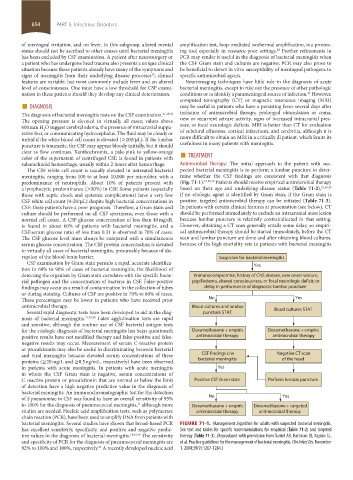
                 subarachnoid hemorrhage, usually within 2 hours after hemorrhage.  Antimicrobial Therapy:  The  initial approach to the  patient with  sus-
                   The CSF white cell count is usually elevated in untreated bacterial   pected bacterial meningitis is to perform a lumbar puncture to deter-
                 meningitis, ranging from 100 to at least 10,000 per microliter, with a    mine whether the CSF findings are consistent with that diagnosis
                 predominance of neutrophils. About 10% of patients present with    (Fig. 71-1). 21,29,30  Patients should receive empirical antimicrobial therapy
                 a lymphocytic predominance (>50%) in CSF. Some patients (especially   based  on  their  age  and  underlying  disease  status  (Table  71-2), 21,29,32
                 those with septic shock and systemic complications) have a very low   if no etiologic agent is identified by Gram stain; if the Gram stain is
                 CSF white cell count (0-20/µL) despite high bacterial concentrations in   positive, targeted antimicrobial therapy can be initiated (Table 71-3).
                 CSF; these patients have a poor prognosis. Therefore, a Gram stain and   In patients with certain clinical features at presentation (see below), CT
                 culture should be performed on all CSF specimens, even those with a   should be performed immediately to exclude an intracranial mass lesion
                 normal cell count. A CSF glucose concentration of less than 40 mg/dL     because lumbar puncture is relatively contraindicated in that setting.
                 is found in about 60% of patients with bacterial meningitis, and a   However, obtaining a CT scan generally entails some delay, so empiri-
                 CSF:serum glucose ratio of less than 0.31 is observed in 70% of cases.   cal antimicrobial therapy should be started immediately, before the CT
                 The CSF glucose level must always be compared with a simultaneous   scan and lumbar puncture are done and after obtaining blood cultures,
                 serum glucose concentration. The CSF protein concentration is elevated   because of the high mortality rate in patients with bacterial meningitis
                 in virtually all cases of bacterial meningitis, presumably because of dis-
                 ruption of the blood-brain barrier.                                 Suspicion for bacterial meningitis
                   CSF examination by Gram stain permits a rapid, accurate identifica-
                 tion in 60% to 90% of cases of bacterial meningitis; the likelihood of         Yes
                 detecting the organism by Gram stain correlates with the specific bacte-  Immunocompromise, history of CNS disease, new onset seizure,
                 rial pathogen and the concentration of bacteria in CSF. False-positive   papilledema, altered consciousness, or focal neurologic deficit; or
                 findings may occur as a result of contamination in the collection of tubes   delay in performance of diagnostic lumbar puncture
                 or during staining. Cultures of CSF are positive in 70% to 80% of cases.
                 These percentages may be lower in patients who have received prior   No                       Yes
                 antimicrobial therapy.                                    Blood cultures and lumbar
                   Several rapid diagnostic tests have been developed to aid in the diag-  puncture STAT   Blood cultures STAT
                 nosis of bacterial meningitis. 21,29,30  Latex agglutination tests are rapid
                 and sensitive, although the routine use of CSF bacterial antigen tests
                 for the etiologic diagnosis of bacterial meningitis has been questioned;   Dexamethasone + empiric  Dexamethasone + empiric
                 positive results have not modified therapy and false-positive and false-  antimicrobial therapy   antimicrobial therapy
                 negative results may occur. Measurement of serum C-reactive protein
                 or procalcitonin may also be useful in discriminating between bacterial
                 and viral meningitis because elevated serum concentrations of these   CSF findings c/w  Negative CT scan
                 proteins (≥20 mg/L and ≥0.5 ng/mL, respectively) have been observed   bacterial meningitis   of the head
                 in patients with acute meningitis. In patients with acute meningitis   Yes
                 in whom the CSF Gram stain is negative, serum concentrations of
                 C-reactive protein or procalcitonin that are normal or below the limit   Positive CSF Gram stain   Perform lumbar puncture
                 of detection have a high negative predictive value in the diagnosis of
                 bacterial meningitis. An immunochromatographic test for the detection
                 of S pneumoniae in CSF was found to have an overall sensitivity of 95%   No              Yes
                 to 100% for the diagnosis of pneumococcal meningitis,  although more   Dexamethasone + empiric  Dexamethasone + targeted
                                                         31
                 studies are needed. Nucleic acid amplification tests, such as polymerase   antimicrobial therapy   antimicrobial therapy
                 chain reaction (PCR), have been used to amplify DNA from patients with
                 bacterial meningitis. Several studies have shown that broad-based PCR   FIGURE 71-1.  Management algorithm for adults with suspected bacterial meningitis.
                 has excellent sensitivity, specificity, and positive and negative predic-  See text and tables for specific recommendations for empirical (Table 71-2) and targeted
                 tive values in the diagnosis of bacterial meningitis. 21,29,30  The sensitivity    therapy (Table 71-3). (Reproduced with permission from Tunkel AR, Hartman BJ, Kaplan SL,
                 and specificity of PCR for the diagnosis of pneumococcal meningitis are   et al. Practice guidelines for the management of bacterial meningitis. Clin Infect Dis. November
                 92% to 100% and 100%, respectively.  A recently developed nucleic acid   1, 2004;39(9):1267-1284.)
                                           31


            section05_c61-73.indd   654                                                                                1/23/2015   12:48:35 PM

