


Page 953 - Hall et al (2015) Principles of Critical Care-McGraw-Hill
P. 953
684     PART 5: Infectious Disorders


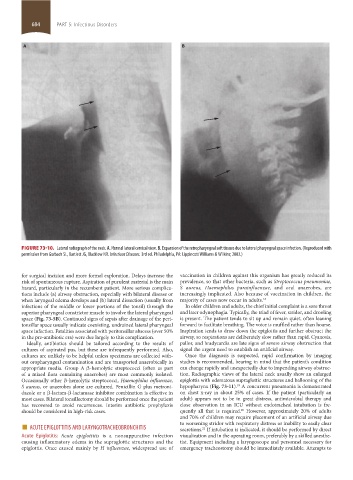
                  A                                                     B


                 FIGURE 73-10.  Lateral radiograph of the neck. A. Normal lateral cervical view. B. Expansion of the retropharyngeal soft tissues due to lateral pharyngeal space infection. (Reproduced with
                 permission from Gorbach SL, Bartlett JG, Blacklow NR. Infectious Diseases. 3rd ed. Philadelphia, PA: Lippincott Williams & Wilkins; 2003.)


                 for surgical incision and more formal exploration. Delays increase the   vaccination in children against this organism has greatly reduced its
                 risk of spontaneous rupture. Aspiration of purulent material is the main   prevalence, so that other bacteria, such as Streptococcus pneumoniae,
                 hazard, particularly in the recumbent patient. More serious complica-  S aureus, Haemophilus parainfluenzae,  and oral  anaerobes, are
                 tions include (a) airway obstruction, especially with bilateral disease or   increasingly implicated. Also because of vaccination in children, the
                 when laryngeal edema develops and (b) lateral dissection (usually from   majority of cases now occur in adults. 18
                 infections of the middle or lower portions of the tonsil) through the   In older children and adults, the chief initial complaint is a sore throat
                 superior pharyngeal constrictor muscle to involve the lateral pharyngeal   and later odynophagia. Typically, the triad of fever, stridor, and drooling
                 space (Fig. 73-5B). Continued signs of sepsis after drainage of the peri-  is present. The patient tends to sit up and remain quiet, often leaning
                 tonsillar space usually indicate coexisting, undrained lateral pharyngeal   forward to facilitate breathing. The voice is muffled rather than hoarse.
                 space infection. Fatalities associated with peritonsillar abscess (over 50%   Inspiration tends to draw down the epiglottis and further obstruct the
                 in the pre-antibiotic era) were due largely to this complication.  airway, so respirations are deliberately slow rather than rapid. Cyanosis,
                   Ideally, antibiotics should be tailored according to the results of   pallor, and bradycardia are late signs of severe airway obstruction that
                 cultures of aspirated pus,  but these are infrequently  performed. Also,   signal the urgent need to establish an artificial airway.
                 cultures are unlikely to be helpful unless specimens are collected with-  Once the diagnosis is suspected, rapid confirmation by imaging
                 out oropharyngeal contamination and are transported anaerobically in   studies is recommended, bearing in mind that the patient’s condition
                 appropriate media. Group A  β-hemolytic streptococci (often as part   can change rapidly and unexpectedly due to impending airway obstruc-
                 of a mixed flora containing anaerobes) are most commonly isolated.   tion. Radiographic views of the lateral neck usually show an enlarged
                 Occasionally other  β-hemolytic  streptococci,  Haemophilus influenzae,     epiglottis with edematous supraglottic structures and ballooning of the
                 S aureus, or anaerobes alone are cultured. Penicillin G plus metroni-  hypopharynx (Fig. 73-11).  A concurrent pneumonia is demonstrated
                                                                                           19
                 dazole or a β-lactam-β-lactamase inhibitor combination is effective in   on chest x-ray in about 25% of cases. If the patient (particularly an
                 most cases. Bilateral tonsillectomy should be performed once the patient   adult) appears not to be in great distress, antimicrobial therapy and
                 has recovered to avoid recurrences. Interim antibiotic prophylaxis   close observation in an ICU without endotracheal intubation is fre-
                 should be considered in high-risk cases.              quently all that is required.  However, approximately 20% of adults
                                                                                            20
                                                                       and 70% of children may require placement of an artificial airway due
                     ■  ACUTE EPIGLOTTITIS AND LARYNGOTRACHEOBRONCHITIS  to worsening stridor with respiratory distress or inability to easily clear
                                                                       secretions.  If intubation is indicated, it should be performed by direct
                                                                               21
                 Acute Epiglotitis:  Acute epiglottitis is a nonsuppurative infection   visualization and in the operating room, preferably by a skilled anesthe-
                 causing inflammatory edema in the supraglottic structures and the   tist. Equipment including a laryngoscope and personnel necessary for
                 epiglottis. Once caused mainly by  H  influenzae, widespread use of   emergency tracheostomy should be immediately available. Attempts to


            section05_c61-73.indd   684                                                                                1/23/2015   12:49:12 PM

