


Page 954 - Hall et al (2015) Principles of Critical Care-McGraw-Hill
P. 954
CHAPTER 73: Life-Threatening Infections of the Head, Neck, and Upper Respiratory Tract  685


                                                                          hoarseness, and respiratory distress. Respirations are noisy, often
                                                                          accompanied by chest wall retractions and inspiratory and expiratory
                                                                          wheezing. Nasal discharge and pharyngeal injection are common, but
                                                                          the epiglottis and supraglottic structures appear normal. Fever and mal-
                                                                          aise are present as part of the upper respiratory viral syndrome. A lateral
                                                                          radiograph of the neck can be helpful by showing the characteristic
                                                                          infraglottic narrowing. Management is similar to that for supraglottic
                                                                          laryngitis, including humidification, hydration, oxygen administration,
                                                                          and antibiotic therapy for secondary bacterial infection. Use of  sedatives
                                                                          and narcotics, which suppress the cough reflex, is to be avoided.
                                                                          Inhalational or oral  steroids are of proven benefit.  Occasionally, an
                                                                                                               22
                                                                            artificial airway is required for 2 to 5 days or more. Extubation is some-
                                                                          times difficult because of additional edema secondary to the endotra-
                                                                          cheal tube itself. It seems reasonable that if the patient fails extubation, a
                                                                          tracheostomy should be considered instead of reintubation.
                                                                              ■  PERICRANIAL INFECTIONS

                                                                          Contiguous Extension From Sinusitis and Mastoiditis:  Fortunately, sup-
                                                                          purative and life-threatening complications of  acute and chronic
                                                                          sinusitis or mastoiditis have become relatively infrequent in the post-
                                                                          antibiotic era. However, because of the unique pericranial location of
                                                                          these air spaces and the rich vascular supply in this region, contiguous
                                                                          spread of infection may extend intracranially via the diploic veins and
                                                                          result in serious complications such as meningitis, brain abscess, sub-
                                                                          dural or epidural empyema, osteomyelitis of the skull, and cavernous
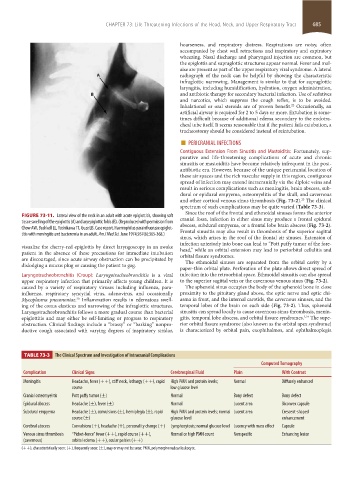
                                                                          and other cortical venous sinus thrombosis (Fig. 73-2).  The clinical
                                                                                                                   23
                                                                          spectrum of such complications may be quite varied (Table 73-3).
                                                                           Since the roof of the frontal and ethmoidal sinuses forms the anterior
                    FIGURE 73-11.  Lateral view of the neck in an adult with acute epiglottitis, showing soft   cranial fossa, infection in either sinus may produce a frontal epidural
                    tissue swelling of the epiglottis (A) and aryepiglottic folds (B). (Reproduced with permission from   abscess, subdural empyema, or a frontal lobe brain abscess (Fig. 73-2).
                    Chow AW, Bushkell LL, Yoshikawa TT, Guze LB. Case report. Haemophilus parainfluenzae epiglot-  Frontal sinusitis may also result in thrombosis of the superior sagittal
                    titis with meningitis and bacteremia in an adult. Am J Med Sci. June 1974;267(6):365-368.)
                                                                          sinus, which arises in the roof of the frontal air sinuses. Extension of
                                                                          infection anteriorly into bone can lead to “Pott puffy tumor of the fore-
                    visualize the cherry-red epiglottis by direct laryngoscopy in an awake   head,” while an orbital extension may lead to periorbital cellulitis and
                    patient  in  the  absence  of  these  precautions  for  immediate  intubation   orbital fissure syndromes.
                    are discouraged, since acute airway obstruction can be precipitated by   The ethmoidal sinuses  are separated  from the orbital cavity by a
                    dislodging a mucus plug or causing the patient to gag.
                                                                          paper-thin orbital plate. Perforation of the plate allows direct spread of
                    Laryngotracheobronchitis (Croup):  Laryngotracheobronchitis is a viral   infection into the retroorbital space. Ethmoidal sinusitis can also spread
                    upper respiratory infection that primarily affects young children. It is   to the superior sagittal vein or the cavernous venous sinus (Fig. 73-2).
                    caused by a variety of respiratory viruses including influenza, para-  The sphenoid sinus occupies the body of the sphenoid bone in close
                    influenza, respiratory syncytial virus, adenovirus, and occasionally   proximity to the pituitary gland above, the optic nerve and optic chi-
                    Mycoplasma  pneumoniae.  Inflammation results in edematous swell-  asma in front, and the internal carotids, the cavernous sinuses, and the
                                      20
                    ing of the conus elasticus and narrowing of the infraglottic structures.   temporal lobes of the brain on each side (Fig. 73-2). Thus, sphenoid
                    Laryngotracheobronchitis follows a more gradual course than bacterial   sinusitis can spread locally to cause cavernous sinus thrombosis, menin-
                                                                                                                    2,24
                    epiglottitis and may either be self-limiting or progress to respiratory   gitis, temporal lobe abscess, and orbital fissure syndromes.  The supe-
                    obstruction. Clinical findings include a “brassy” or “barking” nonpro-  rior orbital fissure syndrome (also known as the orbital apex syndrome)
                    ductive cough associated with varying degrees of inspiratory stridor,   is characterized by orbital pain, exophthalmos, and ophthalmoplegia


                      TABLE 73-3    The Clinical Spectrum and Investigation of Intracranial Complications
                                                                                                     Computed Tomography
                    Complication     Clinical Signs                   Cerebrospinal Fluid   Plain           With Contrast
                    Meningitis       Headache, fever (++), stiff neck, lethargy (++), rapid  High PMN and protein levels;    Normal  Diffusely enhanced
                                     course                           low glucose level
                    Cranial osteomyelitis  Pott puffy tumor (±)       Normal                Bony defect     Bony defect
                    Epidural abscess  Headache (±), fever (±)         Normal                Lucent area     Biconvex capsule
                    Subdural empyema  Headache (±), convulsions (±), hemiplegia (±), rapid   High PMN and protein levels; normal  Lucent area  Crescent-shaped
                                     course (±)                       glucose level                         enhancement
                    Cerebral abscess  Convulsions (+), headache (+), personality change (+)  Lymphocytosis; normal glucose level Lucency with mass effect  Capsule
                    Venous sinus thrombosis   “Picket-fence” fever (++), rapid course (++),    Normal or high PMN count  Nonspecific  Enhancing lesion
                    (cavernous)      orbital edema (++), ocular palsies (++)
                    (++), characteristically seen; (+), frequently seen; (±), may or may not be seen; PMN, polymorphonuclear leukocyte.


            section05_c61-73.indd   685                                                                                1/23/2015   12:49:12 PM

