


Page 956 - Hall et al (2015) Principles of Critical Care-McGraw-Hill
P. 956
CHAPTER 73: Life-Threatening Infections of the Head, Neck, and Upper Respiratory Tract  687


                                                                          syringe for aspiration of loculated pus through an extraoral approach.
                                                                          After the skin is cleansed, pus is aspirated into the syringe. All air is
                                                                          carefully expressed, and the needle tip is inserted into a rubber stopper.
                                                                          This allows the exclusion of air, and the specimen can then be trans-
                                                                          ported directly to the laboratory. This method of specimen collection
                                                                          is superior to using swabs. If a swab is used, it should be saturated with
                                                                          purulent material and inserted into a commercially available transport
                                                                          tube specifically designed to transport swabs under anaerobic condi-
                                                                          tions. An additional swab should be taken for Gram staining. The Gram
                                                                          stain is particularly useful in the assessment of head and neck infec-
                                                                          tions because a polymicrobial flora is generally present, and anaerobic
                                                                          bacteria may require 48 hours or longer for growth. The microscopic
                                                                          morphology of some of the bacteria may be characteristic enough to
                                                                          suggest a provisional diagnosis and, ultimately, therapy. Infected tissues
                                                                          obtained intraoperatively are also suitable for anaerobic and aerobic
                                                                          processing, provided that care is taken to prevent contamination by the
                                                                          normal resident flora.
                                                                           Apart from routine culture and special stains for examination of direct
                                                                          smears, specimens may also be collected for histopathologic examina-
                                                                          tion and direct detection of microbial antigens using immunological
                                                                          or molecular techniques.  Nucleic acid amplification methods such
                                                                                            34
                                                                          as polymerase chain reaction (PCR) and sequence-based analysis are
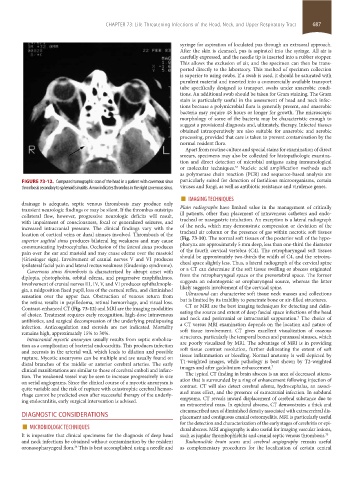
                    FIGURE 73-12.  Computed tomographic scan of the head in a patient with cavernous sinus   particularly suited for detection of fastidious microorganisms, certain
                    thrombosis secondary to sphenoid sinusitis. Arrow indicates thrombus in the right cavernous sinus.  viruses and fungi, as well as antibiotic resistance and virulence genes.
                                                                              ■  IMAGING TECHNIQUES
                    drainage is adequate, septic venous thrombosis may produce only
                    transient neurologic findings or may be silent. If the thrombus outstrips   Plain radiographs have limited value in  the management of critically
                    collateral flow, however, progressive neurologic deficits will result,   ill patients, other than placement of intravenous catheters and endo-
                    with impairment of consciousness, focal or generalized seizures, and   tracheal or nasogastric intubation. An exception is a lateral radiograph
                    increased intracranial pressure. The clinical findings vary with the   of the neck, which may demonstrate compression or deviation of the
                    location of cortical veins or dural sinuses involved. Thrombosis of the   tracheal air column or the presence of gas within necrotic soft tissues
                    superior sagittal sinus produces  bilateral leg  weakness  and  may cause   (Fig. 73-10). The normal soft tissues of the posterior wall of the hypo-
                    communicating hydrocephalus. Occlusion of the lateral sinus produces   pharynx are approximately 5 mm deep, less than one-third the diameter
                    pain over the ear and mastoid and may cause edema over the mastoid   of the fourth  cervical vertebra  (C4).  The retropharyngeal soft  tissues
                    (Griesinger sign). Involvement of cranial nerves V and VI produces   should be approximately two-thirds the width of C4, and the retrotra-
                    ipsilateral facial pain and lateral rectus weakness (Gradenigo syndrome).  cheal space slightly less. Thus, a lateral radiograph of the cervical spine
                     Cavernous sinus thrombosis is characterized by abrupt onset with   or a CT can determine if the soft tissue swelling or abscess originated
                    diplopia, photophobia, orbital edema, and progressive exophthalmos.   from the retropharyngeal space or the prevertebral space. The former
                    Involvement of cranial nerves III, IV, V, and VI produces ophthalmople-  suggests an odontogenic or oropharyngeal source, whereas the latter
                    gia, a midposition fixed pupil, loss of the corneal reflex, and diminished   likely suggests involvement of the cervical spine.
                    sensation over the upper face. Obstruction of venous return from   Ultrasound can characterize soft tissue neck masses and collections
                    the retina results in papilledema, retinal hemorrhage, and visual loss.   but is limited by its inability to penetrate bone or air-filled structures.
                    Contrast-enhanced CT (Fig. 73-12) and MRI are the imaging modalities   CT or MRI are the best imaging techniques for detecting and delin-
                    of choice. Treatment requires early recognition, high-dose intravenous   eating the source and extent of deep fascial space infections of the head
                                                                                                                  7
                    antibiotics, and surgical decompression of the underlying predisposing   and neck and pericranial or intracranial suppuration.  The choice of
                    infection. Anticoagulation and steroids are not indicated. Mortality   a CT versus MRI examination depends on the location and nature of
                    remains high, approximately 15% to 30%.               soft tissue involvement. CT gives excellent visualization of osseous
                     Intracranial mycotic aneurysm usually results from septic emboliza-  structures, particularly the temporal bones and paranasal sinuses, which
                    tion as a complication of bacterial endocarditis. This produces infection   are  poorly  visualized by  MRI.  The advantage of  MRI  is  in providing
                    and necrosis in the arterial wall, which leads to dilation and possible   soft tissue contrast resolution, further delineating the extent of soft
                    rupture. Mycotic aneurysms can be multiple and are usually found on   tissue inflammation or bleeding. Normal anatomy is well depicted by
                    distal branches of the middle or anterior cerebral arteries. The early   T1-weighted images, while pathology is best shown by T2-weighted
                                                                                                         7
                    clinical manifestations are similar to those of cerebral emboli and infarc-  images and after gadolinium enhancement.
                    tion. The weakened vessel may be seen to increase progressively in size   The typical CT finding in brain abscess is an area of decreased attenu-
                    on serial angiograms. Since the clinical course of a mycotic aneurysm is   ation that is surrounded by a ring of enhancement following injection of
                    quite variable and the risk of rupture with catastrophic cerebral hemor-  contrast. CT will also detect cerebral edema, hydrocephalus, an associ-
                    rhage cannot be predicted even after successful therapy of the underly-  ated mass effect, and the presence of extracranial infection. In subdural
                    ing endocarditis, early surgical intervention is advised.  empyema, CT reveals inward displacement of cerebral substance due to
                                                                          an extracerebral mass. In epidural abscess, CT demonstrates a thick and
                                                                          circumscribed area of diminished density associated with extracerebral dis-
                    DIAGNOSTIC CONSIDERATIONS                             placement and contiguous cranial osteomyelitis. MRI is particularly useful
                        ■  MICROBIOLOGIC TECHNIQUES                       for the detection and characterization of the early stages of cerebritis or epi-
                                                                          dural abscess. MRI angiography is also useful for imaging vascular lesions,
                    It is imperative that clinical specimens for the diagnosis of deep head   such as jugular thrombophlebitis and cranial septic venous thrombosis. 23
                    and neck infections be obtained without contamination by the resident   Radionuclide brain scans  and  cerebral angiography  remain  useful
                                      34
                    oronasopharyngeal flora.  This is best accomplished using a needle and   as complementary procedures for the localization of certain central


            section05_c61-73.indd   687                                                                                1/23/2015   12:49:13 PM

