


Page 977 - Hall et al (2015) Principles of Critical Care-McGraw-Hill
P. 977
708     PART 5: Infectious Disorders


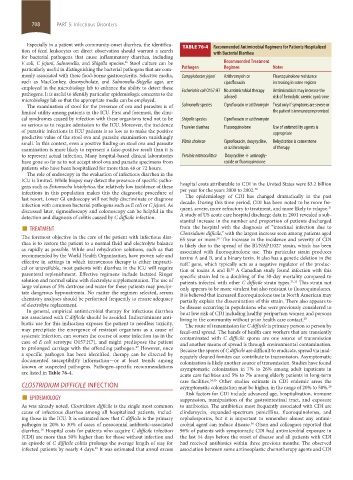
                   Especially in a patient with community-onset diarrhea, the identifica-    TABLE 76-4     Recommended Antimicrobial Regimens for Patients Hospitalized
                 tion of fecal leukocytes on direct observation should warrant a search   with Bacterial Diarrhea
                 for  bacterial  pathogens  that  cause  inflammatory  diarrhea,  including
                 E  coli, C  jejuni,  Salmonella, and  Shigella species.  Stool culture can be   Recommended Treatment
                                                    26
                   particularly useful in distinguishing the bacterial pathogens that are com-  Pathogen  Regimen  Notes
                 monly associated with these food-borne gastroenteritis. Selective media,   Campylobacter jejuni  Azithromycin or    Fluoroquinolone resistance
                 such  as MacConkey, desoxycholate, and  Salmonella-Shigella agar,  are   ciprofloxacin  increasing in some regions
                 employed in the microbiology lab to enhance the ability to detect these   Escherichia coli O157:H7 No antimicrobial therapy   Antimicrobials may increase the
                 pathogens. It is useful to identify particular epidemiologic concerns to the
                 microbiology lab so that the appropriate media can be employed.      advised          risk of hemolytic uremic syndrome
                   The examination of stool for the presence of ova and parasites is of   Salmonella species  Ciprofloxacin or azithromycin Treat only if symptoms are severe or

                 limited utility among patients in the ICU. First and foremost, the clini-             the patient is immunocompromised
                 cal syndromes caused by infection with these organisms tend not to be   Shigella species  Ciprofloxacin or azithromycin
                 so serious as to require admission to the ICU. Moreover, the incidence   Traveler diarrhea  Fluoroquinolone  Use of antimotility agents is
                 of parasitic infections in ICU patients is so low as to make the positive               appropriate
                 predictive value of the stool ova and parasite examination vanishingly
                 small. In this context, even a positive finding on stool ova and parasite   Vibrio cholerae  Ciprofloxacin, doxycycline,   Rehydration is cornerstone
                 examination is more likely to represent a false-positive result than it is   or azithromycin  of therapy
                 to represent actual infection. Many hospital-based clinical laboratories   Yersinia enterocolitica   Doxycycline + aminogly-
                 have gone so far as to not accept stool ova and parasite specimens from   coside or fluoroquinolone
                 patients who have been hospitalized for more than 48 or 72 hours.
                   The role of endoscopy in the evaluation of infectious diarrhea in the
                 ICU is limited. While biopsy may detect the presence of specific patho-
                 gens such as Entamoeba histolytica, the relatively low incidence of these   hospital costs attributable to CDI in the United States were $3.2 billion
                                                                                                 30
                 infections in this population makes this the diagnostic procedure of   per year for the years 2000 to 2002.
                 last resort. Lower GI endoscopy will not help discriminate or diagnose   The epidemiology of CDI has changed dramatically in the past
                 infection with common bacterial pathogens such as E coli or C jejuni. As   decade. During this time period, CDI has been noted to be more fre-
                                                                                                                          31
                 discussed later, sigmoidoscopy and colonoscopy can be helpful in the   quent, severe, more refractory to treatment, and more likely to relapse.
                 detection and diagnosis of colitis caused by C difficile infection.  A study of US acute care hospital discharge data in 2001 revealed a sub-
                     ■  TREATMENT                                      from the hospital with the diagnosis of “intestinal infection due to
                                                                       stantial increase in the number and proportion of patients discharged
                 The foremost objective in the care of the patient with infectious diar-  Clostridium difficile,” with the largest increase seen among patients aged
                                                                       65 year or more.  The increase in the incidence and severity of CDI
                                                                                    28
                 rhea is to restore the patient to a normal fluid and electrolyte balance   is likely due to the spread of the BI/NAP1/027 strain, which has been
                 as rapidly as possible. While oral rehydration solutions, such as that   associated with fluoroquinolone use. This particular strain produces
                 recommended by the World Health Organization, have proven safe and   toxins A and B, and a binary toxin. It also has a genetic deletion in the
                 effective in settings in which intravenous therapy is either impracti-  tcdC gene, which typically acts as a negative regulator of the produc-
                 cal or unavailable, most patients with diarrhea in the ICU will require   tion of toxins A and B.  A Canadian study found infection with this
                                                                                         32
                 parenteral  replenishment.  Effective  regimens include  lactated  Ringer   specific strain led to a doubling of the 30-day mortality compared to
                 solution and normal saline with electrolyte supplementation. The use of   patients infected with other C difficile strain types. 31,33  This strain not
                 large volumes of 5% dextrose and water for these patients may precipi-  only appears to be more virulent but also resistant to fluoroquinolones.
                 tate dangerous hyponatremia. No matter the regimen selected, serum   It is believed that increased fluoroquinolone use in North American may
                 chemistry analyses should be performed frequently to ensure adequacy   partially explain the dissemination of this strain. There also appears to
                 of electrolyte replacement.                           be disease occurring in populations who were previously considered to
                   In general, empirical antimicrobial therapy for infectious diarrhea   be at low risk of CDI including healthy peripartum women and persons
                 not associated with C difficile should be avoided. Indiscriminant anti-  living in the community without prior health care contact. 28
                 biotic use for this indication exposes the patient to needless toxicity,   The route of transmission for C difficile is primary person to person by
                 may precipitate the emergence of resistant organisms as a cause of   fecal-oral spread. The hands of health care workers that are transiently
                 systemic infection, can worsen the course of some infection (as in the   contaminated with  C difficile spores are one source of transmission
                 case of  E coli serotype O157:H7), and might  predispose the  patient   and another means of spread is through environmental contamination.
                 to prolonged carriage with the offending pathogen.  However, once   Because the spores of C difficile are difficult to eradicate, spread via inad-
                                                        27
                 a specific pathogen has been identified, therapy can be directed by   equately cleaned fomites can contribute to transmission. Asymptomatic
                 documented susceptibility information—or at least trends among   colonization is likely another source of transmission. Studies have found
                 known or suspected pathogens. Pathogen-specific recommendations   asymptomatic  colonization in  7% to  26% among  adult  inpatients  in
                 are listed in Table 76-4.                             acute care facilities and 5% to 7% among elderly patients in long-term
                                                                       care facilities. 34,35  Other studies estimate in CDI endemic areas the
                 CLOSTRIDIUM DIFFICILE INFECTION                       asymptomatic colonization may be higher, in the range of 20% to 50%. 28
                     ■  EPIDEMIOLOGY                                   suppression, manipulation of the gastrointestinal tract, and exposure
                                                                         Risk factors for CDI include advanced age, hospitalization, immune
                 As was already noted, Clostridium difficile is the single most common   to antibiotics. The antibiotics most frequently associated with CDI are
                 cause of infectious diarrhea among all hospitalized patients, includ-  clindamycin, expanded-spectrum penicillins, fluoroquinolones, and
                 ing those in the ICU. It is estimated now that C difficile is the primary   cephalosporins, but it is important to remember almost any antimi-
                 pathogen in 20% to 30% of cases of nosocomial antibiotic-associated   crobial agent can induce disease.  Olson and colleagues reported that
                                                                                               36
                 diarrhea.  Hospital costs for patients who acquire C difficile infection   96% of patients with symptomatic CDI had antimicrobial exposure in
                        28
                 (CDI) are more than 50% higher than for those without infection and   the last 14 days before the onset of disease and all patients with CDI
                 an episode of C difficile colitis prolongs the average length of stay for   had  received  antibiotics  within  three  previous  months.  The  observed
                 infected patients by nearly 4 days.  It was estimated that annul excess   association between some antineoplastic chemotherapy agents and CDI
                                          29


            section05_c74-81.indd   708                                                                                1/23/2015   12:37:29 PM

