


Page 975 - Hall et al (2015) Principles of Critical Care-McGraw-Hill
P. 975
706     PART 5: Infectious Disorders


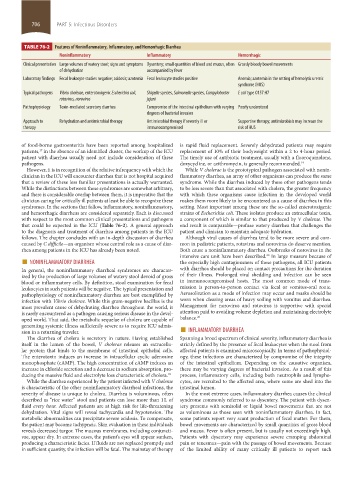
                   TABLE 76-2    Features of Noninflammatory, Inflammatory, and Hemorrhagic Diarrhea
                              Noninflammatory               Inflammatory                   Hemorrhagic
                  Clinical presentation Large volumes of watery stool; signs and symptoms  Dysentery; small quantities of blood and mucus, often  Grossly bloody bowel movements
                              of dehydration                accompanied by fever
                  Laboratory findings Fecal leukocyte studies negative; acidosis; azotemia Fecal leukocyte studies positive  Anemia; azotemia in the setting of hemolytic uremic
                                                                                             syndrome (HUS)
                  Typical pathogens  Vibrio cholerae, enterotoxigenic Escherichia coli,   Shigella species, Salmonella species, Campylobacter   E coli type O157:H7
                               rotavirus, norovirus         jejuni
                  Pathophysiology  Toxin-mediated secretory diarrhea  Compromise of the intestinal epithelium with varying  Poorly understood
                                                            degrees of bacterial invasion
                  Approach to   Rehydration and antimicrobial therapy  Antimicrobial therapy if severely ill or   Supportive therapy; antimicrobials may increase the
                  therapy                                     immunocompromised            risk of HUS


                 of food-borne gastroenteritis have been reported among hospitalized   is rapid fluid replacement. Severely dehydrated patients may require
                 patients,  in the absence of an identified cluster, the workup of the ICU   replacement of 10% of their bodyweight within a 2 to 4-hour period.
                       17
                 patient with diarrhea usually need not include consideration of these   The timely use of antibiotic treatment, usually with a fluoroquinolone,
                 pathogens.                                            doxycycline, or azithromycin, is generally recommended. 19
                   However, it is in recognition of the relative infrequency with which the   While V cholerae is the prototypical pathogen associated with nonin-
                 clinician in the ICU will encounter diarrhea that is not hospital acquired   flammatory diarrhea, an array of other organisms can produce the same
                 that a review of these less familiar presentations is actually warranted.   syndrome. While the diarrhea induced by these other pathogens tends
                 While the distinctions between these syndromes are somewhat arbitrary,   to be less severe than that associated with cholera, the greater frequency
                 and there is considerable overlap between them, it is imperative that the   with which these organisms cause infection in the developed world
                 clinician caring for critically ill patients at least be able to recognize these   makes them more likely to be encountered as a cause of diarrhea in this
                 syndromes. In the sections that follow, inflammatory, noninflammatory,   setting. Most important among these are the so-called enterotoxigenic
                 and hemorrhagic diarrheas are considered separately. Each is discussed   strains of Escherichia coli. These isolates produce an extracellular toxin,
                 with respect to the most common clinical presentations and pathogens   a component of which is similar to that produced by V cholerae. The
                 that could be expected in the ICU (Table 76-2). A general approach   end result is comparable—profuse watery diarrhea that challenges the
                 to the diagnosis and treatment of diarrhea among patients in the ICU   patient and clinician to maintain adequate hydration.
                 follows. The chapter concludes with an in-depth discussion of diarrhea   Although viral causes of diarrhea tend to be more severe and com-
                 caused by C difficile—an organism whose central role as a cause of diar-  mon in pediatric patients, rotavirus and norovirus do deserve mention.
                 rhea among patients in the ICU has already been noted.  Both cause a noninflammatory diarrhea. Outbreaks of norovirus in the
                     ■  NONINFLAMMATORY DIARRHEA                       intensive care unit have been described.  In large measure because of
                                                                                                     20
                                                                       the especially high contagiousness of these pathogens, all ICU patients
                 In general, the noninflammatory diarrheal syndromes are character-  with diarrhea should be placed on contact precautions for the duration
                 ized by the production of large volumes of watery stool devoid of gross   of their illness. Prolonged viral shedding and infection can be seen
                 blood or inflammatory cells. By definition, stool examination for fecal   in immunocompromised hosts. The most common mode of trans-
                 leukocytes in such patients will be negative. The typical presentation and   mission is person-to-person contact via fecal or vomitus-oral route.
                 pathophysiology of noninflammatory diarrhea are best exemplified by   Aerosolization as a mode of infection may occur and masks should be
                 infection with Vibrio cholerae. While this gram-negative bacillus is the   worn when clearing areas of heavy soiling with vomitus and diarrhea.
                 most prevalent cause of dehydrating diarrhea throughout the world, it   Management for norovirus and rotavirus is supportive with special
                 is rarely encountered as a pathogen causing serious disease in the devel-  attention paid to avoiding volume depletion and maintaining electrolyte
                 oped world. That said, the metabolic sequelae of cholera are capable of   balance. 20
                 generating systemic illness sufficiently severe as to require ICU admis-    ■
                 sion in a returning traveler.                            INFLAMMATORY DIARRHEA
                   The diarrhea of cholera is secretory in nature. Having established   Spanning a broad spectrum of clinical severity, inflammatory diarrhea is
                 itself in the lumen of the bowel,  V cholerae releases an extracellu-  strictly defined by the presence of fecal leukocytes when the stool from
                 lar protein that binds to the membrane of intestinal epithelial cells.   affected patients is examined microscopically. In terms of pathophysiol-
                 The enterotoxin induces an increase in intracellular cyclic adenosine   ogy, these infections are characterized by compromise of the integrity
                 monophosphate (cAMP). The high concentration of cAMP induces an   of  the  intestinal  epithelium.  Depending  on  the  causative  organism,
                 increase in chloride secretion and a decrease in sodium absorption, pro-  there may be varying degrees of bacterial invasion. As a result of this
                 ducing the  massive fluid and electrolyte loss characteristic of cholera. 18  process, inflammatory cells, including both neutrophils and lympho-
                   While the diarrhea experienced by the patient infected with V  cholerae   cytes, are recruited to the affected area, where some are shed into the
                 is characteristic of the other noninflammatory diarrheal infections, the   intestinal lumen.
                 severity of disease is unique to cholera. Diarrhea is voluminous, often   In the most extreme cases, inflammatory diarrhea causes the clinical
                 described as “rice water” stool and patients can lose more than 1 L of   syndrome commonly referred to as dysentery. The patient with dysen-
                 fluid every hour. Affected patients are at high risk for life-threatening   tery presents with semisolid or liquid bowel movements that are not
                 dehydration. Vital signs will reveal tachycardia and hypotension. The   as voluminous as those seen with noninflammatory diarrhea. In fact,
                 metabolic abnormalities can precipitate severe acidosis. To compensate,   some patients report very scant production of fecal matter. For them,
                 the patient may become tachypneic. Skin evaluation in these individuals   bowel movements are characterized by small quantities of gross blood
                 reveals decreased turgor. The mucous membranes, including conjuncti-  and mucus. Fever is often present, but is usually not exceedingly high.
                 vae, appear dry. In extreme cases, the patient’s eyes will appear sunken,   Patients with dysentery may experience severe cramping abdominal
                 producing a characteristic facies. If fluids are not replaced promptly and   pain or tenesmus—pain with the passage of bowel movements. Because
                 in sufficient quantity, the infection will be fatal. The mainstay of therapy   of the limited ability of many critically ill patients to report such


            section05_c74-81.indd   706                                                                                1/23/2015   12:37:29 PM

