


Page 978 - Hall et al (2015) Principles of Critical Care-McGraw-Hill
P. 978
CHAPTER 76: Gastrointestinal Infections and Clostridium Difficile  709


                    similarly challenges our understanding of the pathophysiology of these
                    infections.
                        ■  CLINICAL PRESENTATION

                    The clinical presentation of patients with C difficile can be quite diverse.
                    In addition to asymptomatic carriage, some patients may report only
                    a minimal increase in the frequency or liquidity of bowel movements.
                    Such individuals, while at low risk of complication from infection, if
                    not identified and appropriately isolated from other patients, represent
                    a potentially important reservoir for the spread of  C difficile within
                    the ICU. At the other extreme, patients may experience severe clinical
                    deterioration as a result infection with C difficile. The bowel movements
                    of the patient with C difficile infection may be watery and voluminous,
                    such as is seen in noninflammatory diarrheas. Other patients with
                    C  difficile infection experience a clinical syndrome more consistent
                    with that of the inflammatory gastroenteritis, occasionally even report-
                    ing gross blood in the stool. Fever is present in about half of patients.
                    Leukocytosis, sometimes profound, is often a reliable indicator of the
                    onset of C difficile colitis. Clinicians should consider testing for CDI in
                    the setting of unexplained leukocytosis. In rare cases, CDI can cause
                    pouchitis or ileitis in patients who have previously undergone a total
                    colectomy. Symptoms of CDI usually begin soon after colonization, with
                    a median time to onset of 2 to 3 days but it is important to understand
                    the risk of CDI can persist for many weeks after antibiotics are stopped. 28
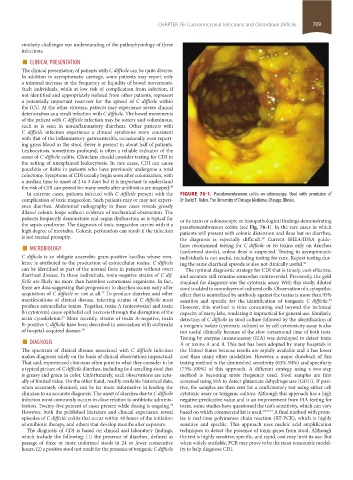
                     In extreme cases, patients infected with C difficile present with the   FIGURE 76-1.  Pseudomembranous colitis on colonoscopy. Used with permission of
                    complication of toxic megacolon. Such patients may or may not experi-  Dr David T. Rubin, The University of Chicago Medicine, Chicago, Illinois.
                    ence diarrhea. Abdominal radiography in these cases reveals grossly
                    dilated colonic loops without evidence of mechanical obstruction. The
                    patients frequently demonstrate end-organ dysfunction as is typical for   or its toxin or colonoscopic or histopathological findings demonstrating
                    the sepsis syndrome. The diagnosis of toxic megacolon carries with it a   pseudomembranous colitis (see Fig. 76-1). In the rare cases in which
                    high degree of mortality. Colonic perforation can result if the infection   patients will present with colonic distension and ileus but no diarrhea,
                    is not treated promptly.                              the diagnosis is especially difficult.  Current SHEA/IDSA guide-
                        ■  MICROBIOLOGY                                   lines recommend testing for  C difficile or its toxins only on diarrhea
                                                                                                     28
                    C difficile is an obligate anaerobic gram-positive bacillus whose viru-  (unformed stools), unless ileus is suspected. Testing in asymptomatic
                                                                          individuals is not useful, including testing for cure. Repeat testing dur-
                    lence is attributed to the production of extracellular toxins. C difficile   ing the same diarrheal episode is also not clinically useful. 32
                    can be identified as part of the normal flora in patients without overt   The optimal diagnostic strategy for CDI that is timely, cost-effective,
                    diarrheal disease. In these individuals, toxin-negative strains of C dif-  and accurate still remains somewhat controversial. Previously, the gold
                    ficile are likely no more than harmless commensal organisms. In fact,   standard for diagnosis was the cytotoxic assay. With this study, diluted
                    there are data suggesting that progression to diarrhea occurs early after   stool is added to monolayers of cultured cells. Observation of a cytopathic
                    acquisition of C difficile or not at all.  To produce diarrhea and other   effect that is neutralized by antibody against the toxins is more than 95%
                                               35
                    manifestations of clinical disease, infecting strains of  C difficile must   sensitive and specific for the identification of toxigenic  C difficile.
                                                                                                                            40
                    produce extracellular toxins. Together, toxin A (enterotoxin) and toxin   However, this method is time consuming and beyond the technical
                    B (cytotoxin) cause epithelial cell necrosis through the disruption of the   capacity of many labs, rendering it impractical for general use. Similarly,
                    actin cytoskeleton.  More recently, strains of toxin A–negative, toxin    detection of C difficile in stool culture followed by the identification of
                                 37
                    B–positive C difficile have been described in association with outbreaks   a toxigenic isolate (cytotoxic culture) or by cell cytotoxicity assay is also
                    of hospital-acquired disease. 38                      not useful clinically because of the slow turnaround time of both tests.
                        ■  DIAGNOSIS                                      Testing by enzyme immunoassay (EIA) was developed to detect toxin
                                                                          A or toxins A and B. This test has been adopted by many hospitals in
                    The spectrum  of clinical  disease associated with  C difficile infection   the United States because results are rapidly available and it has lower
                    makes diagnosis solely on the basis of clinical observations impractical.   cost than many other modalities. However, a major drawback of this
                    That said, experienced clinicians often point to what they consider to be   testing method is the diminished sensitivity (63%-94%) and specificity
                    a typical picture of C difficile diarrhea, including foul-smelling stool that   (75%-100%)  of  this  approach.  A  different  strategy  using  a  two-step
                    is greasy and green in color. Unfortunately, such observations are actu-  method  is  becoming  more  frequency  used.  Stool  samples  are  first
                    ally of limited value. On the other hand, readily available historical data,   screened using EIA to detect glutamate dehydrogenase (GDH). If posi-
                    when accurately obtained, can be far more informative in leading the   tive, the samples are then sent for a confirmatory test using either cell
                    clinician to an accurate diagnosis. The onset of diarrhea due to C difficile   cytotoxic assay or toxigenic culture. Although this approach has a high
                    infection most commonly occurs in close relation to antibiotic adminis-  negative predicative value and is an improvement from EIA testing for
                    tration. Twenty-five percent of cases present while dosing is ongoing.    toxin, some studies have questioned the test’s sensitivity, which can vary
                                                                      39
                    However, both the published literature and clinical experience reveal   based on which commercial kit is used. 28,41,42  A final method with prom-
                    episodes of C difficile colitis that occur within 48 hours of the initiation   ise is real-time polymerase chain reaction (RT-PCR), which is highly
                    of antibiotic therapy, and others that develop months after exposure.  sensitive and specific. This approach uses nucleic acid amplification
                     The diagnosis of CDI is based on clinical and laboratory findings,   techniques to detect the presence of toxin genes from stool. Although
                    which include the following: (1) the presence of diarrhea, defined as   the test is highly sensitive, specific, and rapid, cost may limit its use. But
                      passage of three or more unformed stools in 24 or fewer consecutive   when widely available, PCR may prove to be the most reasonable modal-
                    hours, (2) a positive stool test result for the presence of toxigenic C difficile   ity to help diagnose CDI.


            section05_c74-81.indd   709                                                                                1/23/2015   12:37:30 PM

