


Page 976 - Hall et al (2015) Principles of Critical Care-McGraw-Hill
P. 976
CHAPTER 76: Gastrointestinal Infections and Clostridium Difficile  707


                    complaints, clinicians should be alert for the presence of the unique     TABLE 76-3    Diagnostic Approach to the Patient with Infectious Diarrhea
                    stool characteristics that identify the patient with dysentery and inflam-
                    matory diarrhea. A number of pathogens have been described in associ-  History
                    ation with the clinical manifestations of inflammatory diarrhea, but the     Timing and rapidity of onset
                    classical description of the syndrome is associated with infection with     Associated signs and symptoms (fever)
                    Shigella species, particularly S dysenteriae. As was true for cholera and
                    other noninflammatory diarrheas, this association once again points to     Nature and quantity of bowel movements
                    a shared pathophysiology. Pathogenic Shigella species elaborate an exo-    Prior antibiotics or chemotherapy
                    toxin (Shiga toxin) that acts by inhibiting protein synthesis, damaging   Physical examination
                    the intestinal mucosa. Analogous Shiga-like toxins have been detected in
                    association with other bacterial species linked to inflammatory diarrhea,     Hemodynamic compromise (tachycardia or hypotension)
                    including both enteroinvasive and enterohemorrhagic strains of E coli.    Signs of dehydration (orthostasis, skin tenting)
                     Like  Shigella, the other bacterial species commonly identified in     Rectal examination for gross or occult bleeding
                    cases of inflammatory diarrhea are generally acquired through fecal
                    oral transmission, often in the setting of food-borne outbreaks. In the   Laboratory
                    United States, the most common such pathogens are members of the     Stool for fecal leukocytes
                    Salmonella species. Outbreaks of food-borne salmonellosis, while most     Testing for C difficile
                    commonly linked to undercooked poultry and dairy products, have     Stool culture (especially in the setting of outbreak or community acquisition)
                    even been reported in the context of a deliberate release associated
                    with an episode of domestic bioterrorism.  Other important pathogens     Stool for ova and parasites (if travel related)
                                                  21
                    identified in association with inflammatory diarrhea include E coli and     Endoscopy (reserve for persistent cases in which other tests are not revealing)
                    Campylobacter jejuni and are usually associated with undercooked or
                    cross-contaminated foodstuffs.
                        ■  HEMORRHAGIC DIARRHEA                           of  bowel  movements  (with  particular  emphasis  on  the  presence  or

                    Patients with hemorrhagic diarrhea, characterized by the presence of   absence of bloody stools). Additional essential data include information
                                                                          about recent travel, unusual dietary intake, and the presence of similar
                    frank blood in bowel movements, are increasingly being seen in the   symptoms among companions with whom the patient has shared a meal.
                    setting of the ICU. In addition to the hemodynamic and metabolic   Of course, a specific history of prior antibiotic therapy or cancer che-
                    complications that characterize other inflammatory diarrheas, patients   motherapy will be needed to distinguish individuals at especially high
                    with hemorrhagic diarrhea have been found to be predisposed to sys-  risk for C difficile colitis. By the end of this process, the clinician should
                    temic illness that can warrant admission to critical care. Infections with   be able to characterize the diarrhea as acute or chronic, community
                    enterohemorrhagic E coli O157 : H7 and other serotypes have been epi-  or hospital onset, and severe or mild. The last finding is of particular
                    demiologically linked to the development of the hemolytic uremic syn-  importance in that supportive therapy to alleviate severe dehydration
                    drome and thrombotic thrombocytopenic purpura. 22,23  The mechanism   should not be withheld pending further laboratory and microbiologic
                    linking infection and this syndrome is not yet completely understood.   evaluation of severe cases.
                    It is likely that the interaction between the Shiga toxin, leukocytes, and   Given the emphasis placed on distinguishing inflammatory from
                    platelets contributes to the resultant thrombotic events that are noted on   noninflammatory diarrhea, it will come as no surprise that the initial
                    histopathology.  The deposition of fibrin thrombi in the renal glomeruli   laboratory workup of the critically ill patient with diarrhea should
                               24
                    can induce sufficient anemia, thrombocytopenia, and azotemia as to be   include an objective measure of inflammation. Testing for fecal leuko-
                    life threatening. The hemolytic uremic syndrome typically follows the   cytes offers a reliable means by which to do so. The test is performed
                    onset of diarrhea by about 1 week. While many of these patients will   by mixing a drop of stool with methylene blue on a slide, followed by
                    require intensive supportive therapy, including blood transfusion and   examination under a microscope. Testing for stool occult blood has
                    hemodialysis, for most the condition is reversible. Of particular concern   been suggested as another useful tool to identify patients in the ICU
                    to clinicians caring for these patients is the observation that antimicro-  with inflammatory diarrhea. Unfortunately, testing for occult blood,
                    bial treatment may contribute to the emergence of this syndrome. 25  even in the presence of a new fever in a critically ill patient, may be
                        ■  EVALUATION OF THE CRITICALLY ILL PATIENT WITH DIARRHEA  of little use in discriminating inflammatory infectious diarrhea from
                                                                          other common, noninfectious causes of bloody bowel movements
                    The foremost consideration in the evaluation of the critically ill patient   among such patients, including stress-induced gastric ulceration and
                    with diarrhea is the prompt recognition of infection with C difficile, as   ischemic colitis.
                    is discussed in detail later. In the setting of prior exposure to antimi-  In the setting of noninflammatory diarrhea, epidemiologic data must
                    crobials or antineoplastic therapy, most hospital-onset diarrhea can be   be interpreted to assess the likelihood of infection with unexpected, but
                    presumptively attributed to C difficile infection until proven otherwise.   potentially lethal pathogens such as V cholerae. For a traveler returning
                    Identification of these patients is critical not only for the initiation of   from an endemic area presenting with signs and symptoms consistent
                    directed therapy, but to ensure that adequate infection control proce-  with cholera, direct stool examination under darkfield or phase contrast
                    dures are followed to limit the spread of infection to other vulnerable   microscopy can reveal the linear motility characteristic of V cholerae.
                    patients in the ICU. A comprehensive approach to the diagnosis of    The organism will also grow on nonselective bacteriologic media, but
                    C difficile is provided at the end of this chapter.   the preferred method is culture on thiosulfate-citrate-bile salts-sucrose
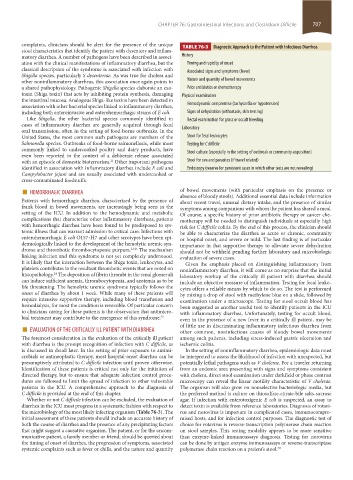
                     Whether or not C difficile infection can be excluded, the evaluation of   agar. If infection with enterotoxigenic E coli is suspected, an assay to
                    diarrhea in the ICU must progress in a systematic fashion with respect to   detect toxin is available from reference laboratories. Diagnosis of rotavi-
                    the microbiology of the most likely infecting organism (Table 76-3). The   rus and norovirus is important in complicated cases, immunocompro-
                    initial assessment of these patients should include an accurate history of   mised hosts, and for infection control purposes. The diagnostic test of
                    both the course of diarrhea and the presence of any precipitating factors   choice for rotavirus is reverse-transcription polymerase chain reaction
                    that might suggest a causative organism. The patient, or for the uncom-  on  stool  samples.  This  testing  modality  appears  to  be  more  sensitive
                    municative patient, a family member or friend, should be queried about   than enzyme-linked immunoassays diagnosis. Testing for norovirus
                    the timing of onset of diarrhea, the progression of symptoms, associated   can be done by antigen enzyme immunoassays or reverse-transcriptase
                    systemic complaints such as fever or chills, and the nature and quantity   polymerase chain reaction on a patient’s stool. 20


            section05_c74-81.indd   707                                                                                1/23/2015   12:37:29 PM

