


Page 979 - Hall et al (2015) Principles of Critical Care-McGraw-Hill
P. 979
710     PART 5: Infectious Disorders


                   Endoscopy can be helpful in the diagnosis of C difficile colitis, but its   reasons previously outlined. However, for cases of severe CDI, which is
                 widespread application for this purpose is limited. The characteristic   defined as leukocytosis >15,000 and elevation of serum creatinine >1.5
                 finding of pseudomembranes comprised of necrotic epithelial tissue   premorbid level, oral vancomycin is the treatment of choice. 28
                 and inflammatory cells all but confirms the diagnosis of C difficile colitis   When oral therapy is not feasible or in cases of severe complicated
                 in the appropriate clinical setting. However, this finding is not always   CDI, intravenous metronidazole achieves adequate intraluminal con-
                 encountered, even in severe episodes of C difficile colitis. Moreover, to   centrations to eradicate  C difficile colitis.  The recommended dosage
                                                                                                      45
                 perform colonoscopy or even flexible sigmoidoscopy in the setting of   is 500 mg every 8 hours. Intravenous vancomycin should never be used
                 C difficile infection is to expose the patient to the risk of unnecessary   to  treat  C difficile  infection.  After  parenteral  vancomycin  administra-
                 trauma that could result in the accidental perforation of an already   tion, drug levels within the intestinal lumen are not sufficient to ensure
                 inflamed and friable GI tract.                        eradication. The role of vancomycin in treating C difficile infection in
                     ■  TREATMENT                                      the critically ill patient instead focuses on intraluminal therapy. When
                                                                       administered via a rectal tube or in the form of an enema, vancomy-
                 Whenever feasible, the first and most important step in the treat-  cin can serve as a useful adjunct to intravenous metronidazole for the
                 ment of the patient with C difficile colitis is the discontinuation of the   severely ill patient. Such methods are particularly useful in the setting
                 pharmacologic agent that precipitated the infection. In most cases, this   of toxic megacolon caused by C difficile, when GI motility has all but
                 means that ongoing antimicrobial therapy for other indications should   halted, and reliable delivery of drug administered orally or by a feeding
                 be withdrawn as soon as it is safe to do so. However, this is a particular   tube cannot be assumed. However, caution is advised when employing
                 challenge when dealing with the critically ill patient. Broad-spectrum   these techniques. The GI mucosa is exceedingly friable in the setting of
                 antimicrobial therapy, even when given empirically, may be essential to   C difficile infection, particularly when toxic megacolon has developed.
                 the survival of the septic patients commonly encountered in this setting.   Such patients are at high risk for GI perforation. When the patient is
                 For them, the discontinuation of therapy is not advisable, and an agent   critically ill as a consequence of C difficile colitis (rather than critically ill
                 with activity against C difficile (discussed below) must instead be added   and also having C difficile colitis), combined therapy with metronidazole
                 to the antimicrobial regimen.                         (500 to 750 mg) IV every 6 to 8 hours plus vancomycin 500 mg enterally
                   The most appropriate antimicrobial strategy to treat C difficile colitis   every 6 hours has been advised. 46
                 can be the source of some controversy and confusion for even experi-  Relapse of CDI occurs in approximately 20% to 25% of cases.
                 enced caregivers in the ICU. Both metronidazole and vancomycin, when   A relapse if suggested by recurrence of symptoms 3 to 21 days after treat-
                                                                                   47
                 administered orally, have been shown to be effective in the treatment of   ment is stopped.  Retreatment of patients with either recurrent C dif-
                 C difficile colitis. Several clinical trials have pointed to the equivalence   ficile colitis or those who fail to respond to initial metronidazole therapy
                 of  vancomycin  and  metronidazole  therapy.   One  study  by Zar  et  al   is controversial and bears special attention. Clinicians should avoid the
                                                 43
                 stratified patients based on severity of disease and randomized to receive   practice of routine laboratory testing to detect C difficile toxin at the end
                 metronidazole or oral vancomycin. Severity of disease was based on a   of a course of therapy in an effort to confirm clearance. Infected patients
                 point system, with one point given for age  >60, temperature  >38.3,   may continue to shed detectable toxin after therapy is complete. Some
                 albumin <2.5 mg/dL, or peripheral WBC count >15,000. Patients were   individuals may do so intermittently for years. In these cases, additional
                 considered to have severe CDI with a score of 2 or greater. The study   therapy is not warranted. However, when diarrhea continues despite
                 found patients with mild disease had similar clinical cure rates with   initial therapy or recurs soon thereafter, additional treatment is advised.
                 metronidazole (90%) or oral vancomycin (98%), respectively (p = 0.36).   In these circumstances, a switch to vancomycin or a more prolonged
                 However, patients with severe disease had better rates of cure with oral   course of metronidazole has been advocated. However, in most cases,
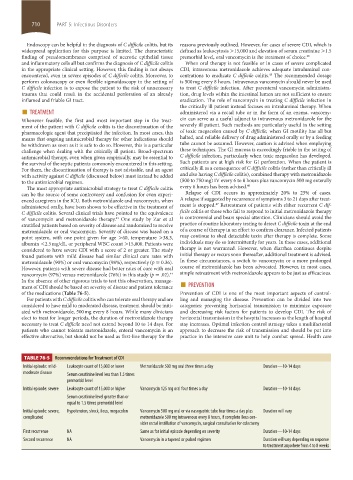
                 vancomycin (97%) versus metronidazole (76%) in this study (p = .02).    simple retreatment with metronidazole appears to be just as efficacious.
                                                                    44
                 ment of CDI should be based on severity of disease and patient tolerance   ■  PREVENTION
                 In the absence of other rigorous trials to test this observation, manage-
                 of the medications (Table 76-5).                      Prevention of CDI is one of the most important aspects of control-
                   For patients with C difficile colitis who can tolerate oral therapy and are   ling and managing the disease. Prevention can be divided into two
                 considered to have mild to moderated disease, treatment should be initi-  categories:  preventing  horizontal  transmission  to  minimize  exposure
                 ated with metronidazole, 500 mg every 8 hours. While many clinicians   and decreasing risk factors for patients to develop CDI. The risk of
                 elect to treat for longer periods, the duration of metronidazole therapy   horizontal transmission in the hospital increases as the length of hospital
                 necessary to treat C difficile need not extend beyond 10 to 14 days. For   stay increases. Optimal infection control strategy takes a multifactorial
                 patients who cannot tolerate metronidazole, enteral vancomycin is an   approach to decrease the risk of transmission and should be put into
                 effective alternative, but should not be used as first-line therapy for the   practice in the intensive care unit to help combat spread. Health care


                   TABLE 76-5    Recommendations for Treatment of CDI
                  Initial episode: mild-  Leukocyte count of 15,000 or lower  Metronidazole 500 mg oral three times a day  Duration—10-14 days
                  moderate disease  Serum creatinine level less than 1.5 times
                                 premorbid level
                  Initial episode: severe  Leukocyte count of 15,000 or higher  Vancomycin 125 mg oral four times a day  Duration—10-14 days
                                 Serum creatinine level greater than or
                                 equal to 1.5 times premorbid level
                  Initial episode: severe,   Hypotension, shock, ileus, megacolon  Vancomycin 500 mg oral or via nasogastric tube four times a day plus   Duration will vary
                  complicated                               metronidazole 500 mg intravenous every 8 hours, if complete ileus con-
                                                          sider rectal instillation of vancomycin, surgical consultation for colectomy
                  First recurrence  NA                    Same as for initial episode depending on severity  Duration—10-14 days
                  Second recurrence  NA                   Vancomycin in a tapered or pulsed regimen  Duration will vary depending on response
                                                                                                    to treatment anywhere from 4 to 8 weeks


            section05_c74-81.indd   710                                                                                1/23/2015   12:37:31 PM

