


Page 982 - Hall et al (2015) Principles of Critical Care-McGraw-Hill
P. 982
CHAPTER 77: Management of the Critically Ill Traveler  713


                    DIAGNOSTIC APPROACHES AND EARLY THERAPEUTICS          Area of Origin            Endemic Organism/Syndrome
                        ■  EPIDEMIOLOGY AND TRAVEL HISTORY                Central Asia              Acute diarrhea


                    The rate of critical illness among the sick traveler is largely unknown,        Dengue
                    but most likely occurs in a minority of cases. Given the wide array of          Malaria
                    clinical possibilities, and the time-sensitive nature required in critically    Influenza
                    ill patients with recent travel, epidemiologic clues provide the initial
                    pathway of treatment. When giving consideration to the more uncom-  South and Central America and Caribbean  Acute diarrhea
                    mon diseases, however, it is of paramount importance that investigation         Dengue
                    and therapeutic intervention are also directed toward less exotic com-
                    munity acquired pathogens. 1,4,6,7,13  These epidemiologic steps are the        Malaria (falciparum)
                    first clues to potential disease, with physical examination findings and        Influenza
                    laboratory/radiology studies providing additional support for the diag-         Histoplasmosis
                    nosis or path of empiric treatment. In essence, both rare and common
                    illnesses should be considered in a critically ill traveler.                    Coccidioidomycosis
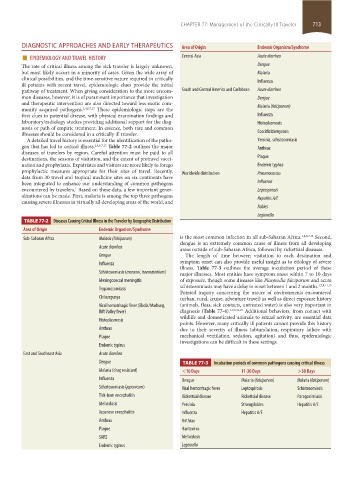
                     A detailed travel history is essential for the identification of the patho-    Yersinia, schistosomiasis
                    gen that has led to critical illness. 1,4,6,7,13  Table 77-2 outlines the major   Anthrax
                    diseases of travelers by region. Careful attention must be paid to all
                    destinations, the seasons of visitation, and the extent of pretravel vacci-     Plague
                    nation and prophylaxis. Expatriates and visitors are more likely to forego      Endemic typhus
                    prophylactic  measures  appropriate  for  their  sites  of  travel.  Recently,   Worldwide distribution  Pneumococcus
                    data from 30 travel and tropical medicine sites on six continents have
                    been integrated to enhance our understanding of common pathogens                Influenza
                    encountered by travelers.  Based on these data, a few important gener-          Leptospirosis
                                      1
                    alizations can be made. First, malaria is among the top three pathogens         Hepatitis A/E
                    causing severe illnesses in virtually all developing areas of the world, and
                                                                                                    Rabies
                                                                                                    Legionella
                      TABLE 77-2     Diseases Causing Critical Illness in the Traveler by Geographic Distribution
                    Area of Origin            Endemic Organism/Syndrome
                    Sub-Saharan Africa        Malaria (falciparum)        is the most common infection in all sub-Saharan Africa. 1,4,6,7,13  Second,
                                                                          dengue is an extremely common cause of illness from all developing
                                              Acute diarrhea
                                                                          areas outside of sub-Saharan Africa, followed by rickettsial diseases.
                                              Dengue                       The length of time between visitation to each destination and
                                              Influenza                   symptom onset can also provide useful insight as to etiology of severe
                                                                            illness.  Table 77-3 outlines the average incubation period of these
                                              Schistosomiasis (mansoni, haematobium)  major illnesses. Most entities have symptom onset within 7 to 10 days
                                              Meningococcal meningitis    of exposure, though some diseases like Plasmodia falciparum and acute
                                                                          schistosomiasis may have a delay in onset between 1 and 2 months. 1,7,8,11,15
                                              Trypanosomiasis
                                                                          Pointed inquiry concerning the nature of environments encountered
                                              Chikungunya                 (urban, rural, cruise, adventure travel) as well as direct exposure history
                                              Viral hemorrhagic fever (Ebola/Marburg,   (animals, fleas, sick contacts, untreated water) is also very important in
                                              Rift Valley fever)          diagnosis (Table 77-4). 1,7,8,11,15  Additional behaviors, from contact with
                                                                          wildlife and domesticated animals to sexual activity, are essential data
                                              Histoplasmosis
                                                                          points. However, many critically ill patients cannot provide this history
                                              Anthrax                     due to their severity of illness (obtundation, respiratory failure with
                                              Plague                      mechanical  ventilation,  sedation,  agitation) and thus, epidemiologic
                                                                          investigations can be difficult in these settings.
                                              Endemic typhus
                    East and Southeast Asia   Acute diarrhea
                                              Dengue                        TABLE 77-3    Incubation periods of common pathogens causing critical illness
                                              Malaria (drug resistant)    <10 Days            11-30 Days          >30 Days
                                              Influenza                   Dengue              Malaria (falciparum)  Malaria (falciparum)
                                              Schistosomiasis (japonicum)  Viral hemorrhagic fever  Leptospirosis  Schistosomiasis
                                              Tick-born encephalitis      Rickettsial disease  Rickettsial disease  Paragonimiasis
                                              Melioidosis                 Yersinia            Strongyloides       Hepatitis A/E
                                              Japanese encephalitis       Influenza           Hepatitis A/E
                                              Anthrax                     Anthrax
                                              Plague                      Hantavirus
                                              SARS                        Melioidosis
                                              Endemic typhus              Legionella


            section05_c74-81.indd   713                                                                                1/23/2015   12:37:32 PM

