


Page 981 - Hall et al (2015) Principles of Critical Care-McGraw-Hill
P. 981
712     PART 5: Infectious Disorders


                 people from developed countries visit the developing world yearly, and   of cases, respectively). Twenty-two percent of patients had an unspeci-
                 this number appears to be increasing. 2,3,10  In addition, preliminary data   fied febrile illness that was not identified while febrile diarrheal disease
                 suggest that visitors and expatriates are expanding subpopulations with   occurred in 15% of patients. Fever and respiratory infection were seen
                 increased risk for both injurious and infectious consequences of inter-  in 14% of patients. Almost 70% of sick travelers at GeoSentinel sites had
                 national travel. 8,9,11  More recent estimates state that 8% of travelers to   visited sub-Saharan Africa, Southeast Asia, the Caribbean, and Central
                 the developing world seek medical attention for infectious illness. 1,12-14    and South America. However, the rate of critical illness and death was
                 While the management of critical trauma and cardiovascular disease can   not determined by these studies, and, in fact, may be falsely low given
                 be difficult, the varying exposures and subsequent infectious diseases   the low rate of self-reporting among severely ill patients. 4,6,7
                 associated with critical illness present the most difficult cases for the   Management of a febrile, critically ill traveler can be difficult, espe-
                 critical care practitioner.                           cially given the wide range of infectious agents that can cause disease.
                   This chapter offers an approach to the critically ill traveler, ranging   Many of these entities, uncommon in the developed world, present
                 from a broad empiric evaluation and treatment strategy through com-    without specific symptoms or signs and may not seem temporally
                 mon disease to subsequent public health protection and impact.  related to travel itself. Rare and unusual diseases are becoming more
                                                                       common, and their presenting symptoms and clinical patterns may be
                 THE IMPORTANCE OF THE CRITICALLY-ILL TRAVELER         unfamiliar to health care providers in the developed world. In addition,
                                                                       diagnosis often requires ancillary testing not available to all hospitals
                 The rate of illness after travel is unknown, but some self-reported rates   and as a consequence may be delayed or require specialty public health
                 suggest 22% to 64% of travelers to developing countries suffer some sort   laboratories. Finally, decisions concerning appropriate antimicrobial
                 of illness related to travel. GeoSentinel, the global surveillance network   therapy as well as infection control measures are optimally made early
                 of the International Society of Travel Medicine and the Centers for   in the course of the disease, often before clinical trajectory is known and
                 Disease Control and Prevention (CDC), publishes on travel-related ill-  diagnostic information has returned.
                 ness by category and location. Sentinel data on ill travelers are  collected   However, only a few diseases and organisms need early recognition
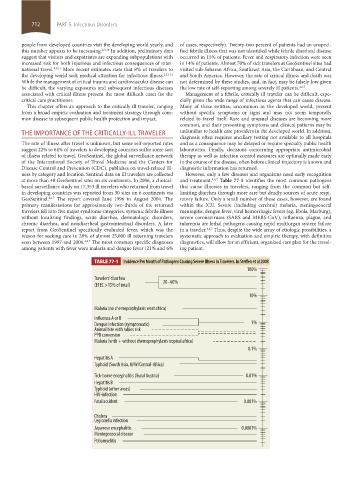
                 at more than 40 GeoSentinel sites on six continents. In 2006, a clinical-  and treatment. 4,6,7   Table 77-1 identifies the most common pathogens
                 based surveillance study on 17,353 ill travelers who returned from travel   that cause illnesses in travelers, ranging from the common but self-
                 in developing countries was reported from 30 sites on 6 continents via   limiting diarrhea through more rare but deadly sources of acute respi-
                 GeoSentinel. 4,6,7  The report covered June 1996 to August 2004. The   ratory failure. Only a small number of these cases, however, are found
                 primary manifestations for approximately two-thirds of the returned   within  the  ICU.  Severe  (including  cerebral)  malaria,  meningococcal
                 travelers fell into five major syndrome categories: systemic febrile  illness   meningitis, dengue fever, viral hemorrhagic fevers (eg, Ebola, Marburg),
                 without localizing findings, acute diarrhea, dermatologic disorders,   severe coronaviruses (SARS and MERS-CoV), influenza, plague, and
                 chronic diarrhea, and nondiarrheal gastrointestinal disorders. A later   tularemia are lethal pathogens causing rapid multiorgan system failure
                 report from GeoSentinel specifically evaluated fever, which was the   in a traveler. 4,6,7  Thus, despite the wide array of etiologic possibilities, a
                 reason for seeking care in 28% of almost 25,000 ill returning travelers   systematic approach to evaluation and empiric therapy, with definitive
                 seen between 1997 and 2006. 4,6,7  The most common specific diagnoses   diagnostics, will allow for an efficient, organized care plan for the travel-
                 among patients with fever were malaria and dengue fever (21% and 6%   ing patient.

                                           TABLE 77-1    Incidence Per Month of Pathogens Causing Severe Illness in Travelers. In Steffen et al 2008
                                                                                              100%
                                          Travelers’ diarrhea
                                          (ETEC >15% of total)   20–60%

                                                                                               10%

                                          Malaria (no chemoprophylaxis west africa)
                                          Influenza A or B
                                          Dengue infection (symptomatic)                       1%
                                          Animal bite with rabies risk
                                          PPD conversion
                                          Malaria (with + without chemoprophylaxis tropical africa)
                                                                                              0.1%
                                          Hepatitis A
                                          Typhoid (South Asia, N/W/Central-Africa)

                                          Tick-borne encephalitis (Rural Austria)             0.01%
                                          Hepatitis B
                                          Typhoid (other areas)
                                          HIV-infection
                                          Fatal accident                                     0.001%

                                          Cholera
                                          Legionella infection
                                          Japanese encephalitis                             0.0001%
                                          Meningococcal disease
                                          Poliomyelitis


            section05_c74-81.indd   712                                                                                1/23/2015   12:37:31 PM

