


Page 121 - Clinical Anatomy
P. 121
ECA2  7/18/06  6:42 PM  Page 106


                 106  The abdomen and pelvis


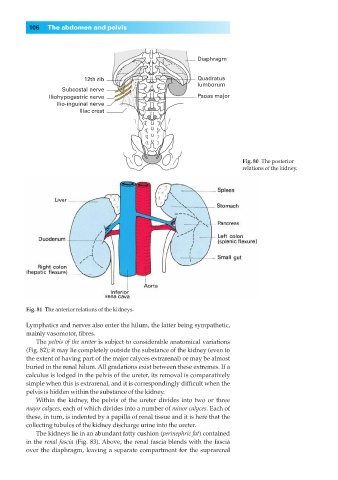
                                                                 Diaphragm

                                12th rib                         Quadratus
                                                                 lumborum
                          Subcostal nerve
                      Iliohypogastric nerve                      Psoas major
                         Ilio-inguinal nerve
                               Iliac crest


                                                                              Fig. 80◊The posterior
                                                                              relations of the kidney.


                Fig. 81◊The anterior relations of the kidneys.
                Lymphatics and nerves also enter the hilum, the latter being sympathetic,
                mainly vasomotor, fibres.
                   The pelvis of the ureter is subject to considerable anatomical variations
                (Fig. 82); it may lie completely outside the substance of the kidney (even to
                the extent of having part of the major calyces extrarenal) or may be almost
                buried in the renal hilum. All gradations exist between these extremes. If a
                calculus is lodged in the pelvis of the ureter, its removal is comparatively
                simple when this is extrarenal, and it is correspondingly difficult when the
                pelvis is hidden within the substance of the kidney.
                   Within the kidney, the pelvis of the ureter divides into two or three
                major calyces, each of which divides into a number of minor calyces. Each of
                these, in turn, is indented by a papilla of renal tissue and it is here that the
                collecting tubules of the kidney discharge urine into the ureter.
                   The kidneys lie in an abundant fatty cushion (perinephric fat) contained
                in the renal fascia (Fig. 83). Above, the renal fascia blends with the fascia
                over the diaphragm, leaving a separate compartment for the suprarenal

