


Page 122 - Clinical Anatomy
P. 122
ECA2  7/18/06  6:42 PM  Page 107


                                                                            The urinary tract  107


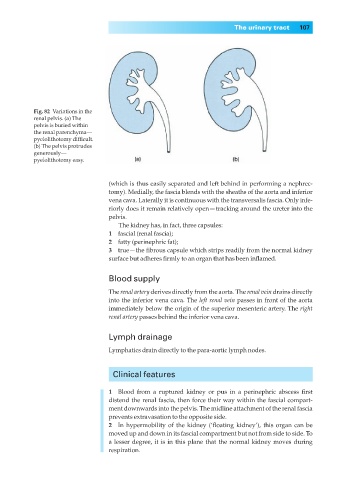
                  Fig. 82◊Variations in the
                  renal pelvis. (a) The
                  pelvis is buried within
                  the renal parenchyma—
                  pyelolithotomy difficult.
                  (b) The pelvis protrudes
                  generously—
                  pyelolithotomy easy.


                                        (which is thus easily separated and left behind in performing a nephrec-
                                        tomy). Medially, the fascia blends with the sheaths of the aorta and inferior
                                        vena cava. Laterally it is continuous with the transversalis fascia. Only infe-
                                        riorly does it remain relatively open — tracking around the ureter into the
                                        pelvis.
                                          The kidney has, in fact, three capsules:
                                        1◊◊fascial (renal fascia);
                                        2◊◊fatty (perinephric fat);
                                        3◊◊true— the fibrous capsule which strips readily from the normal kidney
                                        surface but adheres firmly to an organ that has been inflamed.


                                        Blood supply
                                        The renal artery derives directly from the aorta. The renal vein drains directly
                                        into the inferior vena cava. The left renal vein passes in front of the aorta
                                        immediately below the origin of the superior mesenteric artery. The right
                                        renal artery passes behind the inferior vena cava.

                                        Lymph drainage

                                        Lymphatics drain directly to the para-aortic lymph nodes.


                                         Clinical features

                                        1◊◊Blood from a ruptured kidney or pus in a perinephric abscess first
                                        distend the renal fascia, then force their way within the fascial compart-
                                        ment downwards into the pelvis. The midline attachment of the renal fascia
                                        prevents extravasation to the opposite side.
                                        2◊◊In hypermobility of the kidney (‘floating kidney’), this organ can be
                                        moved up and down in its fascial compartment but not from side to side. To
                                        a lesser degree, it is in this plane that the normal kidney moves during
                                        respiration.

