


Page 127 - Clinical Anatomy
P. 127
ECA2  7/18/06  6:43 PM  Page 112


                 112  The abdomen and pelvis


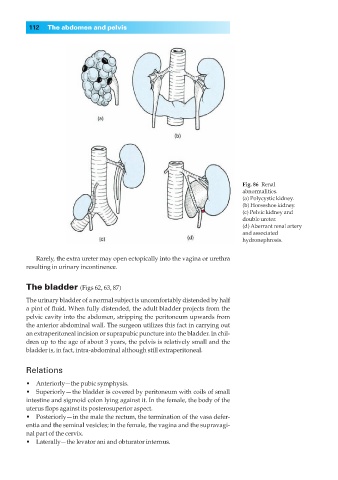
                                                                              Fig. 86◊Renal
                                                                              abnormalities.
                                                                              (a) Polycystic kidney.
                                                                              (b) Horseshoe kidney.
                                                                              (c) Pelvic kidney and
                                                                              double ureter.
                                                                              (d) Aberrant renal artery
                                                                              and associated
                                                                              hydronephrosis.

                   Rarely, the extra ureter may open ectopically into the vagina or urethra
                resulting in urinary incontinence.


                The bladder (Figs 62, 63, 87)
                The urinary bladder of a normal subject is uncomfortably distended by half
                a pint of fluid. When fully distended, the adult bladder projects from the
                pelvic cavity into the abdomen, stripping the peritoneum upwards from
                the anterior abdominal wall. The surgeon utilizes this fact in carrying out
                an extraperitoneal incision or suprapubic puncture into the bladder. In chil-
                dren up to the age of about 3 years, the pelvis is relatively small and the
                bladder is, in fact, intra-abdominal although still extraperitoneal.

                Relations

                •◊◊Anteriorly—the pubic symphysis.
                •◊◊Superiorly — the bladder is covered by peritoneum with coils of small
                intestine and sigmoid colon lying against it. In the female, the body of the
                uterus flops against its posterosuperior aspect.
                •◊◊Posteriorly— in the male the rectum, the termination of the vasa defer-
                entia and the seminal vesicles; in the female, the vagina and the supravagi-
                nal part of the cervix.
                •◊◊Laterally—the levator ani and obturator internus.

