


Page 154 - Clinical Anatomy
P. 154
ECA2  7/18/06  6:43 PM  Page 139


                                                                   The female genital organs   139


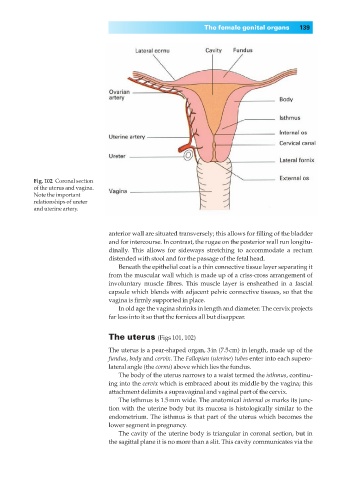
                  Fig. 102◊Coronal section
                  of the uterus and vagina.
                  Note the important
                  relationships of ureter
                  and uterine artery.


                                        anterior wall are situated transversely; this allows for filling of the bladder
                                        and for intercourse. In contrast, the rugae on the posterior wall run longitu-
                                        dinally. This allows for sideways stretching to accommodate a rectum
                                        distended with stool and for the passage of the fetal head.
                                          Beneath the epithelial coat is a thin connective tissue layer separating it
                                        from the muscular wall which is made up of a criss-cross arrangement of
                                        involuntary muscle fibres. This muscle layer is ensheathed in a fascial
                                        capsule which blends with adjacent pelvic connective tissues, so that the
                                        vagina is firmly supported in place.
                                          In old age the vagina shrinks in length and diameter. The cervix projects
                                        far less into it so that the fornices all but disappear.


                                        The uterus (Figs 101, 102)
                                        The uterus is a pear-shaped organ, 3in (7.5cm) in length, made up of the
                                        fundus, body and cervix. The Fallopian (uterine) tubes enter into each supero-
                                        lateral angle (the cornu) above which lies the fundus.
                                          The body of the uterus narrows to a waist termed the isthmus, continu-
                                        ing into the cervix which is embraced about its middle by the vagina; this
                                        attachment delimits a supravaginal and vaginal part of the cervix.
                                          The isthmus is 1.5mm wide. The anatomical internal os marks its junc-
                                        tion with the uterine body but its mucosa is histologically similar to the
                                        endometrium. The isthmus is that part of the uterus which becomes the
                                        lower segment in pregnancy.
                                          The cavity of the uterine body is triangular in coronal section, but in
                                        the sagittal plane it is no more than a slit. This cavity communicates via the

