


Page 178 - Clinical Anatomy
P. 178
ECA3  7/18/06  6:44 PM  Page 163


                                                       Surface anatomy and surface markings    163


                                        Bones and joints (See Figs 120, 122, 123, 125)

                                        The subcutaneous border of the  clavicle can be palpated throughout
                                        its length; the supraclavicular nerves crossing it can be rolled against the
                                        bone.
                                          The acromion process forms a sharp bony edge at the lateral extremity of
                                        the scapular spine. It lies immediately above the smooth bulge of the deltoid
                                        muscle which itself covers the greater tubercle of the humerus. Less easily iden-
                                        tified is the coracoid process of the scapula, lying immediately below the
                                        clavicle at the junction of the middle and outer thirds, and covered by the
                                        anterior fibres of the deltoid.
                                          The medial border of the scapula can be both seen and felt. Abduction of
                                        the arm is a complex affair made up of abduction at the shoulder joint,
                                        depression at the sternoclavicular joint and rotation of the scapula; the last
                                        two are readily confirmed on self-palpation.
                                          With the shoulder abducted, the head of the humerus can be felt in the
                                        axilla; note its movement with rotation of the arm.
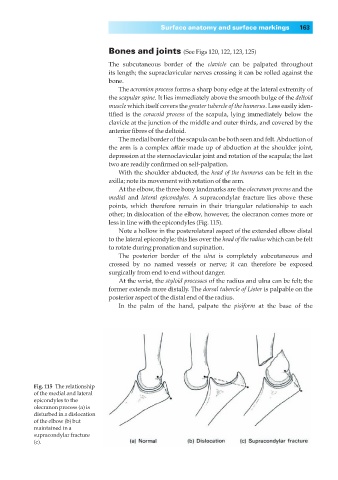
                                          At the elbow, the three bony landmarks are the olecranon process and the
                                        medial  and  lateral epicondyles. A supracondylar fracture lies above these
                                        points, which therefore remain in their triangular relationship to each
                                        other; in dislocation of the elbow, however, the olecranon comes more or
                                        less in line with the epicondyles (Fig. 115).
                                          Note a hollow in the posterolateral aspect of the extended elbow distal
                                        to the lateral epicondyle; this lies over the head of the radius which can be felt
                                        to rotate during pronation and supination.
                                          The posterior border of the  ulna  is completely subcutaneous and
                                        crossed by no named vessels or nerve; it can therefore be exposed
                                        surgically from end to end without danger.
                                          At the wrist, the styloid processes of the radius and ulna can be felt; the
                                        former extends more distally. The dorsal tubercle of Lister is palpable on the
                                        posterior aspect of the distal end of the radius.
                                          In the palm of the hand, palpate the  pisiform at the base of the


                  Fig. 115◊The relationship
                  of the medial and lateral
                  epicondyles to the
                  olecranon process (a) is
                  disturbed in a dislocation
                  of the elbow (b) but
                  maintained in a
                  supracondylar fracture
                  (c).

