


Page 183 - Clinical Anatomy
P. 183
ECA3  7/18/06  6:45 PM  Page 168


                 168  The upper limb


                4◊◊The median nerve (Figs 116, 118) in the forearm lies, as its name suggests,
                in the median plane; its area of distribution in the hand is thus anaes-
                thetized if local anaesthetic be injected exactly in the mid-line at the wrist.
                5◊◊The ulnar nerve at the wrist lies immediately medial to the ulnar pulse
                (Figs 116, 118). In the hand, it passes on the radial side of the pisiform and
                then lies on the hook of the hamate. If you press with your fingernail just
                lateral to the pisiform bone, you will experience tingling in your ulnar two
                fingers.


                The bones and joints of
                the upper limb


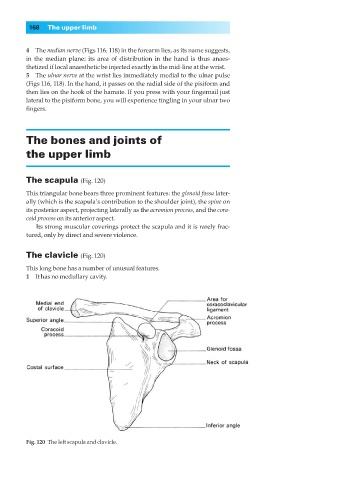
                The scapula (Fig. 120)

                This triangular bone bears three prominent features: the glenoid fossa later-
                ally (which is the scapula’s contribution to the shoulder joint), the spine on
                its posterior aspect, projecting laterally as the acromion process, and the cora-
                coid process on its anterior aspect.
                   Its strong muscular coverings protect the scapula and it is rarely frac-
                tured, only by direct and severe violence.


                The clavicle (Fig. 120)
                This long bone has a number of unusual features.
                1◊◊It has no medullary cavity.


                Fig. 120◊The left scapula and clavicle.

